

Email management software is a purpose-built tool that helps your support team organize, automate, and make sense of customer conversations. Think of it less as an inbox and more as a command center. It takes a chaotic, manual process and turns it into a streamlined system that automatically sorts inquiries, helps draft smart replies, and puts crucial customer data right at your agents' fingertips.
This isn't just about being tidy; it’s about turning customer support from a cost center into a powerful growth engine.
What Is Email Management Software?
Picture your customer support inbox during a major holiday sale. It's like a frantic air traffic control tower with hundreds of planes trying to land all at once. Emails about new orders, return requests, and product questions are all circling, creating a recipe for gridlock, delays, and seriously frustrated customers. This is precisely the chaos that email management software is designed to fix.
It's so much more than a fancy inbox. It is the air traffic control system for all your customer communications. Instead of agents manually sifting through every message one by one, the software acts as an intelligent dispatcher. It can instantly recognize what an email is about, assign the right priority, and route it to the best person for the job—all without a human lifting a finger.
Beyond a Simple Inbox
Your standard email client, like Gmail, is fantastic for one-on-one chats, but it hits a wall when you're dealing with hundreds of customer inquiries a day. It just wasn't built for the high-volume, collaborative nature of team-based support. This is where specialized platforms really shine. For a closer look at these limitations, see why a shared inbox in Gmail often isn't enough for professional teams.
These modern systems introduce a structured workflow by bringing a few key ingredients to the table:
- Automation: It takes over the repetitive stuff. Think automatically tagging emails about "damaged items" or assigning all "shipping update" questions directly to your logistics expert.
- Artificial Intelligence: AI can draft on-brand, accurate replies in seconds. This frees up your human agents to focus on the tricky, sensitive issues where their expertise truly matters.
- E-commerce Integration: The software connects directly to your store's backend, giving your team instant context. They can see a customer's entire order history without ever having to switch tabs.
In short, this software transforms a reactive, messy process into a proactive and organized operation. It gives you the structure you need to deliver fast, consistent, and personalized support as you grow—something that becomes nearly impossible with manual email handling.
What Really Makes Good Email Management Software Tick?
Great email management software isn't just one shiny feature; it's a whole suite of tools working in harmony to bring sanity to your customer communications. Think of these core features as the engine that transforms a reactive, chaotic inbox into a proactive, customer-pleasing machine.
Let's break down the four pillars that are absolutely essential for any modern e-commerce team.
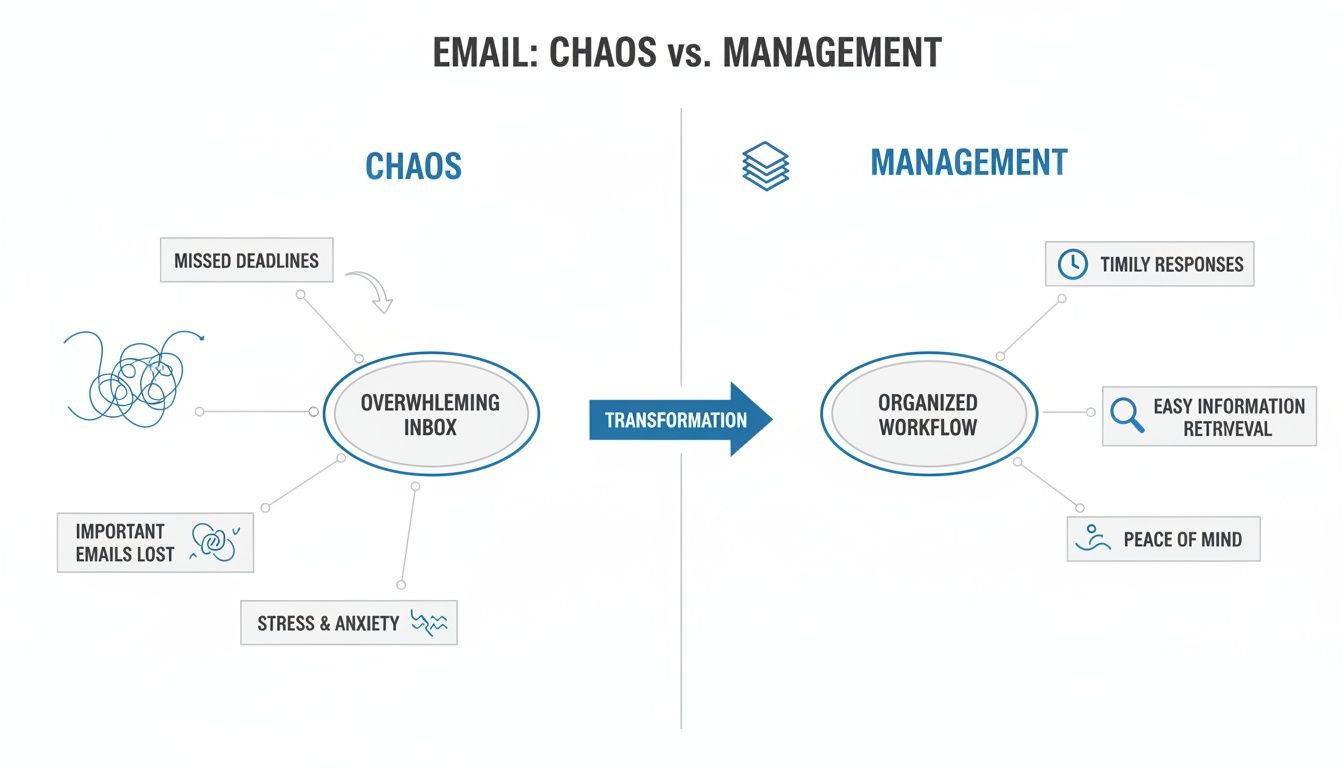
As you can see, a systematic approach untangles messy workflows. The result? Organized, timely responses that build customer loyalty, instead of missed messages and a stressed-out team.
To give you a clearer picture, here’s a quick rundown of the most impactful features and the real-world problems they solve for Shopify stores.
Key Features of E-commerce Email Management Software
| Feature | What It Does | Problem It Solves |
|---|---|---|
| Inbox Automation | Automatically sorts, tags, and assigns emails based on keywords, sender, or topic. | Eliminates manual sorting, prevents missed tickets, and gets questions to the right person faster. |
| AI-Generated Replies | Drafts on-brand, human-sounding answers to common questions for agents to review and send. | Drastically reduces response times for repetitive inquiries and ensures brand voice consistency. |
| Order Data Integration | Pulls live customer data (order history, shipping status) directly from your store into the inbox. | Stops the frustrating back-and-forth of switching tabs to find order details, leading to faster resolutions. |
| Performance Analytics | Tracks key metrics like response times, ticket volume, and customer satisfaction (CSAT). | Provides clear, data-backed insights to identify bottlenecks, coach your team, and improve support quality. |
These features aren't just nice-to-haves; they are the foundation of a support system that can actually keep up with a growing e-commerce business.
Inbox Automation: Your Digital Triage Nurse
Imagine inbox automation as your team's digital assistant, tirelessly working behind the scenes 24/7. This feature automatically sorts, tags, and assigns incoming emails based on rules you set up. For instance, any email containing "where is my order?" can be instantly tagged as a shipping question and sent straight to the agent who handles logistics.
This simple function gets rid of the soul-crushing manual triage that eats up hours of your team's day. Instead of one person digging through a mountain of messages, the system does the heavy lifting, making sure the right conversation lands with the right person, every single time.
AI-Generated Replies: A Co-pilot for Your Agents
Next up is the feature that feels a bit like magic: AI-generated replies. This isn't about sending cold, robotic responses that scream "I'm a bot!" Modern AI actually learns your brand's unique voice and tone, allowing it to draft pitch-perfect replies to common questions in a matter of seconds.
Your support agent simply reviews the AI's suggestion, makes a quick tweak if needed, and hits send. It’s a total game-changer for handling the endless stream of repetitive questions about return policies or product specs. This dramatically cuts down response times while keeping your quality and personalization high across the entire team.
E-commerce Data Integration: The Full Story in One View
This is where things get really powerful. Direct integration with your e-commerce platform, like Shopify, connects your inbox to your store's backend. It pulls all the critical customer and order information right into the support conversation.
When an agent opens an email, they instantly see everything they need:
- The customer’s complete order history
- Live tracking information for current shipments
- Notes from any previous support conversations
This completely eliminates the frustrating process of flipping between tabs to hunt down order details. With all the context in one place, your team can solve problems faster and deliver a much more seamless, knowledgeable customer experience.
Performance Analytics: Your Team’s Report Card
Finally, performance analytics give you a clear, honest look at how your support is actually doing. This feature provides actionable data on key support metrics, letting you track everything from average first response time to customer satisfaction scores (CSAT).
These insights are crucial for spotting bottlenecks, recognizing your top-performing agents, and truly understanding what your customers need help with most often. This data-driven approach is essential for scaling your support. In fact, the email management software market is projected to grow from $4.59 billion in 2024 to $5.08 billion in 2025—a leap showing just how critical these tools have become for DTC brands. You can explore more insights on the rapid growth of the email management software market to see how businesses are adapting.
So, Why Does Your Shopify Store Really Need This?
It’s one thing to look at a list of features for an email management tool, but it's another to see how those features actually move the needle for your business. We're not just talking about a tidier inbox here. This is a strategic shift that has a real impact on your revenue, your customers' happiness, and your ability to grow without breaking a sweat.
Think about it: for most online stores, customer support feels like a constant battle against a rising tide of tickets. It’s a resource drain. But bringing in smart software completely flips that script. When you automate the repetitive stuff and give your team AI-powered tools, you're essentially giving them superpowers. A small team can suddenly handle a huge volume of customer questions, and they can do it better and faster. This keeps your support team lean and effective, cutting costs right where it counts without letting service quality slip.
Turning Support from a Cost into a Money-Maker
Great customer service does more than just fix problems; it creates loyal fans. When a customer gets a quick, helpful, and personal answer, they start to trust your brand on a whole new level. That positive feeling is what brings them back to buy again and again, boosting their lifetime value (LTV).
Imagine a customer gets their shipping question answered in two minutes flat. They’re far more likely to come back and even tell their friends about you. Compare that to the customer who waits two days for a copy-paste response. One experience builds loyalty, the other erodes it. This is how your support team stops being a cost center and becomes a powerful engine for revenue.
When support is fast and frictionless, it becomes a competitive advantage. You're not just selling a product; you're selling a reliable and trustworthy experience that keeps customers coming back.
There’s a reason everyone is jumping on this. The global market for these tools is expected to explode, going from USD 2,500 million in 2025 to a staggering USD 9,500 million by 2033. That kind of growth shows just how essential smart email management has become for any serious e-commerce business. You can dive into the full market research on this trend to see where things are headed.
Get Ready to Scale Without the Chaos
What happens when your Black Friday sale goes viral, or a new marketing campaign completely takes off? With a manual system, your inbox implodes. Responses lag, customers get angry, and the reputation you worked so hard to build takes a serious hit. This is where a proper system proves its worth.
An email management platform gives you the structure to handle that kind of growth smoothly. As your order volume skyrockets, your support process doesn't fall apart—it scales right along with you. You can deliver the same high-quality service whether you're handling 50 orders a day or 5,000. It ensures your customer experience can keep up with your success, paving the way for sustainable, long-term growth.
How To Choose The Right Software
Picking the right software for email management can feel a lot like trying to find one specific item in a massive, crowded store. There are countless options, and on the surface, many look the same. But here's the secret: the key is to focus on what actually matters for an e-commerce business like yours.
A generic tool might get your inbox organized, but software built specifically for Shopify will do so much more—it’ll actively help you sell more products and build real customer loyalty.
To make a smart choice, you need a solid evaluation plan. Think of it as a personal checklist to make sure a platform not only fixes your current headaches but is also ready to scale with you as your business grows. You'll want to look past the flashy marketing features and ask the right questions to uncover a tool's true potential for your store.
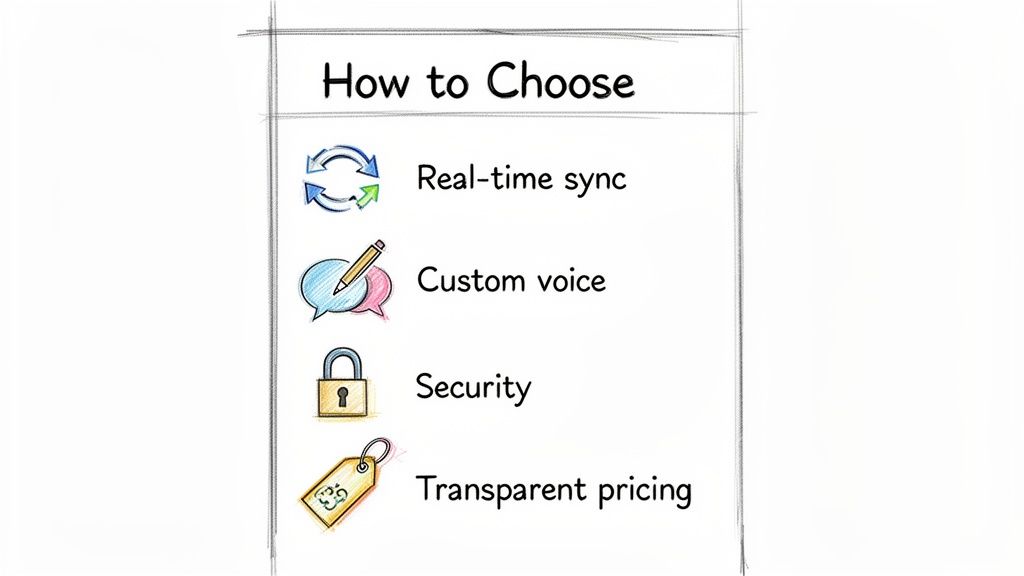
A Practical Vendor Evaluation Checklist
Before you sign any contracts or even start a trial, use this simple checklist. It's designed to help you cut through the noise and quickly see which vendors truly understand the world of online retail.
| Evaluation Criteria | Key Questions to Ask | Why It Matters |
|---|---|---|
| Shopify Integration | Does it offer a deep, native integration? Can it pull real-time order history, shipping status, and customer data directly into the inbox? | This is non-negotiable. Without it, your agents are flying blind. Instant access to order data means faster, more accurate replies and happier customers. |
| AI and Brand Voice | Can the AI learn our specific brand voice and tone? Can we customize the style of its suggested replies? | Your support conversations should always sound like they come from your team, not a generic robot. A customizable AI maintains your brand's unique personality. |
| Automation Power | How flexible are the automation rules? Can we create e-commerce-specific workflows (e.g., auto-tagging returns, prioritizing VIP customers)? | Powerful automation frees up your team from repetitive tasks. The more specific the rules, the more time you save and the smarter your support becomes. |
| Ease of Use | How intuitive is the interface? Can a new team member get up and running quickly with minimal training? | A complicated system creates friction and slows everyone down. The tool should make your team's job easier, not add another layer of complexity. |
| Data Security | What security protocols are in place to protect our customer and order data? Is the platform compliant with data privacy regulations? | You're handling sensitive customer information. Robust security is essential for building and maintaining trust with your buyers. |
| Pricing Model | Is the pricing transparent and scalable? Are there hidden fees or charges that penalize growth? | You need a predictable cost structure that aligns with your business goals. Avoid surprises and ensure the price makes sense as your order volume increases. |
This checklist is your starting point. Use it during demos and trials to directly compare how different platforms stack up against the needs of a modern e-commerce brand.
The goal is to find a partner, not just a tool. The right software should feel like an extension of your team, understanding the nuances of your products, policies, and customers.
While diving into features is crucial, don't forget the human element. During any free trial, pay close attention to the user experience. A clean, easy-to-navigate interface means your team can get started right away without needing weeks of training.
Of course, a tool that's easy to use but not secure is a non-starter. You must verify that the vendor has rock-solid security protocols to protect your valuable customer and order information.
As you explore your options, it can be helpful to see what others are using. Looking through reviews of the best email marketing platforms can offer valuable perspective on what works for other e-commerce businesses. Asking these tough questions upfront ensures you choose a platform that becomes a core asset for your store, not just another monthly bill.
Getting Your New Email Management System Up and Running
The thought of switching to a new system can be intimidating. I get it. But the good news is that modern software for email management is built for a surprisingly quick and painless setup. This isn't about ripping and replacing everything overnight; it's more like a gradual rollout that lets your team get comfortable and see the benefits right away.
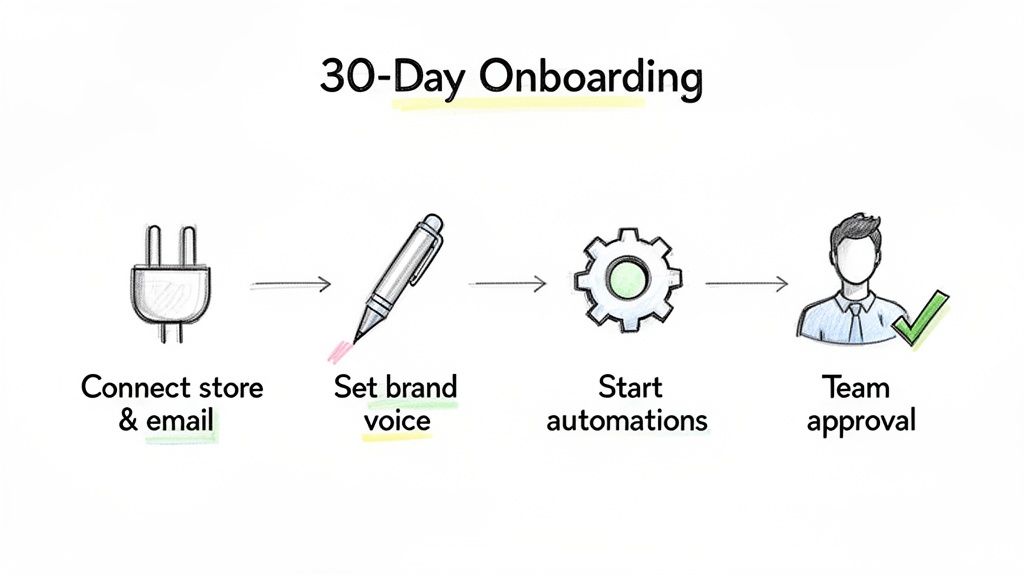
The first couple of steps are actually pretty simple. You'll start by connecting the essentials: your Shopify store and your main support email inboxes. This connection is the secret sauce, allowing the software to tap into all that valuable customer and order data it needs to provide smart, context-rich answers.
Next, you'll teach the AI to sound like you. You’ll set up your unique brand voice so that every automated reply feels authentic and on-brand, not like it came from a robot. This isn’t just a technical setting; it's about making the system a true extension of your team's personality.
A Phased Approach To Automation
The best way to ease into this is with a semi-automated workflow. Basically, the AI drafts replies to the most common customer questions, but a real person on your team gives the final OK before anything goes out. This "human-in-the-loop" model is brilliant because it does two very important things:
- It builds trust: Your team gets to see the quality of the AI's suggestions firsthand, which makes them much more comfortable with the new tool.
- It ensures quality: You keep 100% control over every customer message while the system is still learning and getting sharper.
Once everyone sees how reliable the AI is, you can start flipping the switch to full automation for those mind-numbingly repetitive tasks. This frees up your agents to focus their brainpower on the trickier customer problems. You can dig deeper into how powerful integrations for tools like Slack and Zendesk can make these workflows even smoother.
It's all about setting realistic goals for the first 30 days. Don't try to automate everything at once. Pick one or two high-volume tickets—like all those "Where is my order?" emails—and perfect that workflow first. This gives you a quick, measurable win right out of the gate.
This methodical approach is non-negotiable, especially when you think about the sheer volume of customer emails. With the number of worldwide email users expected to hit 4,730 million by 2026, having an efficient system isn't just a nice-to-have anymore. You can check out the full report on email usage trends to see just how fast communication volumes are climbing. Taking it step-by-step ensures your team is truly ready for what's coming.
Transform Your Support with AI-Powered Tools
As we've seen, the challenges of a growing e-commerce store are real. Disorganized inboxes, inconsistent customer service, and overwhelmed support teams can quickly stall your momentum. This is where AI-powered software for email management steps in, not just as another tool, but as a genuine strategic partner. It’s designed to tackle the core problems of manual support head-on by weaving intelligence and automation into every single customer conversation.
Generic software might help you sort emails, but it has no idea what’s happening inside your Shopify store. A platform with a native Shopify connection, on the other hand, understands the full context. It sees a customer’s entire order history, checks the real-time shipping status, and recalls past conversations. This allows the AI to craft replies that aren't just fast—they're incredibly accurate and genuinely helpful.
Personalization at Scale
The real magic of modern AI is its ability to learn and adopt your brand’s unique voice. This means every automated reply, whether it's a simple shipping update or a tricky return question, feels personal and authentic. You get to move past those stale, robotic templates and deliver a customer experience that builds trust, even when a human agent isn't directly involved.
This is exactly how you scale your support without letting quality slide. If you want to go deeper, check out our guide on the best AI customer support software built for e-commerce brands.
An intelligent inbox also brings order to the chaos by automatically sorting and prioritizing messages as they arrive. This frees up your team to focus their energy on the complex, high-value conversations that truly need a human touch.
By combining smart inbox features with powerful analytics, you get a clear, measurable return on investment. You can track hours saved, response times, and customer satisfaction, proving the direct impact on your bottom line.
For Shopify merchants ready to level up, specialized software is the only logical next step. It’s an investment in efficiency, customer loyalty, and sustainable growth. To see an example of AI transforming support operations, you might explore tools like supportgpt. Ultimately, these systems turn your support from a reactive cost center into a proactive, revenue-driving engine.
Frequently Asked Questions
Let's tackle some of the most common questions we hear from store owners and support managers when they're thinking about email management software.
Is My Customer Data Secure?
This is a big one, and the short answer is yes. Any serious email management platform built for ecommerce puts security front and center. They use powerful tools like data encryption for information both when it's being sent and when it's stored.
These platforms are also built to comply with major data privacy rules like GDPR and CCPA, so your customer and order data is in safe hands. Just be sure to double-check a vendor’s security credentials, but rest assured, professional tools are designed for this from the ground up.
Will AI Replace My Human Support Team?
Not a chance. The real goal here is to make your human team better, not to replace them. Think about all the time your agents spend answering the same questions over and over—especially "Where is my order?"
AI takes care of those repetitive, straightforward queries. This frees up your team's time and mental energy to handle the tricky, sensitive, or high-value customer problems that really need a human touch. The AI is like a super-efficient assistant, letting your experts focus on what they do best.
The best email management software creates a powerful partnership. The AI handles the noise so your human agents can focus on building customer relationships.
How Much Does This Type of Software Cost?
Pricing really depends on the provider, but most modern tools are designed to grow with you. You'll typically find a few different pricing tiers, often based on how many customer conversations you have each month or the number of agents on your team.
This means you can start with a more affordable plan when you're smaller and simply upgrade as your store's sales and support needs increase. Always look for clear, transparent pricing so you don't get hit with surprise fees. This kind of flexibility makes these powerful tools accessible for just about any size of business.
Ready to stop drowning in emails and start delighting customers? MAILO AI integrates directly with your Shopify store to automate replies, provide instant context, and turn your support inbox into a growth engine. Start your free trial today!