

Personalized customer service isn't some luxury add-on anymore; it's the new standard for e-commerce. It’s about seeing each customer as an individual with a unique history and context, not just another ticket in the queue. Real personalization is so much more than just slotting a {{first_name}} tag into an email—it’s about knowing their past purchases, guessing what they might need next, and talking to them like you actually know them.
Why Personalized Customer Service Is No Longer Optional
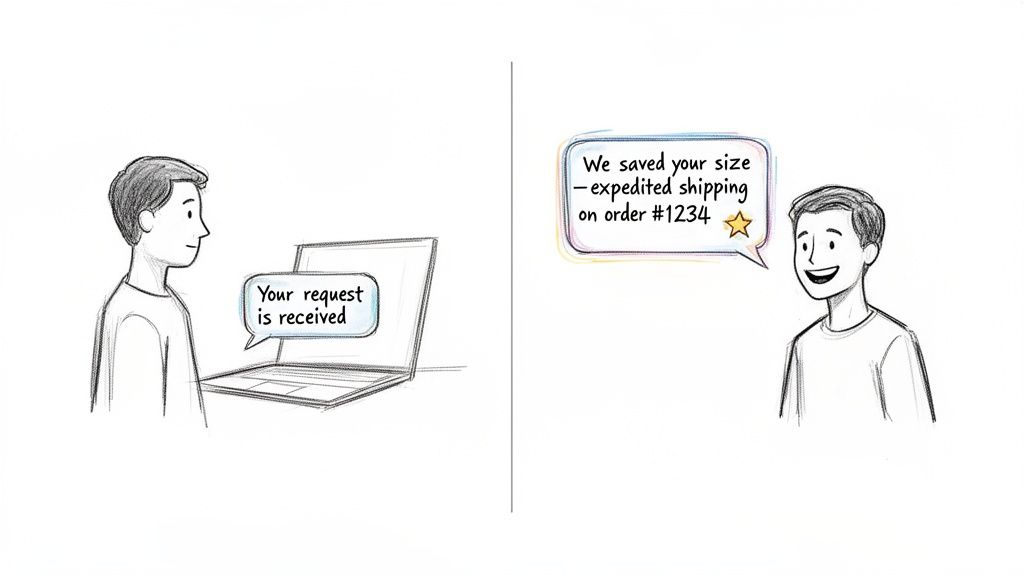
Think about the last time you had a fantastic support experience. It probably wasn't just fast; it felt like the person on the other end got it. They knew your order history or didn't make you repeat information you’d already given them. That's the difference personalized service makes.
We've all been on the other side, too, stuck with frustratingly generic support. Imagine you're a loyal subscriber to an online coffee brand. You email them about a delayed shipment and get a canned response: "Your inquiry is important to us. A representative will be in touch within 48 hours." It’s cold, unhelpful, and makes you feel like a number.
Now, imagine this instead: "Hi Alex, we see your Ethiopian Yirgacheffe order is running a bit behind. We've already contacted the courier and expect it to arrive by Friday. As a thank you for your patience and being a loyal subscriber for over a year, we've added extra reward points to your account."
Which one of these makes you want to stick around? It’s a no-brainer. The second response shows they see you and value your business, turning a snag into a moment that actually builds a stronger relationship.
The Widening Personalization Gap
Today’s shoppers don't just prefer this kind of attention; they demand it. This has created a massive gap between what customers want and what many e-commerce brands are actually delivering.
The personalization gap is one of the biggest opportunities for e-commerce brands today. The data is clear: 76% of customers expect personalization in their interactions with brands.
Here's the problem: only 47% of business leaders believe their customer service is highly personalized. This is a huge disconnect, especially when 76% of customers get frustrated by generic interactions—frustration that directly impacts whether they’ll ever buy from you again. For Shopify stores, this isn't just a problem; it's a golden opportunity to stand out.
Closing the Gap with AI
Trying to close this gap manually is a recipe for burnout, especially as your business grows. This is where AI tools like Mailo AI come into play. They plug right into your store's data, giving your support team the context they need to deliver genuinely personal service, automatically and at scale. After all, understanding this drive for personal connection is the key to achieving excellence customer service everywhere.
This guide will give you a practical roadmap to build an exceptional, scalable support system that turns every customer conversation into a chance to build real loyalty.
Moving Beyond First Names to True Personalization
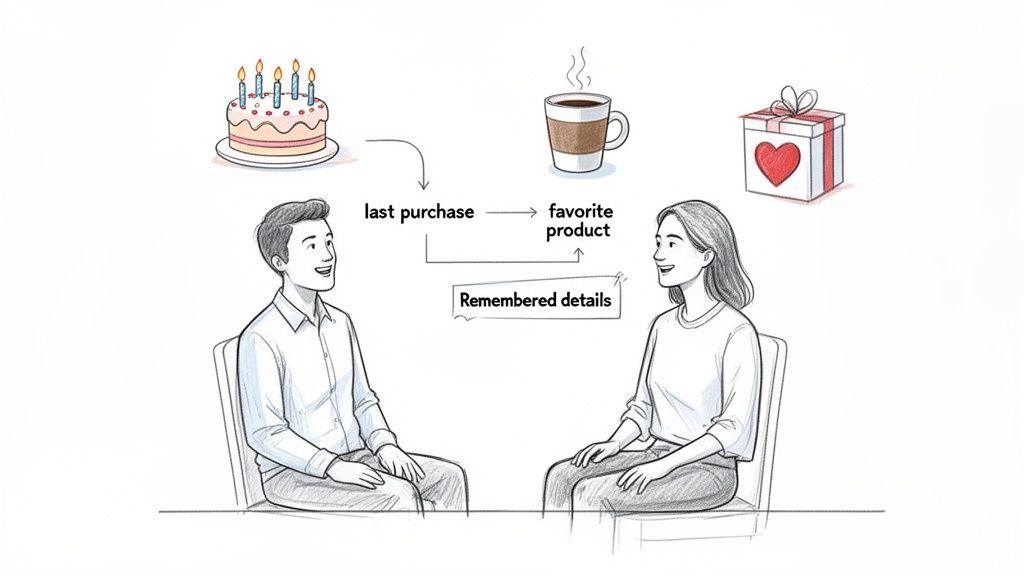
Let's be honest: true personalized customer service is so much more than just dropping a {{first_name}} tag into an email. That’s the bare minimum. Think about it like a real-life friendship. Anyone can remember your name. A real friend remembers your favorite coffee order, the story you told them last week, and that you hate cilantro.
That deeper connection is exactly what separates forgettable online stores from brands that build fiercely loyal communities. It's about showing your customers you see them as real people with a unique history, not just another order number in a spreadsheet. This means going beyond the surface-level stuff and getting a complete picture of their entire journey with your brand.
The Four Pillars of Genuine Personalization
To build this 360-degree customer view, your support strategy needs to pull from a few key sources of information. These aren't just data points; they are the pillars that turn a bland, generic interaction into one that feels smart, helpful, and proves you’re paying attention.
-
Purchase History: This is ground zero for e-commerce personalization. Knowing a customer's past orders is a goldmine. If they always buy a specific line of skincare or prefer certain sizes, you can give them advice and solutions that actually make sense for them.
-
Loyalty Status: Acknowledging a long-time customer or a VIP member is a simple but powerful gesture. A quick "Thanks for being with us since 2021!" makes them feel seen and valued, reinforcing their decision to stick around.
-
Past Support Tickets: Is there anything more frustrating than having to re-explain your problem every single time you contact support? Referencing previous conversations shows you respect your customer's time and that you’re not starting from scratch.
-
Recent Browsing Activity: Knowing what a customer was just looking at on your site gives you incredible context. If they were browsing the FAQs for a specific product and then emailed you, you can get ahead of their question before they even have to type it all out.
When you weave these elements together, you stop having transactions and start having conversations. Understanding how to provide a first-class sales experience for your customers is key to moving beyond just solving problems and actually creating memorable moments.
Levels of Customer Service Personalization
The difference between a generic response and a truly personalized one is stark. Let's look at a few common e-commerce scenarios to see how a little context can completely transform the customer's experience.
| Support Scenario | Generic Response | Personalized Response |
|---|---|---|
| Sizing Question | "You can find our size chart on the product page." | "Hi Sarah, I see you previously bought a Medium hoodie from us. This jacket has a similar fit, so a Medium should be perfect for you too!" |
| Product Recommendation | "Check out the 'New Arrivals' section on our website." | "Since you loved the espresso blend you bought last month, I think you'll really enjoy our new single-origin from Colombia. It has similar tasting notes." |
| Return Inquiry | "Our return policy is 30 days. Please see the link for instructions." | "Hey Alex, I see you're a VIP member. For you, we can offer a free return label and an extended 60-day window. I've just emailed it to you." |
| Follow-Up on Issue | "Has your issue been resolved? Please let us know." | "Hi Jamie, just checking in. Did that troubleshooting step we discussed last Tuesday fix the issue with your device's battery?" |
As you can see, the personalized responses aren't just better—they build trust, solve problems faster, and make the customer feel valued.
This is the kind of context-rich interaction that is fundamental to learning how to build rapport with customers. It's how you turn a one-time buyer into a genuine advocate for your brand.
How Personalization Drives Business Growth
Pouring resources into personalized customer service isn't just about giving customers the warm fuzzies. It's a direct line to your bottom line. Generic, one-size-fits-all support is a cost center, plain and simple. But when you create tailored interactions that show you actually know your customer, support transforms into a powerful engine for growth.
This is the point where personalization stops being a "nice-to-have" and becomes a core business strategy.
By connecting with customers on a human level, you directly move the needle on the key performance indicators (KPIs) that really matter to your store's health. It turns a routine support ticket into a golden opportunity to build loyalty, stop churn in its tracks, and even drive another sale. Let's break down exactly how this powerful shift impacts your most important metrics.
Boost Customer Lifetime Value
Customer Lifetime Value (CLV) is the total amount of money you can expect a single customer to spend with you over their entire relationship with your brand. A high CLV is the holy grail—it means customers are sticking around and spending more. Personalization is one of the best tools you have to get that number climbing.
When a customer gets help from an agent who acknowledges their loyalty or references a past purchase, they feel seen and understood. That positive feeling forges a stronger bond with your brand, making them far more likely to come back and buy again. A single, thoughtful, personalized interaction can be the difference between a one-time buyer and a lifelong fan.
Lower Your Churn Rate
Churn, the rate at which customers leave you, is a silent killer for e-commerce stores. If your churn rate is high, you're stuck on a treadmill, constantly spending money to acquire new customers just to replace the ones walking out the door. Personalized service is a powerful antidote.
By resolving issues with context and empathy, you can turn a frustrating experience into a moment that actually strengthens their loyalty. A customer who gets their problem solved quickly by someone who understands their history is far less likely to jump ship to a competitor. Even better, proactive outreach—like a quick heads-up to a loyal customer about a potential shipping delay—builds incredible trust and gives them every reason to stay. You can learn more about tracking these vital signs by exploring key customer engagement metrics.
Improve Customer Satisfaction Scores
Customer Satisfaction (CSAT) scores are a direct pulse check on how happy customers are with your service. It’s no shocker that personalized interactions lead to higher scores. When getting help feels easy and tailored to them, customers are happier and more willing to tell you (and everyone else) about it.
This satisfaction creates a ripple effect, influencing everything from your online reviews to word-of-mouth referrals. The financial impact is huge.
Brands that nail personalization are 71% more likely to report improved customer loyalty. Going a step further with hyper-personalization can deliver an average 20% lift in loyalty and a 15% boost in revenue.
The numbers don't lie. A staggering 80% of consumers say they are more likely to buy from a brand that offers personalized experiences. This makes personalization not just a tool for keeping customers, but a direct driver for bringing in new revenue. You can discover more insights about these customer service statistics on Salesmate.io.
Increase Conversion Rates
Finally, great personalized service can directly bump up your conversion rates, especially during pre-sale chats. When a potential customer is on the fence and asks a question, a personalized, confident answer can be what seals the deal.
Think about it. Instead of just sending a link to a generic size chart, an agent could say, "I see you've bought our slim-fit tees in a medium before. This jacket has a similar cut, so a medium should be a perfect fit for you." That kind of data-driven recommendation removes friction and doubt, making it much easier for the customer to confidently hit "add to cart."
Implementing AI-Powered Personalization Step by Step
Moving from the idea of personalized customer service to actually doing it can feel like a massive jump. But with the right approach and a little help from AI, it's far more manageable than you think. This is where tools like Mailo AI come into play, turning mountains of customer data into simple, effective conversations.
The goal isn’t to replace your team—it’s to give them superpowers. By linking your Shopify store data directly to your support inbox, you create a complete picture of every single customer. This integration is the bedrock of delivering truly personal service that can scale with your business.
Stage 1: Connect Your Data Sources
First things first, you need to give your AI a brain. That means integrating it directly with your e-commerce platform, especially Shopify. This connection is what allows the AI to pull a rich tapestry of customer information in real time.
We're not just talking about names and email addresses. A solid integration digs much deeper, pulling in the kind of contextual data that turns a generic response into a genuinely helpful one.
- Purchase History: The AI sees every item a customer has bought, so it can give spot-on support for specific products.
- Order Status: It knows instantly if an order is processing, shipped, or on its way, letting it answer "Where is my order?" questions with total accuracy.
- Customer Lifetime Value: The system can spot your VIPs and loyal shoppers, flagging them for a little extra attention or a special perk.
- Previous Conversations: The AI remembers past support tickets, so customers never have to repeat their story.
This unified data hub is what allows an AI tool to understand not just what a customer is asking, but who that customer is.
Stage 2: Define Your Automation Rules
With your data hooked up, the next move is to set up smart automation for your most common questions. Think of it as teaching your AI to handle the repetitive stuff that eats up most of your team's day. The key is to start small and focus on the tasks that will give you the biggest bang for your buck.
A fantastic place to start is the classic "Where Is My Order?" (WISMO) question. These inquiries are constant, simple to answer, and perfect for automation because the reply is 100% data-driven.
You can build a workflow where the AI automatically flags any email with phrases like "shipping status" or "order tracking." The moment it spots one, it uses the live Shopify data to generate a detailed, personalized response with the tracking number, carrier info, and delivery date—closing the ticket instantly without a human ever touching it. For a closer look at this process, check out our guide on how to automate customer service.
This isn't just about saving time; it has a direct impact on your bottom line.
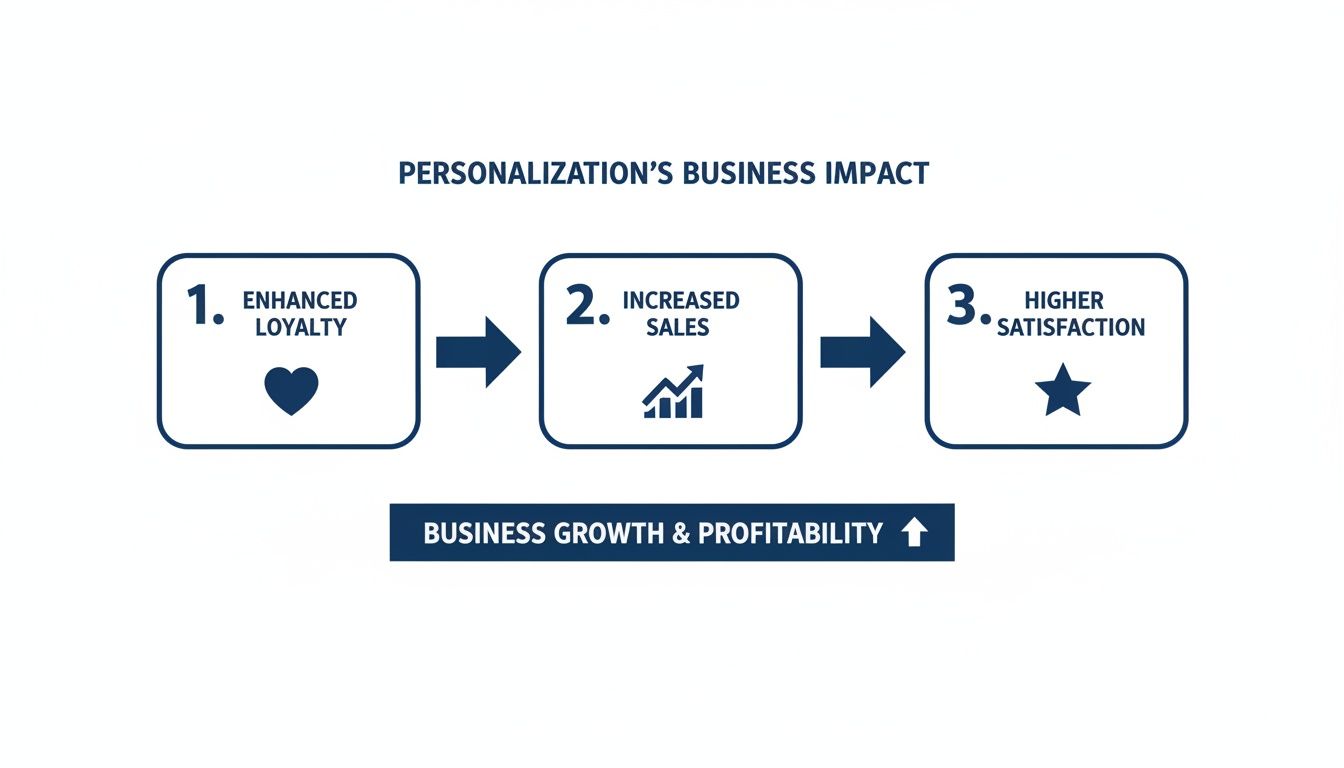
As you can see, every personalized interaction builds loyalty, which in turn fuels sales and boosts customer satisfaction. It's a powerful cycle.
Stage 3: Implement a Semi-Automated Workflow
While full automation is perfect for simple queries, many support issues need a human touch. That's where a semi-automated system really shines. In this setup, the AI acts as a super-efficient assistant for your support agents.
Instead of typing out replies from scratch, your team gets AI-drafted responses that are already filled in with the customer's personal details and order information.
Imagine a customer emails about returning a specific product. The AI can draft a response that includes:
- Confirmation of the item they want to return, by name.
- A reference to their original order number and purchase date.
- A pre-filled return link or instructions specifically for that product.
- A nod to their loyalty status, maybe offering a perk like free return shipping.
Your support agent just has to review the draft, add a personal touch if needed, and hit send. This approach blends the speed and accuracy of AI with the empathy and critical thinking of your human team, creating the perfect recipe for sophisticated personalized customer service. It slashes response times while making sure every single reply is packed with helpful, relevant information.
Real-World Examples of Personalized AI Responses
Seeing is believing, right? The best way to really grasp what personalized customer service can do is to see it in action. The gap between a canned, generic reply and a smart, AI-driven response is massive—it’s the difference between feeling like a number and feeling like a valued customer.
Let's ditch the theory and look at some real-world "before and after" scenarios you'd find in any e-commerce business. These examples show how a little bit of customer data, put to work by AI, can transform a routine support ticket into a moment that genuinely builds loyalty.
Proactive Shipping Delay Notice
Nothing tests a customer's patience like a shipping delay. The way you handle this hiccup can either pour fuel on the fire or earn you a customer for life. A generic, robotic message during a moment of frustration often just makes things worse.
Before: The Generic Template
"Dear Customer, Your order #12345 has been delayed due to unforeseen circumstances. We apologize for the inconvenience and will update you when we have more information. Thank you for your patience."
This message checks the box, but it's cold and unhelpful. It doesn't tell the customer anything new and certainly doesn't make them feel any better.
After: The AI-Personalized Response
"Hi Sarah, we wanted to let you know that your recent order for the 'Sunrise' coffee blend is experiencing a slight shipping delay. We've spoken with the carrier and it's now scheduled to arrive this Friday. We know you've been a loyal customer for over two years, and we really appreciate your business. As a small thank you, we've added 100 bonus points to your account for your next purchase. We're sorry for the hiccup!"
See the difference? The personalized version shows empathy, gives a specific new delivery date, acknowledges Sarah's loyalty, and offers a small gift to make things right. That’s how you turn a negative into a positive.
Helpful Product Recommendation
When a customer asks for a recommendation, it's a golden opportunity. You can either be a passive signpost, or you can be their trusted personal shopper. A generic reply basically tells them, "you're on your own."
Before: The Generic Template
"Thanks for your interest! You can check out all of our new arrivals and best-sellers on our website. Let us know if you have any other questions."
After: The AI-Personalized Response
"Hey Mark! Great question. Since you've ordered our 'Dark Roast Sumatra' twice in the past, I have a feeling you'll love our new limited-edition 'Midnight Espresso' blend. It has similar bold, chocolatey notes but with a slightly richer finish. We're getting fantastic feedback on it from other dark roast fans!"
This reply is incredibly effective because it uses Mark's own purchase history to make a smart, relevant suggestion. By explaining why he'll like it, the recommendation feels genuine and thoughtful, making a sale far more likely.
Seamless and Context-Aware Return Process
Let's face it, starting a return is a pain. The goal should always be to make it as painless as possible. When you show the customer you already have all their information, you lift that burden right off their shoulders.
This isn't just a "nice-to-have" anymore; it's a core expectation. Recent data shows that 90% of consumers expect an immediate response from a company's support channels. On top of that, 63% of customers now expect agents to already know their context and needs before they even start talking. You can read more about these customer service trends on Desk365.io.
This is precisely where AI becomes your secret weapon, providing that instant context for a truly seamless experience.
Before: The Generic Template
"To start a return, please visit our returns portal and enter your order number and email address. Our full return policy is available on our website."
After: The AI-Personalized Response
"Hi Jessica, I can definitely help you with the return for the 'Medium Blue V-Neck Tee' from your order #9876. I've already generated a prepaid return label and emailed it to you. Just print it out, attach it to your package, and drop it off at any local post office. No forms needed!"
The AI-powered response instantly identifies Jessica's item, references her order, and proactively emails her the label. It removes every single point of friction, turning a potentially frustrating task into a surprisingly easy one.
Common Personalization Mistakes and How to Avoid Them
Rolling out personalized customer service can be a huge win, but a few common missteps can trip you up. Think of it like a chef adding just a little too much salt—a small mistake can spoil the whole dish. Knowing what to watch out for helps you create experiences that feel genuinely helpful, not just like a machine going through the motions.
The single biggest mistake? Over-automating to the point where everything sounds robotic. Nothing is more frustrating for a customer with a tricky problem than getting a generic, automated reply that completely misses the mark. It’s a dead giveaway that a machine is on the other end, not a person, and that instantly erodes trust.
Another killer error is working with outdated or just plain wrong data. Personalization is only as good as the information behind it. Calling a customer by the wrong name, mentioning an old order as if it just happened, or suggesting a product they just returned makes your brand look sloppy. Even worse, it can feel a bit creepy, shattering the illusion of a helpful, personal touch.
Don't Lose the Human Element
Even with the smartest tools, the whole point is to sound more human, not less. A common casualty of automation is losing your brand's unique voice. If your brand is known for being fun and upbeat, a stiff, formal automated response will feel completely off and inauthentic.
The trick is to think of AI as an assistant, not a replacement.
- Set the Right Tone: Make sure you configure your AI tools to match your brand's personality, whether that's professional, empathetic, or a little bit quirky.
- Embrace Semi-Automation: For sensitive or complex issues, create a workflow where AI drafts a personalized reply, but a human agent gives it a final check before it goes out. This is the sweet spot between efficiency and genuine empathy.
- Empower Your Team: Give your support agents the flexibility to go off-script. If an automated response doesn't feel right for a specific customer, they should have the freedom to jump in and add that essential human touch.
Keep Your Data Clean and Build Trust
Your personalization strategy is built on data. If that foundation is shaky, the whole thing will fall apart. Building trust means being meticulous with the customer information you use and having systems in place to keep it fresh and accurate.
The best personalization feels like magic—it’s helpful, timely, and seems to know what you need. The worst kind feels like surveillance—it’s invasive, inaccurate, and is a constant reminder that you're being tracked, and not very well at that.
To keep that magic alive, create a solid feedback loop. When a customer points out an error or an interaction just feels off, don't just close the ticket. Dig in and figure out where the data disconnect happened. Regularly audit the connection between your support platform and your e-commerce store to make sure information is flowing smoothly. This kind of proactive work ensures your personalized customer service efforts are always building trust, not breaking it.
Frequently Asked Questions About Personalized Support
Deciding to bring personalization into your customer service often raises a few questions. How does a small team even start? Is it really worth it for a brand new store? Let's tackle the most common questions we hear from e-commerce managers to give you the clarity you need to move forward.
Think of these as the final roadblocks to clear before you go from just thinking about personalization to actually doing it.
How Can a Small Team Implement Personalization Without Getting Overwhelmed?
The secret is to start small and automate the biggest time-sinks first. Don't try to personalize every single customer interaction from day one—that's a recipe for burnout. Instead, pick your top two or three most common support tickets. You know the ones: "Where is my order?" or questions about your return policy.
Use an AI tool to set up automated, personalized replies for just those issues. A solid tool will plug directly into your Shopify data, pulling in order details automatically. This simple move immediately frees up your team's time and gives customers a great experience, letting you build out more automations as you get comfortable.
Is an AI Personalization Tool a Worthwhile Investment for a New Store?
Absolutely. When you're just starting out, your reputation is everything. AI tools give you the power to offer the kind of fast, professional, and personal service that makes customers think you're a much bigger brand. Even if you're a one-person show, this is how you build that crucial early loyalty and start racking up five-star reviews.
Investing in an AI tool from the start means you're building systems that can scale. Your customer support won't become a bottleneck as your sales grow. It's a foundational investment in a brand that's built to last.
How Do I Make Sure AI-Generated Responses Still Sound Like My Brand?
This is a huge—and very valid—concern. Modern AI platforms are built specifically for this. With a tool like Mailo AI, you essentially train the AI on your brand's unique voice. You can show it your past support emails, upload your brand guidelines, or just describe the tone you're going for—whether that's quirky, formal, or super empathetic.
The AI learns your style and generates responses that sound like they came straight from you. Best of all, you always have the final say. You can review and tweak any AI-drafted reply before it goes out, ensuring every message perfectly captures your brand and keeps that human touch.
Ready to see how AI can turn your support emails into a growth engine? With Mailo AI, you can automate personalized responses, delight your customers, and free up your team to focus on bigger things. Start your free trial of Mailo AI today and experience the future of e-commerce support.