

When you're faced with an angry customer, the gut reaction is often to get defensive. Instead, the most effective approach is to immediately acknowledge their frustration, show them you understand, and then pivot the conversation toward a solution. It’s a simple shift, but it’s incredibly powerful for de-escalating tension and proving you’re there to help, not to argue.
Why Handling Rude Customers Is a Critical Business Skill
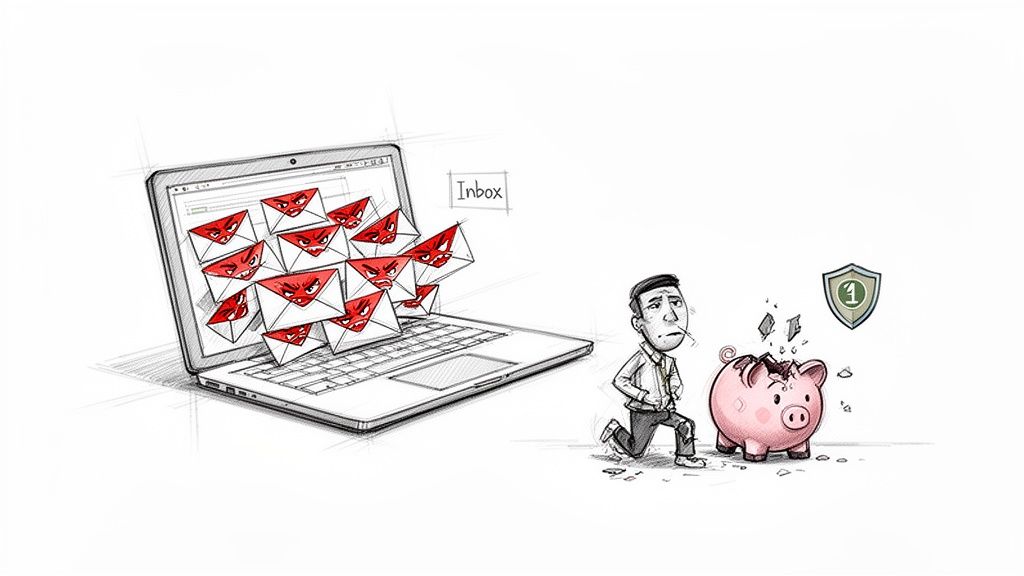
We’ve all seen it: an inbox overflowing with all-caps emails about shipping delays, broken products, or unmet expectations. This isn't just a minor annoyance anymore; it's a significant business challenge that chips away at your team's morale and, ultimately, your bottom line.
Learning how to navigate these conversations isn't just damage control. It's a genuine opportunity to strengthen your brand, uncover valuable feedback, and sometimes, turn your most frustrated customers into your biggest fans. This guide is your playbook for turning those difficult moments into wins.
The Real Cost of Customer Rudeness
Customer rudeness does more than just ruin an agent's day—it has a tangible, negative impact on your entire operation. The negativity is contagious. A recent study found that 76% of frontline workers deal with rude customers at least every month.
Even worse, employees who face that kind of incivility are three times more likely to be short with their own colleagues. You can read the full research on these findings on Axios. For any e-commerce store owner, this means an inbox can quickly become a minefield where one nasty email poisons the well for everyone.
Turning a negative experience into a positive one is a cornerstone of customer retention. A customer who feels heard and respected, even when initially angry, is more likely to return than a customer whose complaint is simply ignored or mishandled.
Turning Conflict into Opportunity
Mastering the art of handling unhappy customers is less of a defensive move and more of a proactive growth strategy. When you get this right, you unlock some serious business benefits.
- Protect Your Team's Sanity: A team that feels confident and supported is far less likely to burn out. That means lower turnover and better, more consistent work.
- Get Unfiltered Feedback: Let's be honest, angry customers don't hold back. Their complaints often shine a bright light on real problems with your products, shipping, or marketing that you might have otherwise missed.
- Build Fierce Brand Loyalty: When you solve a problem for a frustrated customer, something amazing can happen. It’s called the "service recovery paradox," where that customer can end up more loyal than they were before the issue ever occurred. For more details on this, check out our guide on how to improve customer satisfaction.
- Stop Bad Reviews Before They Happen: A quick, empathetic, and effective response is often all it takes to prevent a furious customer from heading straight to your product page to leave a one-star review.
The De-Escalation Playbook for Customer Support
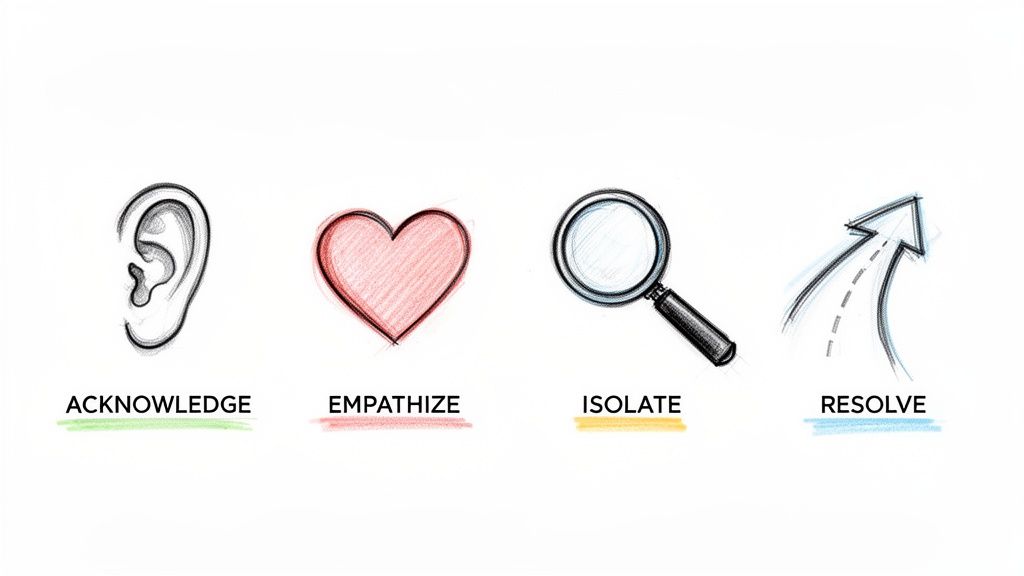
When an angry email from a customer hits your inbox, the first instinct can be to get defensive or just match their tone. But that's a losing game. The most seasoned support pros know that a structured, empathetic approach is the only way to consistently turn conflict into resolution.
It’s not about finding a magic phrase. It's about having a repeatable process that diffuses tension, step-by-step. Let’s break down the four stages that will help you handle even the most difficult customer emails with confidence.
First, Acknowledge Their Frustration
Before you try to solve anything, you have to show the customer they've been heard. A lot of their anger comes from feeling ignored or like just another ticket number. Your opening move is simple: acknowledge their frustration and validate that their feelings are legitimate. This doesn't mean you agree with them, just that you understand why they're upset.
A few well-chosen words can completely change the tone of the conversation. Ditch the generic "Sorry for the inconvenience" and get specific.
- For a late holiday package: "I can absolutely understand your frustration. It's incredibly disappointing when a gift doesn't arrive on time, and I'm very sorry this has happened."
- For a defective item: "Thank you for sending those photos. It's clear the product you received isn't up to our standards, and I can see why you're upset."
This small step immediately proves you’ve actually read their message and are taking them seriously. You're not admitting fault; you're just acknowledging their reality.
Next, Show Some Real Empathy
Acknowledgement opens the door; empathy is what walks you through it. This is where you connect on a human level, showing them you see a person with a problem, not just a complaint. Learning how to build rapport with customers is crucial here, as it can turn a negative interaction into a moment of genuine connection.
Here's a pro-tip: Empathy isn't saying, "I know exactly how you feel." That can sound dismissive. Instead, try, "I can only imagine how frustrating that must be." This small shift in wording respects their individual experience without making assumptions.
Let's say a customer ordered a product for a special event, and it arrived broken. A genuinely empathetic response might include: "I can only imagine how stressful it is to receive a damaged item right before your event. Let's work together to find a solution for you right away." This shows you understand the real problem behind the problem.
Then, Isolate the Core Issue
Once the customer feels heard, you can shift into problem-solving mode. Angry emails are often a jumble of emotion and facts. Your job is to cut through the noise and pinpoint the specific, actionable issue.
A great way to do this is to restate the problem in your own words. This confirms you're on the same page and stops you from wasting time solving the wrong thing.
Their email might be ranting: "Your shipping is a JOKE. I ordered this a week ago and it's still not here. This is the worst service I've ever experienced and I want a refund NOW."
Your isolating response could be: "Just to be sure I have this right, you ordered on [Date], and the tracking hasn't updated as expected. You're looking for a resolution on the package's location and are considering a refund. Is that correct?"
Finally, Offer a Clear Path Forward
The last step is to propose a concrete solution or a clear set of options. No more vague promises. Tell the customer exactly what you're going to do next and when they can expect an update. This gives them a sense of control back.
Giving your team a proven framework for responding to negative comments is a great way to empower them to act decisively and consistently.
Instead of a weak "We'll look into it," be direct: "I am personally going to contact our shipping carrier right now. I will have an update for you within the next three hours—either with a new delivery date or with options for a replacement or refund." This turns chaos into a clear, manageable process.
To make it even simpler, here's a quick summary of the framework in action.
The Four-Step De-Escalation Framework
This table breaks down the entire process, giving you a quick-reference guide for handling those tough emails about a common issue like a late shipment.
| Step | Objective | Example Phrase for a Late Shipment Complaint |
|---|---|---|
| Acknowledge | To show you've heard and understood their initial complaint. | "I can see from your email that your package was expected two days ago, and I completely understand your frustration." |
| Empathize | To connect with the customer's feelings and humanize the interaction. | "I know how disappointing it is to wait for a delivery that doesn't show up on time. I am truly sorry for the delay." |
| Isolate | To confirm the specific problem that needs to be solved, removing emotion. | "To make sure I get this sorted out, your main concern is locating order #12345 and getting an accurate delivery date, correct?" |
| Resolve | To provide a concrete action plan and restore the customer's confidence. | "I am opening an investigation with the carrier right now. I will personally update you via email within four hours with a status." |
By following these four steps—Acknowledge, Empathize, Isolate, and Resolve—you can create a consistent and effective system for turning angry customers into loyal ones.
Email Scripts and Templates for Tough Conversations
Knowing the theory of de-escalation is great, but having the right words when a customer is furious is a whole different ball game. When you're staring at an angry email, having a few solid scripts in your back pocket can be a lifesaver. They help you stay calm, hit all the right notes, and respond effectively.
The trick is to treat them as a starting point, not a copy-paste solution. Customers are sharp—they can sniff out a generic, impersonal response from a mile away. Always personalize your templates. Use their name, reference their specific order, and make sure the tone fits your brand's voice.
The Infamous "Where Is My Order?" Email
This is probably the most common—and most emotionally charged—email you'll get. The customer isn't just asking for a tracking number; they're feeling anxious, frustrated, and let down. Your job is to cut through that anxiety with clear information and reassurance, fast.
Subject: An Update on Your Order #[Order Number]
Body:
Hi [Customer Name],
Thanks for getting in touch. I'm so sorry your order hasn't arrived when you expected it to. I completely understand how frustrating that is, and I'm on it right now.
I just pulled up your order, #[Order Number], and I can see it's currently [Provide Specific Tracking Status, e.g., "in transit with USPS"]. You can track its progress right here: [Tracking Link].
Sometimes the tracking takes a day or so to catch up. I'm going to keep a close eye on it from my end. If we don't see any movement by [Date/Time, e.g., "tomorrow at 5 PM EST"], I will [Next Action, e.g., "personally get a replacement in the mail for you"].
Thanks so much for your patience. I'll be back in touch soon.
Best, [Your Name]
Why this works: It leads with empathy, not excuses. It gives them the immediate info they want (the tracking link) and, more importantly, a concrete plan of action with a deadline. This turns their feeling of uncertainty into a clear, managed expectation.
The Defective or Damaged Product Complaint
There’s nothing more disappointing than waiting for a package only to open it and find something broken. All that anticipation turns instantly into frustration. Your response needs to be all about making it right for them, with zero hassle.
Subject: Regarding Your Recent Order #[Order Number]
Body:
Hi [Customer Name],
Thanks for sending those photos over and letting us know. I am so sorry that your [Product Name] arrived damaged—that's definitely not the experience we want for our customers.
Please don't worry about the hassle of returning it. I've already set up a brand new replacement to ship out to you today, completely free of charge. You'll get a separate shipping confirmation email in a few hours.
We really appreciate you giving us the chance to fix this.
Sincerely, [Your Name]
The Firm Demand for a Refund
When a customer comes right out and asks for their money back, you’ve hit a make-or-break moment. More often than not, their trust in your product or your company is shot. This script is designed to process their request without any friction, while still leaving the door cracked open for them to maybe come back one day.
Subject: Your Refund for Order #[Order Number] Has Been Processed
Body:
Hi [Customer Name],
I understand you're requesting a refund for your order #[Order Number]. I've gone ahead and processed that for you right now. You should see the funds return to your account within 3-5 business days, depending on your bank's processing time.
I'm genuinely sorry we didn't meet your expectations this time. Your feedback is really valuable, and we'll be reviewing what went wrong internally.
We hope we get a chance to provide a much better experience for you in the future.
Best, [Your Name]
When to Escalate, Refund, or Part Ways with a Customer
While most heated situations can be smoothed over with the right de-escalation techniques, some fires just can't be put out. Let's be honest: not every rude customer can be won back. Sometimes, the smartest business move you can make is to cut your losses to protect your team's sanity and your brand's integrity.
Knowing when to hold the line and when to let go is a critical skill. Deciding to issue a refund or even "fire" a customer isn't a sign of defeat. Think of it as a strategic choice to stop one bad interaction from draining your team's time, energy, and morale. A single, consistently abusive customer can cost you far more in lost productivity and employee burnout than their business is worth.
Reading the Escalation Triggers
So, what's the difference between a frustrated customer who just needs a little extra help and someone who's become a genuine liability? The line is crossed when frustration turns into abuse.
Here are some hard-to-miss signals that it’s time to escalate or end the relationship:
- Threats or Harassment: Any communication that includes threats, personal insults, or discriminatory language is a zero-tolerance issue. This is an immediate red flag.
- Endless, Unreasonable Demands: The customer is impossible to satisfy, no matter what you offer. They keep moving the goalposts and demanding more and more.
- Operational Disruption: They're monopolizing your support team with endless, circular emails, which keeps your agents from helping other customers who genuinely need it.
Protecting your team's psychological safety is non-negotiable. No employee should ever be expected to sit there and take abuse. Empower your team to escalate these situations without fear of getting in trouble—that's how you build a resilient and healthy support culture.
Knowing when to offer a refund can also save you from much bigger financial headaches down the road. The National Customer Rage Survey found that businesses risk an eye-watering $887 billion in future revenue from poorly handled complaints. With revenge-seeking customer behavior on the rise, a strategic refund can be a small price to pay to avoid a much larger fallout. You can discover more insights about consumer behavior from the full report.
This decision tree can help you map out the process, from the moment a rude email lands in your inbox to the final call.
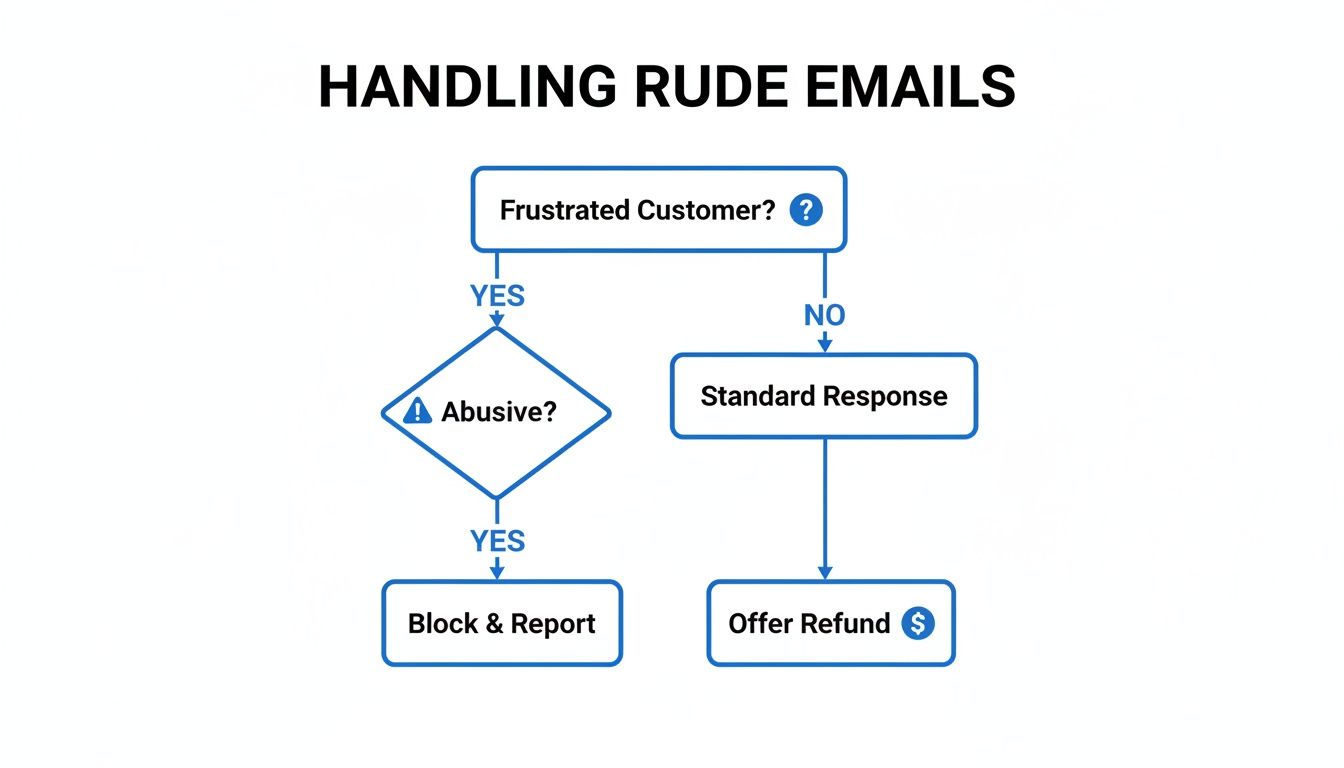
As the flowchart shows, there are clear decision points. It helps you separate genuinely unhappy customers who might just need a refund from the abusive ones you may need to block entirely.
The Process for Parting Ways
If you do decide it's time to "fire" a customer, the process has to be handled with care—be professional, clear, and final. Don't get emotional. Just stick to the facts. A simple, direct email usually works best.
For instance:
"Hi [Customer Name],
After reviewing our recent interactions, it’s clear we aren’t able to meet your expectations.
We have processed a full refund for your recent order, #[Order Number], and have now closed your account. We wish you the best in finding a service that's a better fit for your needs."
This approach gets straight to the point without being confrontational. It provides a clear resolution and closes the loop for good, letting your team get back to focusing on what really matters: helping the rest of your customers.
Using Automation to Manage Customer Frustration
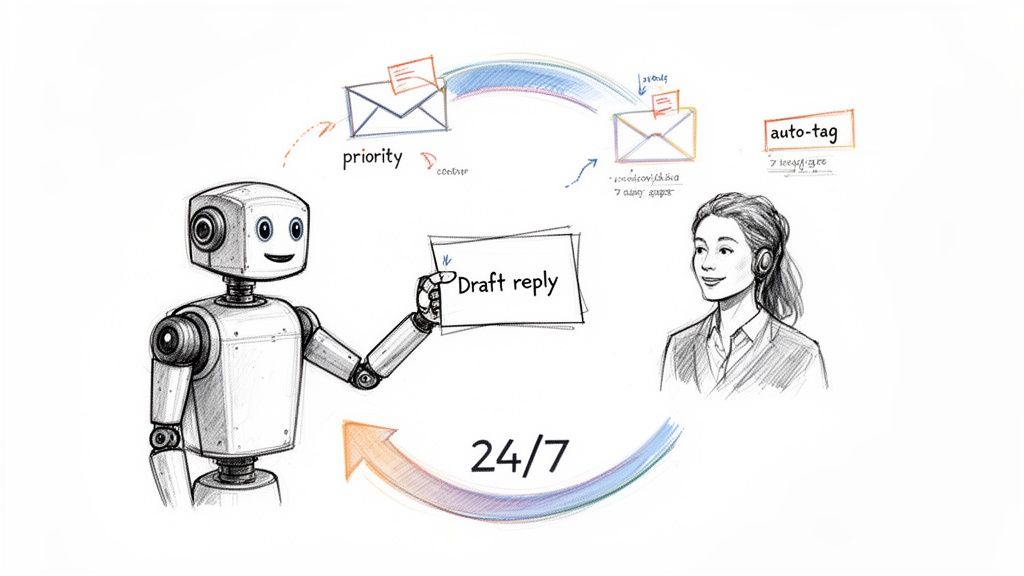
While the human touch is essential for de-escalation, it doesn't always scale. Let's be real—when your team is staring down a mountain of angry emails, it's tough to maintain a perfectly empathetic tone with every single response. Burnout is a genuine risk.
This is where automation becomes your support team's best friend. Think of AI-powered tools as the first line of defense, handling those initial interactions with flawless consistency and patience, 24/7. Instead of your agents starting from scratch with every rude email, automation can triage the conversation and draft a smart, data-driven reply. This frees up your people to handle the most complex and sensitive customer problems that truly need their expertise.
How AI Can Triage and Draft Responses
Modern tools like Mailo AI are built to intelligently sift through your support inbox. They can instantly analyze an email's content and sentiment, automatically tagging messages from rude or frustrated customers for priority handling. Right away, you know the most urgent conversations are getting seen first.
But the real magic happens when the AI connects directly with your e-commerce platform. It goes beyond just tagging and can:
- Generate instant drafts: The AI pulls live order data to create an empathetic first-response draft that’s already filled with the right context.
- Understand the problem: It knows if the issue is a late shipment, a damaged item, or a refund request based on the customer’s message and order history.
- Suggest a solution: It can propose a specific, actionable next step, like offering a reshipment or a partial refund based on your policies.
This creates a "human-in-the-loop" workflow. Your agent’s job shifts from repetitive typing to simply reviewing and approving the AI's smart suggestion. It’s a massive time-saver. If you want to dig deeper into setting this up, our article on how to automate customer service walks through these workflows in more detail.
Proactively Preventing Future Frustration
The long-term value of automation is in the patterns it uncovers. By analyzing thousands of customer interactions, AI can pinpoint recurring complaint trends. Are customers constantly frustrated about a specific product's sizing? Is one shipping carrier always causing delays?
By identifying the root cause of common complaints, you can make operational changes that prevent rude customer interactions before they even happen. This data-driven approach shifts your support from a reactive function to a proactive business strategy.
This isn't just a "nice-to-have"—it's becoming critical. Support teams are under immense pressure, with a recent survey revealing that 57% of service workers face customer harassment every single week. By implementing automation, some brands have seen 60% fewer escalations and a 25% jump in CSAT scores. It's clear proof that smart tech leads to a healthier and more effective support environment.
Exploring different call center software solutions can also provide tools to streamline support across various channels. By combining genuine human empathy with AI efficiency, you build a resilient support system that protects your team and turns frustrated customers into loyal ones.
A Few Lingering Questions About Handling Rude Customers
Even with the best game plan, you're going to run into some curveballs when dealing with upset customers. Let’s tackle some of the most common questions I hear from managers and support agents trying to put these de-escalation ideas into practice.
Think of this as the "what now?" section—quick, practical advice to help you sharpen your approach, get your team up to speed, and figure out if what you're doing is actually making a difference.
How Do You Train New Team Members on This?
Getting new hires ready to handle difficult customers isn't about memorizing scripts. It's about building their confidence and giving them the emotional toolkit to stay cool under pressure.
I always start with role-playing. We pull from real, tough conversations we've had in the past—the yelling, the accusations, the pure frustration—and let the new agent walk through our de-escalation framework. The real magic happens when you have them switch roles and play the angry customer. It builds empathy in a way nothing else can.
Another thing that works wonders is creating a "greatest hits" library. We save anonymized email threads and call snippets where a team member masterfully turned a bad situation around. It gives trainees a concrete example of what "good" looks like in action, far better than any abstract theory.
What Is the Best Way to Document Abusive Interactions?
Good documentation is non-negotiable. It’s your best defense if a customer's behavior becomes a recurring problem, and it's absolutely essential if you have to make the tough call to fire a customer. It takes the situation from a subjective "they were rude" to a factual, objective record.
Keep the process simple so your team actually follows it:
- Use Internal Notes: Every helpdesk or CRM has a place for private notes on a customer's profile. Use it. Every single time.
- Stick to the Facts: Instead of writing, "This customer was a complete nightmare," document what actually happened. For example: "Customer used profane language (see quotes below) and personally insulted the agent after being reminded of our standard 30-day return policy."
- Grab Timestamps and Direct Quotes: Note the date, time, and channel. If it's an email or chat, copy-paste the exact abusive language. This creates an undeniable paper trail that backs up your team.
How Can You Measure the Success of These Strategies?
You have to measure your efforts. Otherwise, you’re just guessing. While you can't exactly put a number on "less rudeness," you can track a few key metrics that tell you if your de-escalation work is paying off.
Tracking the right data is what turns your support team from a cost center into a value-driver. It proves you're not just putting out fires—you're actively improving the customer experience and protecting the company's bottom line.
Focus on these three KPIs:
- Customer Satisfaction (CSAT) Scores: Getting a good CSAT score after a really tough conversation is the ultimate win. It’s a clear sign that your agent successfully de-escalated the situation and salvaged the relationship.
- First-Contact Resolution (FCR): When your FCR rate is high, it means you're solving problems efficiently on the first try. That proactive problem-solving cuts down on the very frustration that leads to angry outbursts in the first place.
- Agent Satisfaction and Retention: Don't forget about your team's well-being. If your agents feel supported and morale is high, it’s a powerful indicator that your strategies are shielding them from burnout. Happy agents are far better equipped to handle stress and deliver great service.
Ready to stop angry emails before they start? MAILO AI uses smart automation to handle routine inquiries, generate empathetic responses, and free up your team to focus on customers who truly need a human touch. Start your free trial today.