

If you want to improve customer satisfaction, you have to get inside your customers' heads. It’s about truly understanding what they need and then consistently going above and beyond their expectations, every single time they interact with your brand. For DTC brands, this means treating every support ticket not as a problem, but as a golden opportunity to build loyalty.
Why Customer Satisfaction Is Your Most Valuable Metric

For anyone running a direct-to-consumer (DTC) brand, customer satisfaction is so much more than a feel-good metric or a nice collection of five-star reviews. It’s the actual engine that drives sustainable growth.
Think about it: every customer interaction, especially in your support channels, is a make-or-break moment. Get it right, and you can create a lifelong fan. Get it wrong, and you might as well have sent them a gift card for your biggest competitor.
Your happiest customers become your best marketers. They don't just come back to buy again; they spend more over their lifetime and tell their friends about you. That cycle of retention and advocacy is what separates the brands that thrive from those constantly bleeding money on customer acquisition.
The Real Cost of a Bad Experience
It's easy to overlook small service hiccups, but they can have a massive impact on your bottom line. A slow reply to a shipping question, a clunky return process, or a canned, impersonal email can instantly sour a customer's view of your entire brand.
The financial fallout is staggering. It's estimated that U.S. companies lose $75 billion a year just from poor customer service. What's more, a whopping 70% of customers will walk away from a brand after just two bad experiences. That doesn’t leave much room for error.
This reality highlights a core truth for any Shopify or DTC business: customer service isn't a cost center. It's a powerful revenue driver. Investing in a better customer experience is a direct investment in your bottom line.
"A single mishandled support ticket isn't just one lost sale. It's the loss of all future sales from that customer and the potential loss of sales from anyone they share their negative experience with. That ripple effect is where the real damage lies."
Connecting Service to Business Goals
Improving customer satisfaction isn't a separate, fluffy goal; it's directly tied to the hard numbers that define your brand's health. When you focus on creating a smooth and positive customer journey, you're building a direct path to hitting your most important business targets.
Here’s a practical look at how that connection works:
- Increased Customer Lifetime Value (CLV): Happy customers are loyal customers. They make repeat purchases, are less sensitive to price, and significantly boost how much they're worth to your business over time.
- Higher Conversion Rates: A reputation for amazing support builds trust. All those positive reviews and word-of-mouth recommendations give new visitors the confidence they need to click "buy." You can find more on this in our guide at https://mailo.ai/blogs/conversion-growth.
- Reduced Churn: A great experience is your best retention tool. When you solve problems quickly and with a human touch, you give customers a powerful reason to stick with you instead of seeing what else is out there.
Of course, you can't improve what you don't measure. Figuring out how to quantify customer sentiment is the first real step. For a deep dive into the nuts and bolts, check out a practical guide to measuring customer satisfaction.
The strategies we'll cover next are all designed to help you shift your support from a reactive chore into a proactive engine for growth.
Pinpointing Where Your Customer Experience is Falling Short
Before you can boost customer satisfaction, you have to get an honest look at where you're starting from. It’s all too easy to glance at a Customer Satisfaction (CSAT) score and either panic or pat yourself on the back, but that one number never tells the full story. To really understand what your customers are going through, you have to roll up your sleeves and find the specific points of friction in their journey.
This isn’t about assigning blame; it's about uncovering opportunities. Every single recurring question or piece of negative feedback is a signpost pointing you directly to an area you can improve. Think of this as the diagnostic phase—you're looking for the symptoms that reveal the underlying health of your entire customer experience.
Key Customer Satisfaction Metrics for DTC Brands
Metrics like CSAT and Net Promoter Score (NPS) are a great starting point, but they're just that—a start. A CSAT score of 85% might feel good, but what about the 15% who weren't happy? Their stories are often where the most valuable, actionable insights are hiding. A high NPS doesn't mean there aren't specific, irritating issues frustrating even your most loyal fans.
To get a complete picture, you need to combine this quantitative data with qualitative feedback—the real, human conversations happening every day. Here are the core metrics every DTC brand should be tracking.
| Metric | What It Measures | DTC Industry Benchmark | How to Improve It |
|---|---|---|---|
| Customer Satisfaction (CSAT) | Short-term happiness with a specific interaction or purchase. | 80% or higher | Improve support quality, product descriptions, and shipping speed. |
| Net Promoter Score (NPS) | Long-term loyalty and likelihood to recommend your brand. | 50 or higher | Enhance overall brand experience, community building, and product quality. |
| First Response Time (FRT) | How quickly your team replies to a new customer inquiry. | Under 1 hour for email | Implement auto-replies, use AI to triage tickets, and optimize staffing. |
| Customer Effort Score (CES) | How easy it is for a customer to get their issue resolved. | A score of 5 or higher (on a 7-point scale) | Simplify processes, create a clear knowledge base, and empower agents. |
Ultimately, the goal is to use these metrics to ask better questions. Why is our CES low? Why are our response times slipping? The answers are almost always found in your support tickets and customer surveys.
Audit Your Support Tickets for Recurring Themes
Your support inbox is a goldmine of raw, unfiltered customer feedback. A systematic audit of your past support tickets can reveal patterns that individual agents, busy putting out fires, might miss. Block off some time, dig into the last few hundred conversations, and start categorizing them.
Don't just skim the initial question. Pay close attention to:
- Repeated questions: Are people constantly asking about your return policy or shipping times to Canada? This is a huge clue that your on-site information isn't clear enough.
- Points of confusion: Do customers often misunderstand a key product feature or a promotional discount? That's a direct signal to improve your product descriptions or marketing copy.
- Resolution times: Which types of tickets take forever to solve? These are prime candidates for better internal documentation or automation workflows.
By manually tagging and analyzing your tickets, you create a data-backed roadmap for improvement. If 25% of your tickets are "Where Is My Order?" (WISMO) inquiries, you've just identified your single biggest opportunity to slash ticket volume and improve the post-purchase experience.
This qualitative audit turns vague feelings like "our shipping seems confusing" into a concrete, solvable problem: "customers are confused about international shipping timelines." Now you have something you can actually fix.
If you’re looking for a more structured approach, our guide on how to improve the ecommerce customer experience offers a ton of detailed strategies.
Ask the Right Questions in Post-Purchase Surveys
While your support inbox captures the problems people complain about, surveys help uncover the silent frustrations. A customer might not bother emailing you about a slightly clunky checkout process, but you can bet they'll remember it next time they think about buying.
The key is to keep your surveys short and focused. Instead of asking generic questions, get specific about pivotal moments in the buying journey.
A few post-purchase survey questions I’ve seen work wonders:
- How easy was it to find what you were looking for on our site?
- Was there any information you were looking for but couldn't find before you purchased?
- Did anything during the checkout process make you hesitate?
- How well did our delivery time meet the expectation we set?
These questions are designed to pinpoint specific gaps. A "yes" to question #3, for instance, tells you there's a friction point right before the final conversion—a place where you're likely losing sales. Once you've gathered this feedback, you have a clear, evidence-based list of priorities to start making meaningful changes that will genuinely move the needle on customer satisfaction.
Using Automation to Deliver Better Support Faster
In ecommerce, speed is everything. When a customer asks, "Where is my order?" they're not just curious—they're looking for immediate reassurance. Making them wait hours, or even days, for a reply can kill that post-purchase excitement and tank your customer satisfaction scores. This is where automation becomes your secret weapon.
By automating responses to your most common questions, you're not just speeding things up; you're fundamentally improving the customer experience. Instead of sitting in a queue, your customers get the right answer, right away, 24/7. That kind of instant gratification is a massive win.
Build Your First High-Impact Automation Workflow
The trick to getting automation right is to start with the low-hanging fruit. I’m talking about the repetitive, high-volume questions that clog up your support inbox. For pretty much every DTC brand, the number one offender is the "Where Is My Order?" (WISMO) ticket.
This is the perfect place to start. WISMO requests are frequent, straightforward, and can be resolved instantly with the right data. Instead of an agent manually digging up an order number and copy-pasting tracking info, an automation tool like MAILO AI can handle the entire thing in seconds.
Here’s how this simple but powerful workflow usually works:
- Trigger: The system sees an incoming email with keywords like "shipping," "order status," or "tracking."
- Data Sync: It instantly pulls the customer's latest order information directly from your Shopify backend.
- Instant Response: It shoots back a personalized email with the live tracking number, a direct link to the carrier’s page, and the current shipping status.
This single workflow can often knock out 20-30% of a brand's total support volume overnight. Not only does this make customers happier, but it also frees up your human agents to handle the tricky issues that actually require a human touch.
To deliver support faster and more efficiently, explore how integrating some of the top AI chatbot platforms can significantly streamline your customer interactions.
Expanding Automation to Returns and Exchanges
Once you’ve nailed WISMO, the next logical step is automating your returns and exchanges. Let's be honest, this process is often a huge point of friction. A clunky or slow returns process can easily sour an otherwise great experience and convince a customer never to buy from you again.
Automation smooths out all that frustration. You can set up a workflow that guides customers through the entire process without them ever having to wait for an agent.
Your automation should feel less like a robot and more like a hyper-efficient personal assistant. The goal is to make the customer's life easier by giving them the information and tools they need to solve their own problem, instantly.
This visual shows the simple yet powerful process for figuring out which parts of your customer experience are ready for this kind of upgrade.
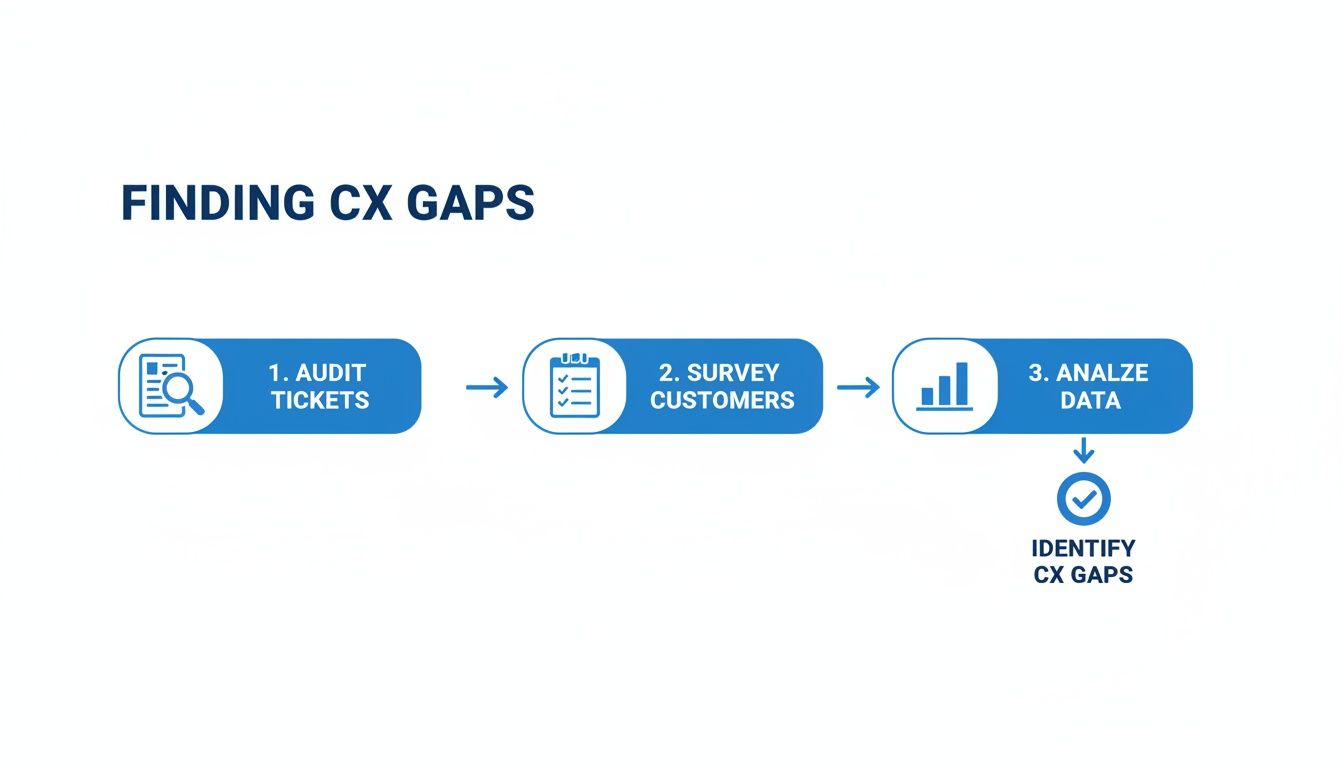
By auditing your tickets, surveying customers, and analyzing the data, you'll see exactly which recurring pain points automation can solve best.
A standard returns automation might look like this:
- Initiation: A customer emails with "return" or "exchange." The system instantly replies with a link to your self-service returns portal.
- Verification: The customer enters their order info, and the system confirms the items are within the return window.
- Resolution: Depending on your policies, the system automatically issues a prepaid shipping label, sends instructions, or processes an exchange right then and there.
You just turned a multi-day headache into a five-minute task for the customer. That’s how you build loyalty.
Using Decision Trees for Smarter Automation
Of course, not all support tickets are created equal. A simple question about your return policy is a world away from a complaint about a damaged item. To handle this complexity, good automation relies on decision trees—basically, a set of rules that tells the system how to react based on what the customer is actually asking for.
Think of it as a digital triage nurse. The AI first figures out the email's intent. Is it a question? A complaint? A compliment? From there, it follows a specific path to get to the right resolution.
For instance, a decision tree for a "return request" email might branch out like this:
- If the order is within your 30-day return policy, then send the self-service portal link.
- If the order is outside the 30-day policy, then escalate the ticket to a human agent who can make a judgment call.
- If the email mentions words like "damaged" or "broken," then tag it as urgent and route it straight to a senior support agent.
This kind of smart routing ensures automation handles what it’s best at—speed and efficiency—while your team handles what they’re best at—empathy and complex problem-solving. It’s this hybrid approach that lets you scale support without ever sacrificing quality.
Scaling Your Support Without Losing the Human Touch
When brands hear "automation," they often picture cold, robotic interactions that frustrate customers. I've seen that fear hold back a lot of growing stores. But here's the reality: smart automation does the exact opposite. It’s about taking the repetitive, soul-crushing tasks off your team's plate so they can be fully present for the conversations that truly matter.
This isn’t about replacing your amazing support agents. It's about giving them superpowers. Think of automation as the first line of defense that handles the simple stuff instantly, freeing up your team to be the problem-solving heroes for complex issues. It’s this blend of speed and genuine care that lets you scale without sacrificing quality.
Turning Data Into Personalized Conversations
Your Shopify store is practically overflowing with valuable customer data. Every single order tells a story—purchase history, total spend, location, what they bought last. Tapping into this information is what separates a generic, copy-paste reply from a conversation that makes a customer feel genuinely recognized.
Imagine setting up a workflow that automatically identifies a VIP customer the moment they email you. Instead of them landing in the general queue, the system can instantly:
- Flag their ticket for a senior agent, ensuring they get white-glove service.
- Arm the agent with a personalized discount code to offer as a thank you.
- Apply a unique email template that uses a warmer, more appreciative tone.
This is how you show customers you’re paying attention. You’re not just solving a problem; you’re reinforcing their value to your brand and building serious loyalty in the process.
Proactive Support That Wows Customers
Why wait for a customer to ask a question? With the right tools, you can use that same order data to get ahead of their needs and create amazing experiences. A simple shipping update can become a powerful brand touchpoint when you make it personal.
Let’s say a customer, Sarah, just bought a specific yoga mat. Instead of a bland "Your Order Has Shipped" email, think about this:
"Hi Sarah, great news! Your new Sunrise Yoga Mat has just shipped. We know you’re excited to start your morning routine with it, and you can follow its journey to you right here: [Tracking Link]."
See the difference? It's a small touch, but it acknowledges the specific product and connects with the customer's excitement. That’s how you build an emotional connection that lasts far beyond a single transaction.
And the impact is huge. The quality of service is no longer just a nice-to-have; it's a primary driver of sales. Eye-opening research for 2025 reveals that a staggering 99% of consumers say customer service influences their choice to buy, and 3 in 4 people will happily spend more with a business that delivers a great experience. You can dig into more of these customer support trends on usepylon.com.
Scripting That Sounds Human
The words you use in your automated responses matter more than you think. Ditching the corporate jargon for a natural, helpful tone can completely change how your brand is perceived. It's often the small tweaks in wording that make the biggest impact.
This is where a tool like MAILO AI really shines. It's designed to pull in specific customer data from your store to generate replies that feel like they were written by a person, not a machine.
As you can see, the AI uses the customer's name and order details to craft a response that's both personal and genuinely helpful. By leaning on this kind of tech, you can make sure every single interaction—even the automated ones—reinforces your brand's voice and your commitment to making customers happy.
Building a Support Team That Thrives with AI
Getting powerful AI tools in place is a huge step, but it’s only half the battle. To really move the needle on customer satisfaction, you have to structure your support team to get the most out of that automation. This isn't about replacing people; it's about setting them up to do their absolute best work.
When an AI handles the flood of repetitive questions—think endless "Where Is My Order?" tickets—your human agents are freed from the copy-paste grind. This frees up their brainpower for the complex, emotionally-charged issues where a real human connection makes all the difference. The goal is a smart hybrid model where technology and people work in tandem, each playing to their strengths.
Setting and Hitting Your Service Level Agreements
A Service Level Agreement (SLA) is much more than an internal KPI. It’s a direct promise to your customers, setting clear expectations for how fast they'll get a response and a resolution. For any growing DTC brand, consistently hitting those targets is a massive trust-builder.
But let's be real—manually tracking and meeting SLAs during a Black Friday rush can feel next to impossible. This is exactly where automation becomes your team’s MVP. By setting up workflows that instantly tackle common questions, you can dramatically slash your average first response time.
Here's how that looks in practice:
- Instant First Response: An AI tool like MAILO AI can fire off an acknowledgment email within seconds. This small touch assures the customer their message was received and gives them an estimated response time.
- Automated Triage: The system can read an email, understand its intent, and then automatically categorize and prioritize it. This ensures that the truly urgent stuff always gets seen first.
- Proactive Resolution: For straightforward requests like order status checks, the AI can resolve the ticket entirely on its own. It never even has to hit an agent's queue, which keeps your metrics looking great.
This approach means that even when your team is totally swamped, every single customer gets a timely interaction, and you keep your SLA promises.
"Your support team's structure should reflect a clear strategy. By creating a tiered system with AI at the frontline, you're not just improving efficiency—you're reserving your team's most valuable resource, human expertise, for the moments it matters most."
Designing a Tiered Support System
A tiered support structure is a classic, battle-tested way to organize a team for efficiency. When you add AI into the mix, this model gets a serious upgrade. Your AI effectively becomes your Tier 1—always on, infinitely scalable, and ready to handle the bulk of simple, informational questions.
This frees up your skilled human agents to operate at higher tiers, focusing on problems that require real investigation or a personal touch. For example, a customer who's genuinely unhappy with a product's quality doesn't want a fast, robotic answer; they need an empathetic ear and a thoughtful solution.
A modern, AI-powered tiered system often looks something like this:
- Tier 0 (Self-Service): This is your FAQ page and knowledge base, which the AI can intelligently pull from and link to in its responses.
- Tier 1 (AI Automation): The first line of defense. It instantly resolves WISMO, returns, policy questions, and other high-volume tickets.
- Tier 2 (Human Agents): They handle anything escalated from the AI, along with complex product questions and sensitive complaints.
- Tier 3 (Senior Agents/Leadership): This tier is for managing high-value customer issues, technical problems, or major service hiccups.
This structure ensures simple problems get simple, fast solutions, while the tough stuff gets the focused human attention it deserves.
Training Your Team to Partner with AI
The final, and most critical, piece of the puzzle is shifting your team's mindset. It’s absolutely essential to frame AI not as a replacement, but as a powerful assistant designed to make their jobs less repetitive and more fulfilling. When your team sees AI as a tool that crushes boring tasks and helps them hit their goals, you get enthusiastic adoption instead of fear.
Your training should be all about collaboration. Show your agents how to review AI-suggested replies, teach them when to let the automation run its course, and demonstrate how to seamlessly take over a conversation when needed. This approach is a core part of how AI is transforming e-commerce strategy in 2025 for brands that want to get ahead.
The result? A confident, capable team that uses technology to provide faster, smarter, and more human support than ever before.
Creating a Cycle of Continuous Improvement
Great customer service isn't a destination you arrive at. It’s a living, breathing part of your business that needs constant attention—a process of listening, adapting, and fine-tuning. You can't just launch a new set of automations, dust off your hands, and call it a day.
The real key to consistently improving customer satisfaction is building a tight feedback loop. This loop turns every single customer interaction, good or bad, into a chance to learn and get better.
This means you have to tie your support initiatives directly to the metrics that actually move the needle. When you roll out a new automated return process, for example, you need to have your eyes glued to your CSAT and NPS scores. If you see them tick up, you've just proven the ROI of your work.
Analyzing and Refining Your Automations
Let's be honest: not all automations are created equal. You have to treat them like living things within your support ecosystem, which means checking in on their performance regularly. It’s time to get your hands dirty in the analytics and start asking some tough questions.
- Which of our automated workflows have the lowest resolution rates? If an automation keeps kicking tickets back to a human agent, something is broken in its logic.
- Are certain automated replies consistently getting hammered with negative CSAT scores? That’s a huge red flag. The tone could be completely off, or the answer it's giving is just plain unhelpful.
Picture this: your "Where is my order?" (WISMO) automation has a terrible resolution rate. You dig in and realize it’s failing to pull carrier updates for international shipments. Bingo. That's a specific, solvable problem. By fixing the workflow to grab the right tracking data for all customers, you instantly make it more effective.
The goal here is to shift your support team from being a reactive cost center into a strategic intelligence hub for the entire company. The data you pull from your automation performance is pure gold. It can tell you what products need improving, where your marketing messages are confusing, and what parts of your website are causing friction. This is how you create a powerful, self-improving cycle.
Got Questions? We've Got Answers
Putting these strategies into practice always brings up a few real-world questions. Let's tackle some of the most common ones I hear from DTC founders who are getting serious about customer satisfaction.
How Can a Small Brand Possibly Offer 24/7 Support?
Let's be real: for a small team, having a human on standby 24/7 is a pipe dream. The good news is you don't need one. This is exactly where smart automation steps in to provide instant help when your team is offline.
An AI tool can easily handle the lion's share of after-hours questions—things like order status updates or simple return requests. It’s about building a hybrid model. Your customers get an immediate answer for the common stuff, and the trickier issues are neatly queued up for your human team to tackle first thing in the morning.
What's the First Automation I Should Build for the Biggest Impact?
Without a doubt, start with "Where Is My Order?" (WISMO) requests. For nearly every DTC brand I've worked with, this single question is the most common, repetitive ticket in the inbox, often making up a staggering 20-30% of all support volume.
Automating your WISMO responses gives you an immediate, massive win. It frees up your team from mind-numbing copy-pasting and gives customers the instant gratification they expect. If you're looking for the quickest way to boost both team efficiency and customer happiness, this is it.
How Should I Handle an Angry Customer with Automation?
This is a critical one. You never want automation to feel like a barrier that a frustrated customer can't get past. The goal isn't to block them; it's to use AI for intelligent triage.
You need to set up your system to listen for negative sentiment. Teach it to spot keywords like "angry," "unacceptable," or "disappointed." As soon as one of those pops up, the automation's only job is to bypass the standard flow and immediately escalate that ticket to a senior agent. This ensures your most volatile conversations get the human empathy they need, right away.
Ready to turn your email support into an engine for growth? MAILO AI syncs with your Shopify data to give customers instant, personalized answers that delight them and save your team countless hours. See how it works and start a free trial.