

When a rude customer email hits your inbox, the gut reaction is to either get defensive or just give them what they want to make them go away. But the most effective approach isn't about gut reactions—it's about having a system. The key is to stay calm, genuinely listen to what's going on, show some real empathy, and then work with them to fix it. This method skillfully shifts the conversation from their anger to the actual problem, which stops things from getting worse and protects your team from burnout.
The Real Cost of Customer Rudeness in E-Commerce
Every e-commerce owner knows that sinking feeling. An email notification pops up, and it's a wall of text in all caps, filled with frustration and demands. It’s tempting to brush these off as just another "difficult customer," but that's a mistake. These aren't isolated incidents; they're a direct threat to your business that goes way beyond a single bad conversation. When you fumble these interactions, you're not just failing to solve a problem—you're actively hurting your brand.
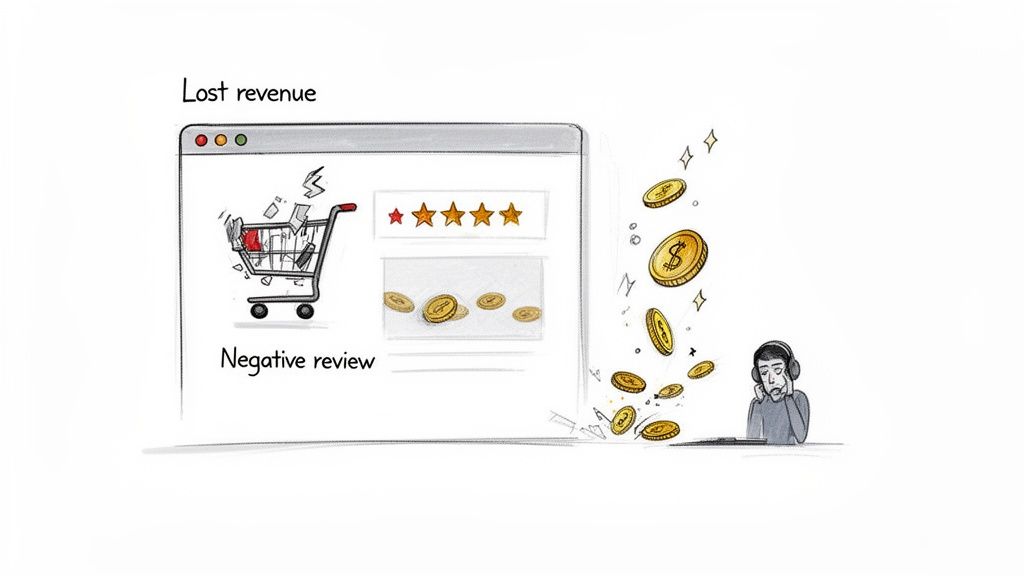
And this isn't just a hunch; customer agitation is climbing. A recent study found that a jaw-dropping 76% of frontline employees now have to deal with rude customers on a monthly basis. This shift in consumer patience means having a solid plan for handling these situations is no longer optional. It's essential.
The Financial and Human Toll
Negative interactions create a domino effect that hits your wallet hard. An angry customer is way more likely to plaster a one-star review on your site, scaring off who knows how many new buyers. Worse, they might file a chargeback, which costs you the sale and a penalty fee. But the damage isn't just financial.
Below, we've outlined the tangible impacts that unmanaged customer rudeness can have on your store.
The Hidden Costs of Unmanaged Customer Rudeness
| Area of Impact | Direct Business Consequence | Long-Term Risk |
|---|---|---|
| Brand Reputation | Negative online reviews and social media callouts | Eroded public trust and difficulty attracting new customers |
| Team Morale | Increased agent stress, burnout, and anxiety | High employee turnover, increased hiring costs, and inconsistent service quality |
| Revenue | Lost sales from deterred shoppers and chargeback fees | Decreased Customer Lifetime Value (CLV) as unhappy customers don't return |
| Operational Efficiency | Agents spend disproportionate time on escalations | Resources are diverted from proactive support and growth initiatives |
Ignoring this problem creates a vicious cycle: poor service leads to more frustrated customers, which leads to more burnout, and so on.
When your support team is constantly weathering hostility without the right training or tools, burnout is inevitable. This leads to high turnover and a nosedive in the quality of your service, which only creates more angry customers.
This guide goes beyond the generic advice to "just be empathetic." We're handing you a concrete, tech-powered playbook specifically for Shopify brands. The objective here is to switch from reactive damage control to a proactive system that protects your team, saves customers, and can even turn a negative experience into a show of loyalty. We'll show you exactly how to build workflows that empower your team to handle anything that comes their way.
Ultimately, mastering these difficult conversations is a core part of building a healthy support operation. For a deeper dive, check out our guide on how to measure customer service to see how it all connects.
Mastering De-Escalation and Empathy in Your Replies
Before you can even think about solving a customer's problem, you have to manage their emotions. It's a simple truth of support. When a rude message lands in your inbox, the immediate goal isn't to fix the issue—it's to lower the temperature. A calm, empathetic response is your most powerful tool, capable of turning a tense standoff into a productive conversation.
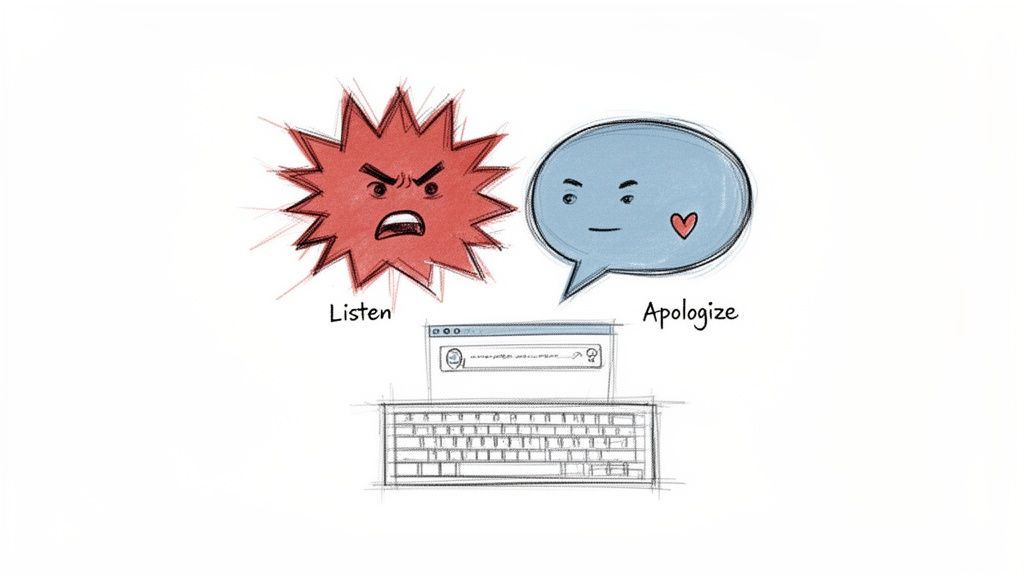
Many of us know the classic L.A.S.T. method—Listen, Apologize, Solve, Thank. It’s a great starting point, but for email and chat, it needs a little tweaking. "Listening" becomes "active reading," where your job is to dig for the core issue buried under all that frustration.
Read Between the Lines
A customer who’s furious about a "late delivery" might actually be upset because it was a birthday gift that missed the big day. Their rudeness isn’t just about logistics; it’s rooted in disappointment and the feeling of letting someone down.
Your first job is to decode the real story. Don't just skim the angry words. Look for the why behind the what. This deeper understanding is what separates a generic, robotic reply from one that genuinely connects.
It's also worth remembering that what seems like rudeness can sometimes just be a difference in communication style. A customer might be blunt due to cultural norms or neurodivergence, not because they’re trying to be hostile. It’s always best to give them the benefit of the doubt.
Crafting a Response That Disarms
Once you’ve got a handle on their frustration, your reply needs to validate their feelings—without necessarily admitting fault. The idea is to get on their side of the table and show them you’re an ally, not an opponent.
Here are a few opening lines that work wonders:
- "I can absolutely see why you're so frustrated by this. It’s completely understandable that you'd be upset about the shipping delay."
- "Thank you for bringing this to our attention. I’m so sorry to hear about the trouble you've had with your recent order."
- "That sounds like a very difficult situation, and I want to assure you I'm here to help get this sorted out for you."
Notice the subtle distinction here. These phrases acknowledge their emotional state ("frustrated," "upset") and apologize for the bad experience ("sorry to hear about the trouble") without automatically accepting blame. It’s a small detail, but it’s crucial for maintaining a professional yet caring tone. For more ideas, our guide on https://mailo.ai/blogs/customer-support-automation/how-to-build-rapport-with-customers has some great strategies.
Key Takeaway: Real empathy isn't about saying "I understand how you feel." It's about showing you understand their situation and are ready to jump in and find a solution.
Stay Calm and Project Confidence
It’s human nature to get defensive when someone comes at you with hostility, but giving in to that impulse will only pour gasoline on the fire. Your own emotional state bleeds directly into your writing. If you feel attacked, take a breath. Step away before you type a single word.
Try this little exercise next time you get a nastygram:
- Read the rude email once, just to get the general idea.
- Take a 60-second break. Seriously. Stand up, stretch, look out a window.
- Reread the email, but this time, hunt for the facts. Filter out the insults and pinpoint the actual, solvable problem.
- Now, draft your reply, focusing only on empathy and the solution.
This simple process creates just enough emotional distance to let you respond like the professional you are. To really hone these skills, it helps to give your team proven frameworks to follow. You can find excellent, practical strategies in resources like this guide on Mastering De-escalation Techniques in Customer Service.
When you master these techniques, you're doing more than just handling a difficult customer. You're turning a potential brand detractor into a loyal advocate. A single, thoughtful reply can completely shift a customer's perspective and prove your brand genuinely cares, even when things go wrong.
Email Templates That Turn Frustration into Loyalty
The right words have a way of putting out fires. When a support agent knows exactly what to say, a heated complaint can become a chance to prove your brand really cares. Think of a set of proven, adaptable email templates as a fire extinguisher for your team—it gives them the confidence to handle flare-ups calmly and effectively.
These aren't just copy-and-paste scripts. They’re frameworks, thoughtfully designed to address the raw emotions that fuel customer frustration. The goal isn't just to solve the problem, but to make the customer feel heard, respected, and valued, even when they’re at their worst.
Getting this wrong can cost you, big time. The 2023 National Customer Rage Survey found that businesses risk losing a staggering $887 billion in future revenue from botched complaint handling. That number has nearly doubled since 2020, which shows just how critical a solid game plan is. You can dig into the numbers yourself in the full customer rage study.
A Quick-Reference Guide for Responding
Sometimes, you just need a starting point. This quick guide matches common angry customer scenarios with the right emotional focus and an effective way to open the conversation.
Rude Customer Scenario Response Matrix
| Customer Complaint | Primary Emotion to Address | Effective Opening Line | Key Action |
|---|---|---|---|
| "Where is my order?!" | Helplessness & Impatience | "I'm so sorry about the unexpected delay with your order. I can see it was supposed to arrive by [Date], and I completely understand your frustration." | Provide transparency, offer a new timeline, and set a follow-up action. |
| "You sent me the wrong/broken item!" | Disappointment & Betrayal | "Thank you for sending that photo. I am so sorry to see your [Item Name] arrived damaged. That is definitely not up to our standards." | Immediately offer a no-hassle replacement or refund. |
| "Your product doesn't work as advertised." | Deception & Frustration | "I'm really sorry to hear the [Product Name] isn't meeting your expectations. Could you tell me a bit more about what's happening?" | Listen, troubleshoot patiently, and offer a return/exchange. |
| "I've been waiting forever for a reply." | Feeling Ignored & Disrespected | "My sincerest apologies for the delay in getting back to you. You've been waiting far too long for an answer, and I'm here to help get this sorted out now." | Take immediate ownership and resolve the issue on that contact. |
This matrix acts as a mental shortcut for your team, helping them quickly categorize the complaint and choose the most effective path forward before they even start typing.
Template for Delayed Shipments
Shipping delays are a classic trigger. Customers feel powerless and left in the dark, and that feeling quickly sours into anger aimed at you. This template is all about restoring their sense of control by giving them clear information and a path forward.
Subject: An Update on Your Order [Order Number]
Hi [Customer Name],
I’m so sorry about the unexpected delay with your order. I can see it was scheduled to arrive by [Original Date], and I completely understand your frustration that it hasn't arrived yet. That is not the experience we want for our customers.
I’ve looked into this for you, and it appears there’s been a carrier delay in your area. While this is out of our direct control, I want to help get this sorted for you. Here is the most up-to-date tracking link: [Tracking Link].
We expect it to be delivered within the next [Number] business days. If it hasn’t arrived by [New Date], please let me know, and we will [State Next Action - e.g., issue a replacement, provide a refund].
As a thank you for your patience, here is a code for 15% off your next purchase: PATIENCE15.
Thank you for your understanding.
Best, [Your Name]
Why It Works: This template nails it by immediately validating the customer’s feelings ("completely understand your frustration"). It also takes ownership of the communication—even if the carrier is at fault—and provides a concrete timeline and next step. The discount is a small gesture that acknowledges their inconvenience and builds goodwill.
Template for an Incorrect or Damaged Item
There's nothing more disappointing than opening a package to find the wrong thing or, worse, something broken. The customer's frustration comes from a broken promise. This template focuses on a swift, painless solution to immediately start rebuilding that trust.
Subject: So Sorry About the Issue with Your Order [Order Number]
Hi [Customer Name],
Thank you for reaching out and for sending over that photo. I am so sorry to see that your [Item Name] arrived [damaged/incorrect]. That is definitely not up to our standards, and I understand this must be disappointing.
I’ve already gone ahead and created a new order for a replacement [Item Name] for you, completely free of charge. You can expect it to ship out within 24 hours. There’s no need to return the original item—please feel free to keep it or dispose of it.
We’re also taking steps to review our packing process to ensure this doesn't happen again.
We really appreciate you bringing this to our attention. Please let me know if there's anything else I can assist with.
Sincerely, [Your Name]
Don't Just Copy-Paste: Make It Personal
A template is a starting point, not the finish line. The real magic happens when you infuse it with personal details from your e-commerce platform. Suddenly, a generic apology becomes a targeted solution.
Here are a few simple ways to customize these templates:
- Use Their Name: Always. It’s the bare minimum.
- Reference Specifics: Mention the exact product, order number, and relevant dates.
- Acknowledge Their History: If they’re a loyal customer, a simple "Thanks for being a longtime customer" goes a long way.
This level of detail shows the customer you see them as a person, not just another ticket number. This is where integrating your support system with your Shopify store data is a game-changer. Tools like Mailo AI can automatically pull this context into draft replies, empowering your team to send highly personalized, empathetic responses in a fraction of the time. It’s that blend of smart automation and a human touch that lets you handle tough situations at scale without losing quality.
Using AI to Automate Your Support System
Strong de-escalation skills are a superpower for any support agent. But during a Black Friday rush or an unexpected shipping delay, even your best people hit a wall. There's a very real limit to how many angry emails one person can handle effectively. That's a scaling problem, and it's where a smart system becomes your team's most valuable player.
Building an intelligent support system isn't about replacing people. It's about giving them the right tools at the right moment, freeing them up to focus their very human skills on the customers who need them most.
Automatically Detect and Prioritize Angry Emails
The first challenge is simply finding the angriest people in a crowded inbox. A frustrated customer left waiting is a problem that gets worse by the minute. This is where AI-powered sentiment analysis is a total game-changer for e-commerce teams.
Instead of an agent manually sifting through hundreds of messages, an AI can instantly read the room. It analyzes the tone, keywords, and even punctuation to flag emails that scream frustration, anger, or urgency.
Here’s what that looks like in the real world:
- Sentiment Analysis: An email lands, and the system immediately flags it as “Negative,” “Urgent,” or “Angry.”
- Automatic Tagging: The email gets tagged and sorted into a priority queue without anyone lifting a finger.
- Smart Routing: The ticket can then be automatically sent to a senior agent or a specialist trained in handling tough conversations.
This simple workflow stops volatile situations from festering. Your inbox goes from a chaotic free-for-all to an organized, prioritized list where the biggest fires get put out first.
This flowchart breaks down the simple but incredibly effective three-step process.
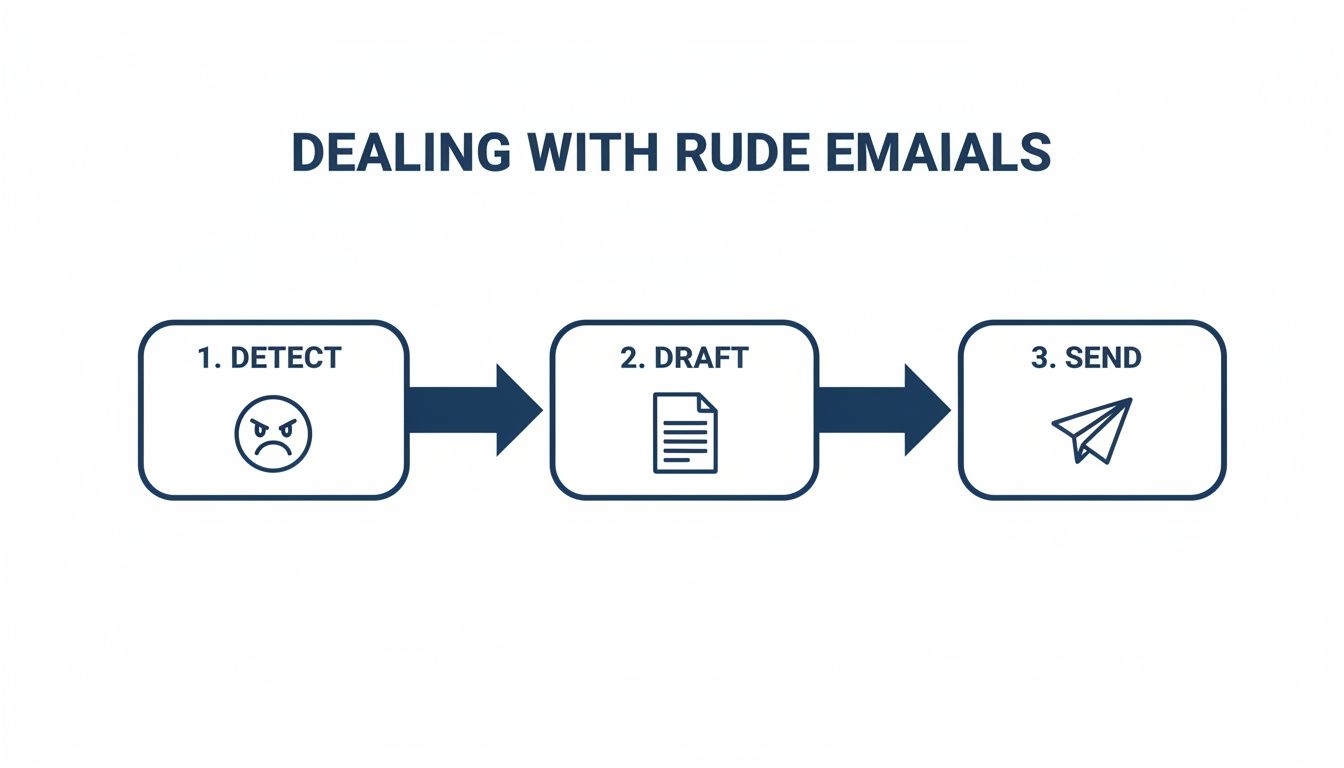
It’s all about detecting the sentiment, drafting a contextual reply, and getting a resolution out the door faster than ever.
Generate On-Brand, Context-Aware Drafts
Okay, so you've found the angry email. The next bottleneck is writing the perfect reply. Your agent has to pull up order history, check tracking info, and review past conversations, all while trying to sound calm and empathetic. This is where the real time-suck happens.
AI can shrink that process from minutes to seconds by generating a complete, on-brand draft.
Modern tools built for e-commerce, like Mailo AI, don't just see words—they see context. When a customer emails about a late shipment, the AI connects to your Shopify store data and instantly knows their name, order number, what they bought, and the latest tracking update.
By pulling real-time context directly from your e-commerce platform, AI generates replies that are not only empathetic but also factually accurate and immediately helpful. This eliminates the tedious copy-and-paste work that slows agents down and leads to errors.
The agent gets a pre-written draft that acknowledges the customer's frustration, includes their specific order details, and suggests a solution based on your store policies. Their job transforms from researcher and writer to editor. They just need to review, add a personal touch, and hit send. In the quest for team efficiency, tools that help Boost Your Productivity With Reclaim AI are also becoming essential for support departments looking to get more done.
Create Approval Workflows for Consistency
Speed is great, but consistency is what builds trust. For sensitive cases—like processing a big refund or responding to a particularly nasty email—you might want a second set of eyes on the reply before it goes out.
This is where approval workflows are so valuable. You can set up a rule that any response drafted for an "Angry" ticket gets automatically routed to a manager for a quick review.
This does two things: it gives junior team members the confidence to tackle tough tickets, and it acts as a final quality check to ensure every high-stakes reply is 100% on-brand. If you're looking to learn more about the underlying systems, it's worth exploring the different types of AI customer support software available.
Ultimately, bringing AI into your support system isn't about removing the human element—it's about amplifying it. You're clearing the clutter so your team can focus their energy and problem-solving skills where they truly matter.
How to Build a Resilient and Supported Team
Your support team is on the front lines every single day. Constant exposure to customer frustration and anger is a surefire path to burnout, and protecting their mental health isn't just a nice-to-have—it's a core business strategy.
A team that feels supported provides better service, sticks around longer, and becomes your greatest asset in navigating tough customer interactions. The real goal here is to build a safety net. You want to create a system where your agents never feel trapped or alone when a conversation gets heated. This means empowering them with clear policies, practical training, and the confidence that management truly has their back.
Create Ironclad Escalation Policies
Every seasoned support agent knows that feeling in the pit of their stomach when a customer crosses a line, shifting from frustrated to genuinely abusive. Without a clear plan, agents are left asking themselves, "How much of this am I supposed to take?" That uncertainty is incredibly draining.
An escalation policy removes that burden completely. It's a simple, documented process that gives an agent the exact playbook for when and how to loop in a manager or, if necessary, disengage from an abusive conversation. This isn't just a document for the agent; it’s a powerful signal from leadership that their well-being is more important than any single ticket.
Your policy needs to define clear, non-negotiable triggers for escalation:
- Threats or Profanity: The second a customer uses threatening language or slurs, the conversation is over. Your team needs to feel empowered to end that interaction on the spot.
- Unreasonable Demands: When a customer is demanding something that is miles outside your company policies (like a full refund on a final sale item from a year ago), it’s time for a manager to step in.
- Agent's Discretion: Sometimes, an agent just hits a wall. Give them the power to escalate a conversation simply because they feel overwhelmed or out of their depth. No questions asked.
A clear escalation path is a lifeline. It transforms an agent's feeling of being trapped into a feeling of being supported, knowing there's always a next step they can take to protect themselves.
Make sure this policy is written down, easy to find, and discussed regularly. When an agent uses it, they should be praised for making a smart call, not grilled about why they couldn't handle it themselves.
Train for Tough Conversations
You wouldn’t send a soldier into battle without training, so why would you put your agents on the front lines without preparing them for conflict? Real-world training has to go beyond product knowledge. It must include practicing how to navigate emotional, high-stakes interactions.
Role-playing is one of the best tools you have. It can feel a little awkward at first, but trust me, it works.
A Sample Role-Playing Scenario:
- The Setup: One person plays a furious customer whose long-awaited package just arrived completely crushed. The other plays the support agent.
- The Goal: The agent's mission is to de-escalate the situation using empathy and sharp problem-solving skills, all while resisting the urge to get defensive.
- The Debrief: Afterward, talk it through. What went well? What could have been better? Did the agent actually validate the customer's feelings? Did they stay calm under pressure? Did they offer a clear, actionable solution?
This kind of practice builds muscle memory. So, when a genuinely angry customer calls, the agent’s response is calm and confident, not panicked. It creates a safe space to fail and learn without any real-world consequences.
Use Analytics to Support Your People
Data isn't just for tracking sales—it's an incredible tool for monitoring the health of your team. The analytics in your support platform are packed with insights that can help you spot agents who might be struggling long before they hit the point of burnout.
Keep an eye out for these indicators:
- An agent whose average handle time suddenly shoots up might be getting stuck in long, draining conversations.
- A sudden dip in an agent’s customer satisfaction (CSAT) score could be a sign they're feeling overwhelmed.
- A suspiciously high number of tickets tagged as "Angry" or "Escalated" for one particular agent is a major red flag.
When you spot these trends, the goal isn't to punish anyone. It's to offer support. A simple, private message like, "Hey, I noticed you've been handling a lot of tough tickets lately. How are you doing? Anything I can do to help?" can make all the difference. This proactive check-in shows your team you're watching out for them, not just watching their numbers.
Common Questions About Dealing With Rude Customers
Even with the best game plan, some customer interactions will leave you scratching your head. Let's tackle some of the most common questions we hear from e-commerce teams about handling those really tough conversations.
Is the Customer Really Always Right?
Nope. But that's not the point.
The old saying, "the customer is always right," was never about blindly giving in to every single demand. It’s about recognizing that a customer's perception is their reality. If they feel like they've been let down, that feeling is real, and you can't argue it away.
Your job isn't to win the argument; it's to listen, understand why they're frustrated, and find a fair solution that still works for your business. It's about shifting from a "who's right" mindset to a "how can we fix this" one.
The takeaway: Their frustration is always valid, even if their facts are wrong. Address the emotion first, then you can solve the problem together.
What's the Line Between Rude and Abusive?
There’s a world of difference between a customer who’s just venting their frustration and one who is being genuinely abusive. Your team’s well-being is the top priority, full stop. No one should ever have to put up with threats, harassment, or bigotry.
This is where a clear, zero-tolerance policy becomes essential. Your team needs to know exactly what crosses the line and feel 100% empowered to shut it down.
- First, give a clear warning: A simple, firm "I understand you're upset, but I can't help you if you continue to use that language" often works.
- Then, end the conversation: If it continues, they need to have the authority to end the chat or state they will no longer reply to the email thread before escalating it to a manager.
Make sure every single one of these incidents is documented. It’s crucial for protecting your team and your business if things get worse.
Should I Just Throw a Discount at Every Angry Customer?
It’s tempting, right? A quick discount can feel like an easy fix, but it's a dangerous habit to get into. If you do it every time, you’re basically training customers that complaining equals a freebie.
Save discounts for when you genuinely messed up—a damaged product, a seriously botched delivery, a major mistake on your end. That’s when it’s an appropriate gesture to make things right.
For smaller hiccups, a sincere apology and a fast, effective solution often mean more. A customer who feels like you truly heard them and fixed their problem is more valuable than one you just paid to go away.
How Can I Tell If I'm Being Rude Back?
This is a tough one. It’s incredibly easy to mirror a customer’s negative energy without even realizing it. What you think is just being direct can come across as cold or defensive to someone who's already on edge.
Before you hit send, read your reply out loud. Seriously. Does it sound like you're on their side, or does it sound like you're fighting them?
Watch out for little phrases that instantly put people on the defensive:
- "As I already told you..."
- "You failed to..."
- "Actually, that’s not correct..."
Swap them out for something more collaborative. Try "Just to clarify, the next step is..." or "Let's see what we can do to get that sorted out." Tiny shifts in wording can completely change the tone and keep the conversation moving forward.
Handling unhappy customers is never easy, but it doesn't have to derail your day. With the right systems in place, it becomes a manageable part of the job. Mailo AI helps your Shopify store instantly spot negative emails, drafts empathetic replies, and gives your team the breathing room to focus on what matters: building relationships. See how it works with a free trial of Mailo AI.