

Knowing how to address an email correctly means personalizing the greeting based on where the customer is in their journey, the reason for the message, and your own brand's voice. It's about moving past the generic 'Hi Customer' and using a specific, thoughtful opening that makes the recipient feel seen from the very first line.
Why Your Email Greeting Is a Hidden Growth Lever
That first line of your email? It does a lot more than just say hello. It sets the entire tone for your relationship with that customer. For any e-commerce brand today, figuring out how to address an email isn't just about good manners—it's a strategic move that directly impacts engagement, trust, and your bottom line.
The Challenge of Personal Connection at Scale
The real trick for direct-to-consumer (DTC) brands is keeping that personal, human touch when you're sending thousands of emails, both automated and manual. Every single transactional update, support ticket, and marketing campaign is a chance to connect. Nailing the greeting turns what could be a cold, robotic interaction into a genuinely positive moment with your brand.
This simple act can be a powerful performance lever. We know from research that personalized emails drive much higher engagement, contributing to an impressive marketing ROI of around $36–$42 for every dollar spent. That incredible return starts with building trust from the very first word. You can dig into more of these stats in Optinmonster's email marketing report.
Building Relationships from the First Word
A thoughtful greeting tells your customer you see them as a person, not just an order number. This isn't just about dodging a generic "Hi there"; it's about starting a real connection that can turn a one-time buyer into a loyal fan. Mastering this first step is a cornerstone of great communication, a topic we cover in more detail in our guide on how to write a business email.
The goal is simple: make every customer feel like they're your only customer. The right greeting is the first and most crucial step, whether you're sending a shipping confirmation or handling a tricky support issue.
The impact is real and measurable:
- Boosted Open Rates: A personalized preview line is far more likely to get noticed in a crowded inbox.
- Increased Trust: An appropriate greeting signals professionalism and shows you care about the details.
- Reduced Friction: Getting the tone right from the start can de-escalate a support problem before it even begins.
At the end of the day, every email is a chance to show who you are as a brand. When you treat the salutation as a strategic part of your communication, you're laying the groundwork for a stronger, more profitable relationship with your customers.
Finding Your Brand's Perfect Salutation
Let's move past the simple “formal vs. informal” argument. That’s just the starting point. The salutation you choose is a direct, immediate reflection of your brand’s personality. It's the very first thing your customer reads, and it instantly sets the tone for everything that follows.
Think about it. Are you a luxury skincare line that conveys elegance with a classic “Dear Ms. Johnson”? Or are you a bold streetwear company building a community with a casual “Hey Alex”? This choice isn’t just about being polite; it’s about reinforcing your brand identity in every single interaction.
Aligning Greetings with Brand Voice
The secret to getting this right is consistency. Your email salutations should feel like they came from the same brand that designed your website, wrote your product descriptions, and crafted your social media posts. A mismatch can feel jarring to a customer and chip away at the trust you've worked so hard to build.
It's easy to spot when things go wrong. A brand that’s all about playful language and memes on Instagram would completely confuse customers by sending a support email starting with “Dear Valued Customer.” On the flip side, a high-end jewelry brand that opens a message with “What’s up?” would immediately damage its premium, carefully crafted image.
This visual guide can help you map out the decision process, from where the customer is in their journey to the final greeting you land on.
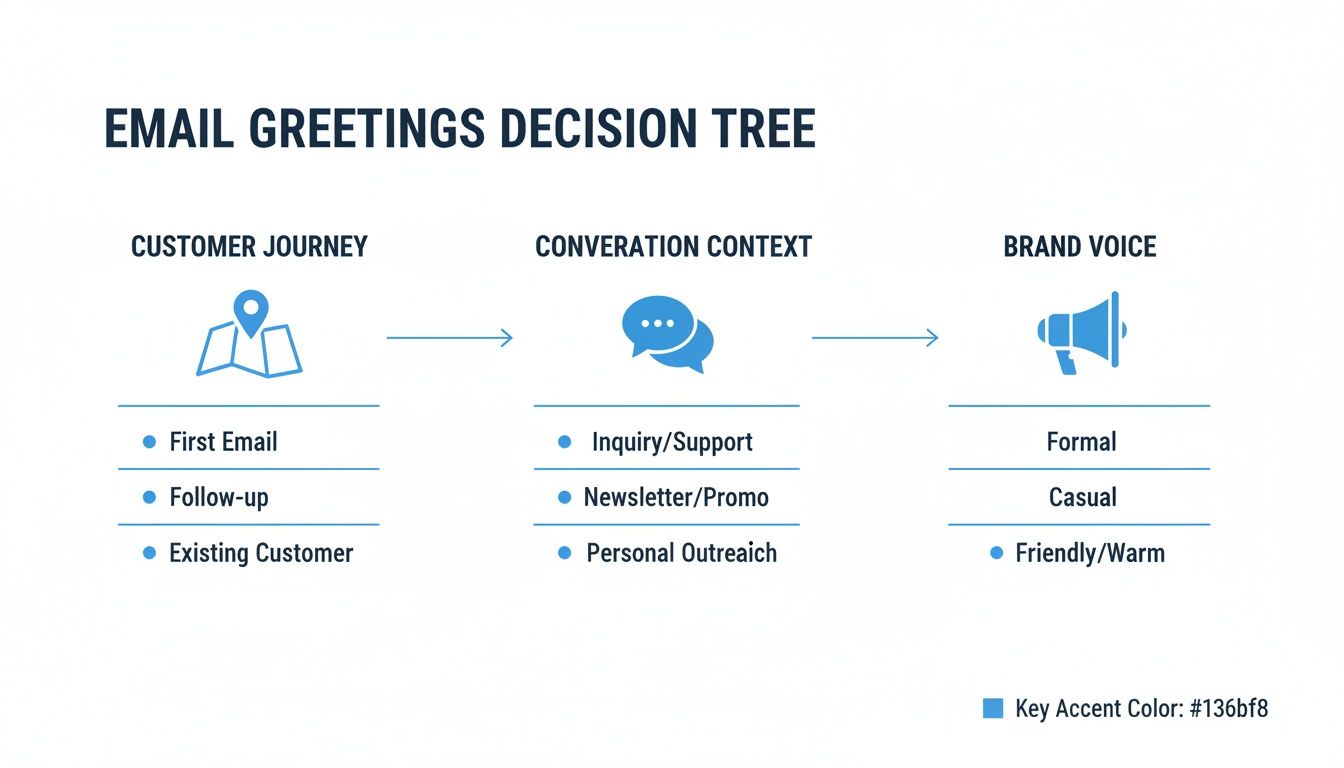
As you can see, the right salutation sits at the intersection of the customer's journey, the specific conversation, and your established brand voice.
Creating Clear Guidelines for Your Team
Once you’ve defined your approach, the next step is to get it down on paper. Create clear, simple guidelines for your support team and make sure your automation tools are configured to match. This is how you ensure every single email opening consistently reinforces who you are as a brand.
Here are a few common scenarios to show you how brand voice dictates the greeting:
- B2B Inquiry: A potential wholesale partner reaches out. A professional yet modern greeting like “Hello [First Name],” strikes a great balance for most brands, showing respect without being stuffy.
- Welcome Sequence: A brand new subscriber joins your list. A warm and friendly “Hi [First Name],” is a safe and incredibly effective way to start the relationship on the right foot.
- Customer Complaint: An upset customer needs help. An empathetic and slightly more formal “Dear [First Name],” can show you’re taking their issue seriously and treating it with care.
If you want to go deeper, this resource on the best email salutations for every occasion is fantastic. It offers a ton of options you can adapt to make sure your brand's voice is conveyed perfectly.
Your salutation is a micro-moment that has a macro impact on brand perception. Consistency across all channels—from marketing blasts to one-on-one support—is what builds a strong, recognizable, and trusted brand identity.
By establishing these rules, you empower both your team and your tools to communicate with one cohesive voice. This ensures that whether a customer is getting a shipping notification or asking a tough question, they always feel like they’re talking to your brand.
Making Automated Emails Feel Genuinely Personal
Automation is the engine that keeps your e-commerce store running, but it should never make your customers feel like they're just another number. Every automated email—from an order confirmation to a shipping update—is a real chance to build your brand and make a genuine connection.
The secret? Turning these purely transactional messages into positive, personal touchpoints. It all starts with how you address the person on the other end. Instead of a cold, robotic alert, you can create a moment that feels human and reassuring. This just takes a bit of work to connect your e-commerce platform's data directly to your email system.
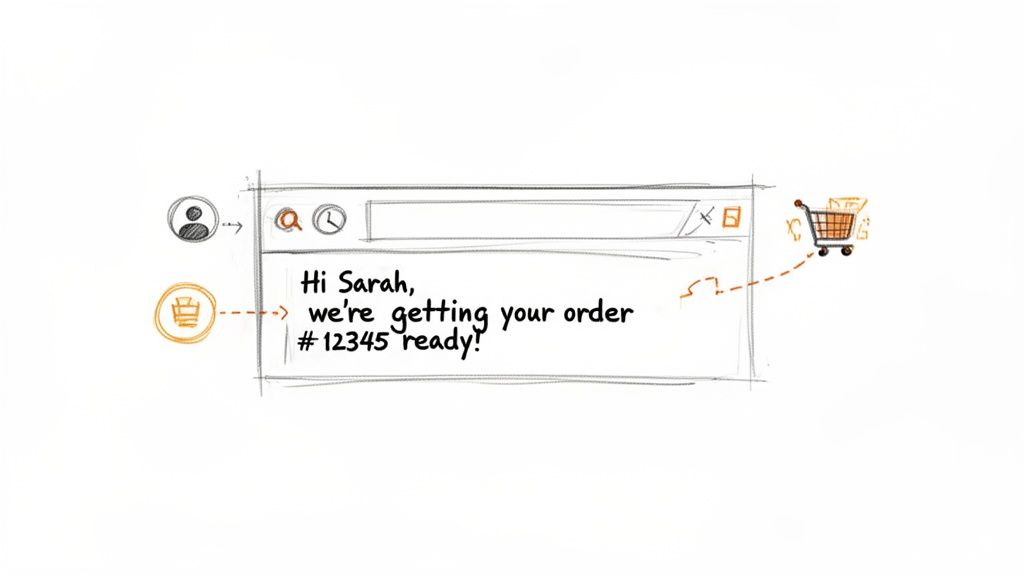
From Generic Alerts To Brand Moments
Just think about the difference between these two order confirmations. Which one feels better to receive?
- Generic: "Your order has been received."
- Personalized: "Hi Sarah, we're already getting your new gear ready! Thanks for your order, #[Order Number]."
The second one does so much more than just confirm a transaction. Using the customer’s first name creates an immediate sense of familiarity and care. That simple shift turns a functional message into a brand-building moment, making the customer feel seen and valued. This is a core idea behind effective e-commerce marketing automation.
Using Customer Data for a Personal Touch
The key to making automated emails feel personal is simply using the data you already have. By syncing customer information from your Shopify store, you can craft dynamic greetings that go far beyond just a first name.
You can pull in data points like:
- First Name: This is the most common and effective starting point. A simple "Hi [FirstName]," is almost always better than a generic opening.
- Order History: Acknowledge their loyalty. For a repeat customer, you could try something like, "Welcome back, David! We're excited to get your next order started."
- Loyalty Status: Make your best customers feel special. An automated greeting like, "Hi Maria, as a VIP member, your order is being prioritized," builds incredible goodwill.
The sheer volume of email flying around makes this crucial. With forecasts suggesting daily email traffic will hit nearly 400 billion by 2025, standing out is harder than ever. As automated systems send more of these messages, that first line—how you address the recipient—becomes one of the only humanizing elements left.
The goal isn't just to automate; it's to create personal connections at scale. Using data to customize your greetings is the most direct way to show customers that a real brand is behind the email, not just a machine.
For a deeper dive into making your automated emails feel less, well, automated, this guide to email automation and recurring emails is a great starting point. It provides a solid foundation for setting up systems that send the right message at the right time.
When you treat every automated message as a chance to reinforce your brand's human side, you build trust and start turning one-time buyers into lifelong fans. That small detail in how you address an email really does make a world of difference.
Navigating Tricky Situations and Common Mistakes
Even the most seasoned customer support teams run into conversations that are just plain tricky. Knowing how to open an email during a sensitive or awkward moment can be the difference between a customer who’s fuming and one who feels heard and valued. These are the moments where your team’s training and clear guidelines really prove their worth.
Probably the most common hurdle we all face is not having a customer’s name. It’s so tempting to lean on old-school, stuffy greetings, but something like "To Whom It May Concern" is almost always a mistake. It’s impersonal, feels like a form letter from a hundred years ago, and instantly puts a wall between you and the customer.
What to Do When You Don't Have a Name
When a customer's name is nowhere to be found, you still have plenty of strong, brand-safe ways to say hello. The goal is to keep things warm and professional without sounding like you've been replaced by a robot.
Here are a few options that work great in the real world:
- Greetings from [Your Brand Name] This one is friendly, keeps your brand front and center, and fits just about any situation.
- Hello there, A casual and approachable opening that feels much more human than a generic salutation.
- Hi, and thanks for reaching out, This gets straight to the point while still kicking things off with a helpful, positive vibe.
The trick is to acknowledge the person on the other end without needing their specific name. This simple shift in language helps you maintain that personal connection you’ve worked so hard to build.
Adjusting Your Tone for Complaints
When a customer is reaching out with a complaint, the stakes are suddenly much higher. Your very first words have to show you're taking their problem seriously. Even if your brand voice is typically playful or casual, this is the time to dial up the professionalism and empathy.
Using a slightly more formal "Dear [First Name]," can be incredibly effective here. The word "Dear" carries a sense of respect and care that can help de-escalate a tense situation from the get-go. It shows the customer they aren't just another ticket number; they're an individual whose problem genuinely matters. For a deeper dive into getting the tone just right, you can explore these fantastic email etiquette samples.
Even when things go wrong, a thoughtful and appropriate greeting reinforces your commitment to the customer. It’s a small detail that demonstrates professionalism and helps turn a negative experience into an opportunity to strengthen the relationship.
Common Email Addressing Mistakes and How to Fix Them
We've all been there—a simple slip-up in an email greeting can undermine all your efforts to build trust. But some mistakes are more common and more damaging than others. Getting too casual in a serious situation or, the classic, misspelling a name are two of the biggest offenders.
To keep your team sharp, here’s a quick guide to some common blunders and how to course-correct.
| Common Mistake | Why It's a Problem | Better Alternative |
|---|---|---|
| Misspelling a Name | It screams carelessness and instantly makes the customer feel unimportant. It’s the email equivalent of a limp handshake. | Always double-check the name from past emails or their account details. It takes two seconds and makes all the difference. |
| Using "Hey," for a Complaint | This is way too casual and can come across as dismissive. It minimizes their frustration before you’ve even heard them out. | A thoughtful "Dear [First Name]," shows you're treating the issue with the gravity it deserves and signals you're ready to help. |
| Defaulting to "Hi Sir/Madam" | This is just outdated and clunky. It's overly formal, and guessing someone's gender is a risky, alienating game. | "Hello [Full Name]," or a simple "Hi [First Name]," is safer, more modern, and far more inclusive. |
By preparing your team to handle these tricky spots with grace, you ensure every single interaction—even the difficult ones—reinforces your brand's commitment to outstanding service.
Optimizing Greetings for Mobile-First Audiences
Let's face it: most of your customers are reading your emails on their phones. On that small screen, they only see three things before deciding to open or delete: the sender, the subject line, and the first few words of the email. That preview text is prime real estate, and your greeting often takes up the entire space.
A long, clunky salutation like "Dear Valued Customer," can eat up the whole preview pane. It effectively kills your open rate before the customer even gets a hint of what's inside. Optimizing for mobile means making those first few words work for you. It's about respecting your customer's time and delivering clarity right in the palm of their hand.
Crafting a High-Impact Mobile Greeting
The strategy is simple: be concise and get straight to the point. Every single character matters when you only have a tiny window to grab someone's attention. Your goal is a greeting that feels personal but is brief enough to let the actual purpose of the email shine through in the preview.
This mobile-first thinking doesn't just help with opens; it often leads to faster customer responses because the value is obvious from the very beginning.
Here are a few ways to put this into practice:
- Lead with "Hi [Name],": This is almost always the perfect balance of friendly and direct. It’s short, personal, and leaves plenty of room for the email's key message to appear right beside it in the preview.
- Get Straight to the Value: Don't waste a word. Follow the greeting immediately with the most important information. "Hi Sarah, your order has shipped!" is infinitely more effective than a long-winded opening that pushes that crucial update out of view.
- Test Your Previews: Always use a tool to see how your emails look on different mobile devices. What seems fine on your desktop might get awkwardly cut off on a phone, completely butchering your message.
The data backs this up, too. By 2025, mobile open rates for email are expected to hit the 60–80% range globally. Most people only see the first 40–60 characters of preview text. If that preview starts with a generic, clumsy address, it can tank your engagement in a channel where average open rates are already hovering around 30–33%. You can dig deeper into these email marketing trends and see what they mean for your strategy.
The Real-World Impact on Open Rates
Let’s look at two versions of a back-in-stock notification to see how this plays out in the wild.
Before (Not Optimized for Mobile):
Preview Text: "Dear loyal customer, we are writing to inform you that the product you were interested in is..."
After (Optimized for Mobile):
Preview Text: "Hi Alex, the wait is over! The Classic Leather Tote is back in stock..."
Which one are you more likely to open? The second one, hands down. It's personal, it builds excitement, and it immediately tells the customer what they want to know. This proves that learning how to address an email for a mobile audience isn't just about good manners—it’s a critical part of modern e-commerce strategy.
Answering Your Trickiest Email Etiquette Questions
Even with the best templates, you'll eventually run into those tricky situations that make you pause and second-guess your greeting. We get these questions all the time from store owners and support managers, so let's clear up a few of the most common ones.
How Should You Address an Email to a Group?
When you’re writing to more than one person, ditch the generic "Hi all." It feels a bit lazy and impersonal. The best approach really depends on who you're talking to.
If it's an internal message to your own people, "Hi team" or "Hello everyone" is perfect. For a big customer announcement, something like "Greetings from [Your Brand Name]" strikes a nice balance between professional and welcoming. And if you're emailing a small, specific group, take a moment to list their names—"Hi Sarah, Mike, and Jen,"—it shows you’re talking to them, not just at them.
Is It Okay to Use Emojis in a Greeting?
This really comes down to your brand voice and the context of the email. If you're a fun, modern DTC brand, a little wave emoji in a marketing email ("Hey [Name] 👋") can feel totally on-brand and friendly. It adds a human touch that can make you stand out.
But when things get serious, like handling a customer complaint or a formal B2B conversation, emojis are a no-go. They can easily come across as unprofessional or make it seem like you aren't taking the issue seriously.
Pro Tip: My rule of thumb is simple: when in doubt, leave it out. It's always a good idea to create a clear style guide for your team that spells out when and where emojis are appropriate.
What If You Are Unsure of Someone's Gender?
This is a big one, and getting it right is non-negotiable. If you're not 100% sure about someone's gender or their preferred title, stick to gender-neutral greetings. It’s the safest and most respectful way forward.
Using their full name, as in "Dear Alex Johnson,", is always a professional and safe bet. A simple "Hello [First Name]" is also perfectly fine and inclusive for almost any business context. Whatever you do, never guess at titles like "Mr.," "Ms.," or "Mrs."
Should Your Closing Match Your Opening?
Yes, absolutely. Think of your email as a single, complete conversation. The tone you start with should be the tone you end with. It just feels more natural and polished.
So, if you open with a formal "Dear Mr. Smith," you’ll want to close with something equally formal, like "Sincerely," or "Best regards,". On the flip side, if you kicked things off with a casual "Hey [Name]," a friendly sign-off like "Cheers," or "Thanks!" keeps the vibe consistent.
Ready to stop guessing and start delighting customers with every email? MAILO AI uses your brand voice to instantly generate perfect, personalized replies for any situation. Start your free trial and see how it works.