

Picture this: you have an expert on your team who works 24/7, never sleeps, and knows exactly when to send the perfect message to every single customer. That’s the power of ecommerce marketing automation. It’s not about sending out cold, robotic spam; it’s about using smart software to handle the repetitive, time-consuming marketing tasks, freeing you up to focus on growing your business.
What Is Ecommerce Marketing Automation Really?
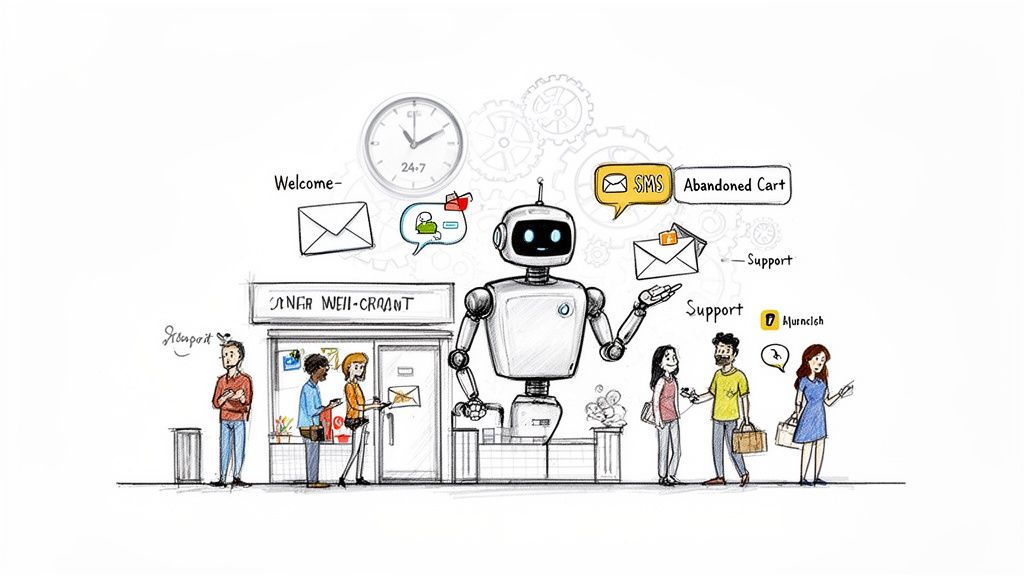
Think of marketing automation as putting your customer engagement on a very smart autopilot. Instead of you or your team having to manually send every welcome email, abandoned cart reminder, or post-purchase thank you, you set up intelligent systems—often called "workflows"—that do the heavy lifting for you.
These workflows spring into action based on specific things your customers do. For instance, when someone new signs up for your newsletter, a "welcome series" automatically kicks off to introduce them to your brand. If a shopper leaves items in their cart without checking out, a "cart recovery" sequence gets triggered a few hours later. This system works around the clock to nurture leads, win back sales you might have lost, and build real customer relationships, all without you lifting a finger.
The True Impact On Your Business
At its core, automation gives you back your most precious resource: time. By letting the software handle routine communications, your team can stop drowning in repetitive tasks and start focusing on big-picture strategy—like new product development, creative brand campaigns, and digging into market trends.
But the real magic goes far beyond just saving a few hours. Good automation creates a remarkably consistent and personal shopping experience. Every customer gets messages that feel like they were written just for them, at exactly the right moment in their journey. This builds trust and keeps them coming back.
The numbers don't lie. A huge 80% of marketers report an increase in leads, and 77% see a jump in conversions after bringing automation into their toolkit. It's not uncommon for sales productivity to climb by 14.5% while marketing overhead actually goes down.
Here's a quick look at how things change when you make the switch.
Marketing Automation At a Glance
| Business Area | Manual Approach (The Hard Way) | Automated Approach (The Smart Way) |
|---|---|---|
| New Subscribers | Manually send a one-off welcome email (if you remember). | Instantly trigger a multi-part welcome series that builds brand loyalty. |
| Abandoned Carts | Hope the customer comes back on their own. | Automatically send a sequence of reminders, maybe with a small incentive. |
| Customer Support | Staff answers the same "Where is my order?" question 50 times a day. | An AI-powered system provides instant order status updates 24/7. |
| Post-Purchase | Send a generic order confirmation and move on. | Trigger follow-ups asking for a review, suggesting related products, or offering a future discount. |
| Segmentation | Blast the same email to your entire list and hope it sticks. | Send targeted campaigns based on purchase history, browsing behavior, and engagement. |
As you can see, the automated approach isn't just faster—it's smarter, more personal, and ultimately more effective at driving revenue.
Setting The Stage For Growth
Getting started with these systems doesn't have to be some overwhelming technical nightmare. A good first step is to simply identify the key moments in your customer journey where a timely, automated message could make the biggest difference. If you want to dig deeper into the core ideas, this comprehensive guide to ecommerce marketing automation is a fantastic resource.
The goal isn't just to automate tasks; it's to automate growth. By creating seamless, personalized journeys, you turn one-time buyers into loyal advocates for your brand.
A huge piece of this puzzle that often gets overlooked is customer support. Tools like MAILO AI can integrate directly with platforms like Shopify to automatically handle common support questions, such as "Where is my order?" This not only delights customers with instant answers but also closes the automation loop.
Curious about how AI fits into the bigger picture? Our guide on a strategic approach to AI for e-commerce offers some great insights. When you unify your marketing and support automation, you create a powerful engine for scalable, sustainable growth.
The Core Channels of Ecommerce Automation
Think of your marketing automation strategy not as a single tool, but as a team of specialists working together. Each channel has a distinct job to do, and when they coordinate their efforts, the results are powerful. To get this right, you need to understand the four key players on your team: Email, SMS, Onsite tools, and Ads.
Each one shines in different situations. By learning how to use them on their own and, more importantly, in harmony, you can create a smooth, connected experience that turns first-time visitors into loyal fans. Let's look at what each channel brings to the table.
Email: The Relationship Builder
Email is, without a doubt, the foundation of ecommerce marketing. It’s your primary channel for building real, lasting relationships with customers. You have the space to tell your brand story, explain the benefits of your products, and connect with people on a deeper level than a quick text or a social media ad ever could.
This is where automated "flows" or "series" really shine. While these automated messages are just a small slice of all the emails you'll send, their impact is massive. Believe it or not, research shows that while only 2% of emails sent are automated, they're responsible for a whopping 37% of all sales generated from email. The heavy hitters here are welcome series, abandoned cart reminders, and browse abandonment emails. You can dig deeper into these numbers in the 2025 Ecommerce Marketing Report.
SMS: The Urgent Messenger
If email is for building relationships, SMS is for getting an urgent message across right now. With open rates that can soar past 90%, text messages are your go-to for time-sensitive communication. They cut through the clutter of a crowded inbox and deliver a message with immediate impact.
SMS automation is perfect for things like:
- Flash Sales: Announcing a surprise deal that customers need to act on quickly.
- Shipping Updates: Giving customers that "your order is on its way!" dopamine hit.
- Low Stock Alerts: Creating a little friendly urgency for in-demand products.
The secret to good SMS marketing is to use it sparingly. It's for high-value, time-critical moments. If you start sending daily newsletters via text, you'll see your unsubscribe list grow fast.
Onsite: The Interactive Guide
Onsite automation tools are all about engaging with shoppers while they're actively browsing your store. Think of them as your best digital sales associates—they’re there to greet visitors, answer questions, and gently guide them toward a purchase.
This channel is all about striking while the iron is hot. You’re interacting with people at the peak of their interest, right on your website.
A few common onsite tools include:
- Pop-ups: Great for capturing email signups, often by offering a first-purchase discount or a fun "spin-to-win" game.
- Personalized Banners: These can show a unique welcome message or a special offer based on where a visitor came from or what they've looked at before.
- Live Chatbots: They can instantly answer common questions about shipping or returns, removing friction and helping hesitant shoppers feel more confident.
Ads: The Customer Retriever
Finally, think of your automated ads as your retrieval squad. Their main job is to bring people back to your store, whether they're a first-time visitor who left or a previous customer you haven't seen in a while. This is mostly done through retargeting—showing specific ads to people who've already interacted with you.
For example, if someone looked at a particular pair of sneakers on your site but left without buying, you can set up an automation to show them an ad for those exact sneakers on their social media feed. It’s a simple, powerful way to stay on their radar and give them a gentle nudge to come back and finish what they started. When you connect your ad platforms to your store's data, these ads feel helpful and relevant, not creepy.
Automation Playbooks That Actually Drive Sales
Alright, so you understand the different channels you can use for marketing automation. Now for the fun part: putting that knowledge into action. Let’s talk about the specific, high-impact workflows—or "playbooks"—you can set up today. These are the automated sequences that quietly work in the background to build relationships, rescue sales, and grow your business.
Think of each playbook as a specific strategy built to hit one clear goal. By mixing the right triggers, timing, and messaging, you can guide customers on their journey in a way that feels genuinely personal and helpful, not like they're talking to a robot.
This flowchart gives you a great visual of how these different channels can—and should—work together.
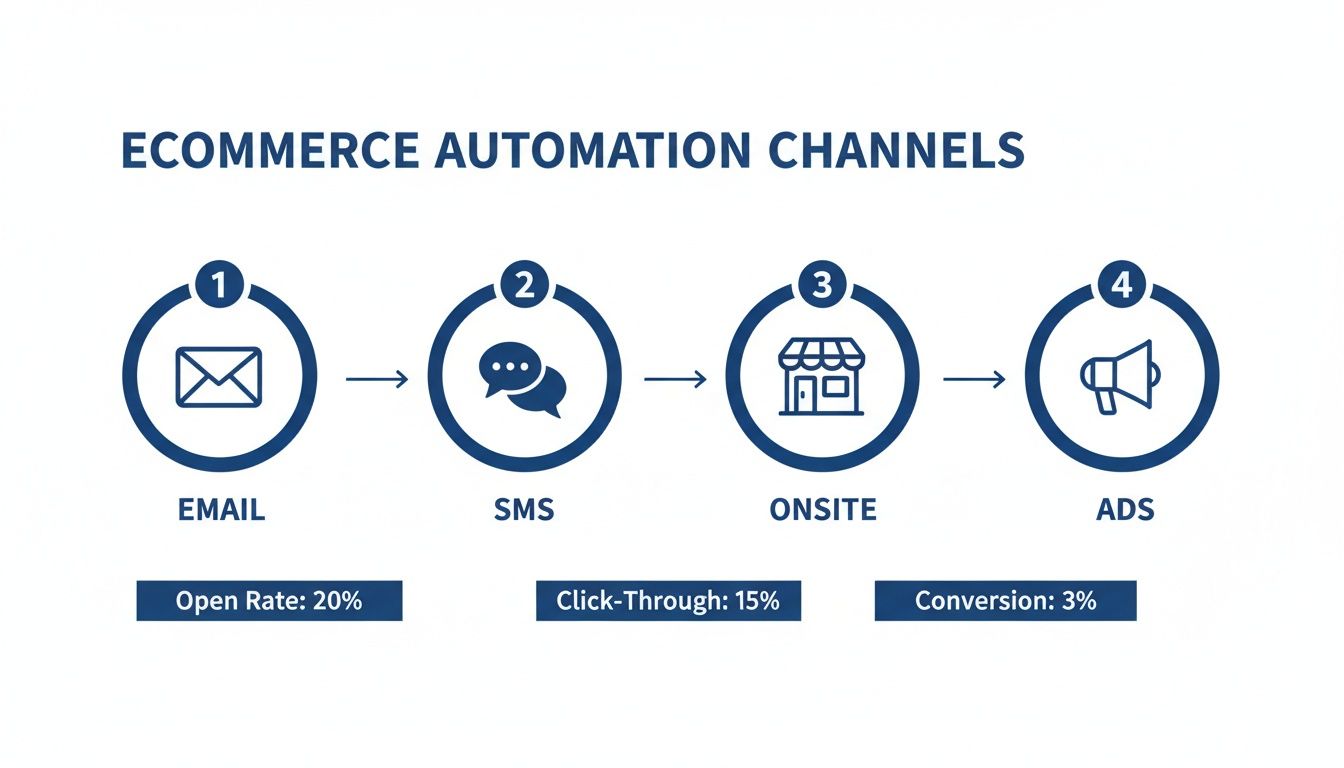
As you can see, email, SMS, what happens on your site, and even your ads can all be woven together to create one seamless customer experience that gets results.
The All-Important Welcome Series
You only get one chance to make a first impression, and a Welcome Series is yours. It’s how you greet new subscribers, share your brand’s story, and nudge that initial flicker of interest into a first purchase. Honestly, this is probably the most crucial automation you'll ever build.
Trigger: Someone new subscribes to your newsletter or creates an account on your store.
Goal: Turn that fresh subscriber into a first-time customer and start building real brand loyalty.
A classic welcome flow usually unfolds like this:
- Email 1 (Right away): A warm "hello," confirming they’ve subscribed. This is your chance to briefly introduce what your brand is all about. Tossing in a small discount, like 10-15% off their first order, gives them immediate value.
- Email 2 (A day or two later): Show off your best-sellers or share some glowing customer reviews. This is all about social proof—it helps new folks see what everyone else already loves about you.
- Email 3 (After 3-4 days): Go beyond just selling. Share some genuinely useful content, like a guide on how to use your products or a behind-the-scenes look at your company. This builds your authority and deepens the connection.
The Revenue-Saving Abandoned Cart Flow
Get this: nearly 70% of all online shopping carts are abandoned. People get distracted, have second thoughts, or just run out of time. An Abandoned Cart Flow is your automated safety net, designed to bring these super-interested shoppers back to seal the deal.
Trigger: A known user adds something to their cart but leaves without buying. You'll want to set a time limit, like an hour or two.
Goal: Claw back what would have been lost sales and chip away at your cart abandonment rate.
Here's how a powerful recovery sequence works:
- Message 1 (1-4 hours after they leave): Send a gentle nudge. An email or an SMS simply asking, "Did you forget something?" works wonders. Always include pictures of the items they left behind to remind them.
- Message 2 (24 hours later): Time to add a bit of urgency or handle common objections. You could mention that popular items sell out fast or remind them about your hassle-free returns policy.
- Message 3 (48-72 hours later): If they still haven't come back, it’s time for a compelling offer. A small discount or free shipping is often the final push they need to click "buy."
An effective abandoned cart flow is one of the fastest ways to see a direct ROI from your marketing automation. You're talking to customers who are literally one step away from giving you money.
The Loyalty-Building Post-Purchase Follow-Up
The relationship doesn't end when the credit card is charged. In fact, the time right after a purchase is a golden opportunity to build loyalty, get valuable feedback, and plant the seed for the next sale.
Trigger: A customer successfully places an order.
Goal: Boost customer lifetime value by encouraging reviews and driving repeat business.
This flow keeps the conversation going:
- Message 1 (Immediately after purchase): A simple order confirmation and a genuine "thank you."
- Message 2 (After the item is delivered): Follow up and ask for a product review. This user-generated content is pure gold for building trust with future shoppers.
- Message 3 (2-3 weeks later): Now’s the time for a smart cross-sell or upsell. Based on what they bought, suggest a related product they might love.
The Re-Engagement Win-Back Campaign
It happens. Over time, some customers just drift away. A Win-Back Campaign is your focused effort to reconnect with these "lapsed" customers and remind them why they shopped with you in the first place.
Trigger: A customer hasn't purchased from you in a while—say, 90 or 180 days.
Goal: Wake up those dormant accounts and stop your email list from shrinking.
A simple win-back sequence can do the trick:
- Email 1: A friendly "We miss you!" message. Remind them what’s great about your brand and show off some exciting new products.
- Email 2: Hit them with a strong incentive. A significant discount can be very persuasive.
- Email 3: Make one last offer or send a quick survey asking for feedback on why they haven't been back.
By putting these core playbooks in place, you’re building an automated engine that consistently drives sales and makes your customer experience better. To dig deeper into optimizing these flows, check out our insights on achieving sustained conversion growth.
Putting Automation into Action on Your Shopify Store
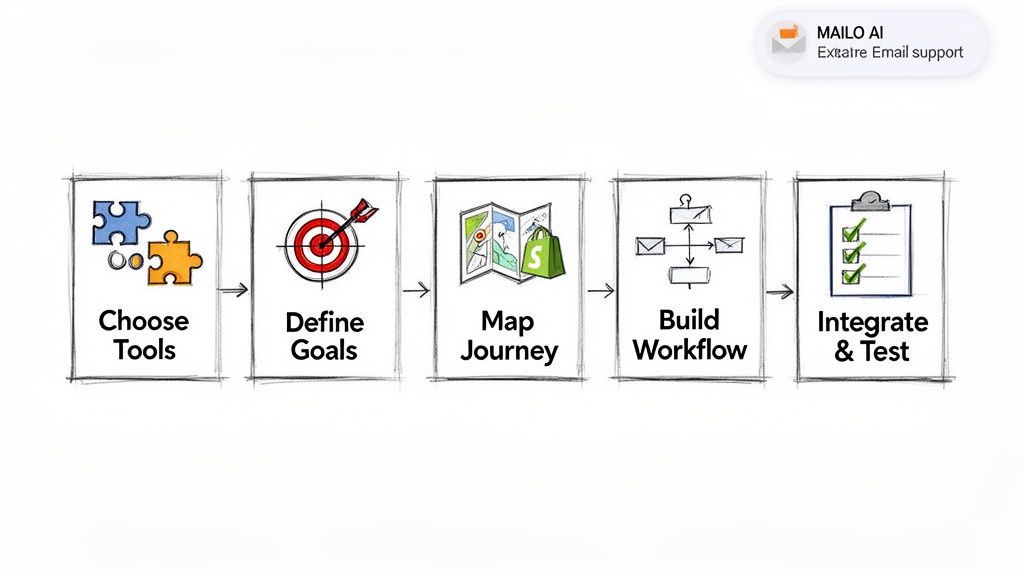
Alright, let's move from theory to reality. Getting marketing automation running on your Shopify store isn't some overwhelming technical project. It's really just a series of smart, manageable steps.
Think of it less like trying to build a car engine from scratch and more like adding some powerful, pre-built upgrades that just click into place. The whole process is designed to build on itself, starting with a clear idea of what you want and ending with a system that works for you around the clock.
Let's walk through exactly how to get it done.
Step 1: Define Your Goals
Before you even think about software, you have to know what you're trying to accomplish. A vague goal like "increase sales" is useless here. Your objectives need to be specific, measurable, and tied to a real business outcome.
These goals become your North Star, guiding every decision you make down the line. Good examples look like this:
- Reduce our cart abandonment rate by 20% in the next three months.
- Boost the 60-day repeat purchase rate from first-time customers by 15%.
- Generate an extra $5,000 in monthly revenue directly from our welcome email series.
Having clear targets like these helps you prioritize which automations to build first. My advice? Start with the one that solves your biggest headache or offers the most significant upside.
Step 2: Map The Customer Journey
Now it’s time to see your store through your customers' eyes. Sketch out every touchpoint they have with your brand, from the first time they land on your site to their tenth order and beyond. Where do they get stuck? Where do they lose interest and drop off?
This exercise is where you’ll find your golden opportunities for automation. You might discover that most first-time buyers never come back, which tells you a post-purchase follow-up sequence is critical. Or maybe you see tons of people viewing a specific product but never adding it to their cart—a perfect opening for a browse abandonment flow.
Step 3: Choose Your Tools
With your goals set and your journey mapped, you can finally start looking at platforms. For any Shopify store, the number one requirement is seamless integration. The tool you pick must sync effortlessly with your store’s data—customers, orders, and products—without you needing to build clunky workarounds.
Look for a platform that can handle multiple channels like email and SMS in one place. You should also consider specialized tools that excel at one specific part of the experience. For example, a platform like MAILO AI can integrate with Shopify to automate your customer support emails. It uses real order data to give customers instant, accurate answers to common questions, which is a huge piece of the automation puzzle.
The right tool doesn't just automate tasks; it unlocks new possibilities. It should feel like a natural extension of your Shopify dashboard, making complex actions feel simple.
Step 4: Build Your First Workflow
This is important: don't try to build everything at once. Pick one high-impact workflow based on the goals you defined in the first step. The welcome series is almost always the best place to start. It engages every single new subscriber and has a proven track record of driving that crucial first purchase.
Focus on the core components:
- Set a clear trigger: e.g., "When a customer subscribes to the newsletter."
- Outline the sequence: A simple three-email series is a great starting point.
- Write compelling copy: Make sure it sounds like your brand and gives them a reason to be excited.
By building one workflow from start to finish, you’ll gain the confidence and know-how to tackle more advanced automations later. It's the foundational skill you need to master your ecommerce marketing automation strategy.
Step 5: Integrate and Test Thoroughly
Once your workflow is built, it's time to connect your tools and test everything like crazy. Send test emails to yourself. Go through the checkout process and abandon a cart to make sure the trigger fires correctly. Double-check that personalization tags like {{ first_name }} are pulling in the right information.
Never, ever launch an automation without confirming it works exactly as you planned. A broken link or a messed-up name can ruin the very customer experience you’re trying to improve. Once you’ve worked out all the kinks, you can confidently set your automation live and watch it go to work. For those wanting to tackle the support side of things, our guide on how to automate customer service offers a much deeper dive into that specific area.
How to Measure Your Automation Success
Getting your automation workflows up and running is really just the first step. The real magic happens when you start digging into the data to see what’s working, what’s falling flat, and where you can make improvements. If you're not tracking your results, you're essentially flying blind, guessing at what your customers want.
This is where Key Performance Indicators (KPIs) become your best friend. We're not talking about vanity metrics like email opens, either. We need to zero in on the numbers that actually move the needle for your business. Tracking the right KPIs is how you turn your ecommerce marketing automation from a cool tech tool into a powerful, predictable revenue machine.
Core KPIs for Marketing Automation
To get a clear picture of what's going on, you have to look at more than just one number. A truly successful automation strategy leaves its fingerprints all over your business, from how well a single email performs to the long-term health of your customer relationships.
Here are the must-track KPIs to keep on your dashboard:
-
Conversion Rate Per Workflow: This is the big one. It tells you the exact percentage of people who enter a specific automation—like a cart abandonment series—and go on to complete a purchase. A high conversion rate is a clear sign your timing and messaging are hitting the mark.
-
Revenue Per Recipient (RPR): This simple but powerful metric cuts right to the chase. Just take the total revenue from a campaign and divide it by the number of people you sent it to. It's a fantastic way to compare the dollar-for-dollar impact of different flows, like seeing if your welcome series brings in more cash than your win-back campaigns.
-
Average Order Value (AOV) from Automation: Are your automations encouraging customers to spend more? By isolating the AOV from orders that came through your workflows, you can see if those automated upsells, cross-sells, and product recommendations are actually working.
Watching these metrics closely helps you spot problems before they get out of hand. For instance, if your welcome series has a sluggish conversion rate, it might be a hint that your introductory offer just isn't exciting enough to get people to bite.
Broader Business Impact Metrics
Beyond the performance of individual campaigns, your automation should be making a real, tangible impact on your business's bottom line. There’s a reason the ecommerce marketing automation market is exploding—it gets results. The US market alone is expected to reach $13.32 billion by 2030, and high-growth brands are over 70% more likely to be using these tools.
To see that big-picture impact, keep a close eye on these metrics:
-
Customer Lifetime Value (CLV) Growth: Great automation is all about building relationships that last. When you see a rising CLV among customers who've engaged with your automated messages, it's a powerful signal that your strategy is creating loyal, repeat buyers.
-
List Growth Rate: Your pop-ups and welcome offers should be a consistent source of new subscribers. A healthy, steady list growth rate means you always have a fresh, engaged audience to talk to.
Remember, the goal here isn't just to send more emails. It's to build a more profitable, resilient business, and your KPIs should tell you if you're succeeding.
Measuring Support Automation Success
Finally, don't forget about the operational wins. Automation isn't just for marketing; it can free up a ton of time for your team.
For example, platforms like MAILO AI offer detailed analytics on support metrics. You can see precisely how many hours your team saves by letting the AI handle common customer questions. This gives you a complete view of your return on investment. Understanding this is key to maximizing your marketing automation ROI and proving its immense value to your entire organization.
Common Automation Pitfalls to Avoid
Bringing marketing automation into your ecommerce store is a huge leap forward, but it's not a silver bullet. If you’re not careful, it’s easy to stumble into common traps that can turn a powerful growth tool into a source of customer frustration.
The biggest mistake? Automating so much that you lose your brand's personality. When every message sounds like a robot wrote it, you're eroding the very human connection that builds lasting loyalty. Another classic blunder is poor segmentation, which results in blasting generic, one-size-fits-all offers to everyone. It's the digital version of junk mail, and nobody likes junk mail.
These aren't just small mistakes; they can actively damage your reputation and drive customers away for good.
Losing the Human Touch
One of the sneakiest traps is letting automation make your brand feel cold and impersonal. Your customers are smart—they can spot a generic, canned message from a mile away, and it instantly makes their experience feel cheap.
The fix is simple: infuse your unique brand voice into every single automated template. Never settle for the default copy. Use the same tone, humor, and language that your customers already know and love. For customer support, you can even use tools like MAILO AI that offer a "human-in-the-loop" system. This lets your team review and approve AI-generated replies before they go out, making sure every interaction feels genuine.
Setting It and Forgetting It
Automation is here to save you time, not to be ignored completely. The "set it and forget it" mindset is a fast track to stale, ineffective campaigns. The market is always changing, customer tastes evolve, and what worked six months ago might be a total flop today.
Automation thrives on optimization. Think of your workflows as living, breathing processes, not static instructions. You need to constantly review their performance, test new subject lines, adjust your timing, and update your offers to keep everything fresh and relevant.
Neglecting the Mobile Experience
More than half of all ecommerce traffic now comes from mobile devices. Sending emails or texts that aren't built for a smaller screen is a massive, unforced error. An email that looks great on a desktop but is a jumbled mess on a phone will be deleted without a second thought.
Here’s a quick checklist to keep you on the right path:
- Test Everything: Always send test versions of your emails and SMS messages to both Android and iOS devices before they go live.
- Keep It Concise: Use short paragraphs, clear headings, and a single, obvious call-to-action. Don't make people squint and scroll.
- Optimize for Speed: Compress any images in your emails so they load quickly, even on a weak mobile connection.
By steering clear of these common pitfalls, your ecommerce marketing automation strategy can finally do what it's supposed to: build stronger customer relationships and drive real, sustainable growth for your store.
Frequently Asked Questions
Jumping into marketing automation always brings up a few questions. It’s a powerful strategy, but it’s smart to get a feel for the practical side of things before you commit. Let's walk through some of the most common things people ask.
How Much Does Marketing Automation Cost?
There's no one-size-fits-all price tag. You'll find tools with affordable monthly plans perfect for small businesses, while others offer custom pricing for large-scale operations. Most platforms base their fees on how many contacts you have or the number of messages you're sending out.
But honestly, the sticker price is only part of the equation. What really matters is your return on investment (ROI). Think about it: a solid abandoned cart workflow that claws back just a couple of sales each day can easily pay for the software itself, and then some.
The best way to think about automation is not as a cost, but as an investment in a machine that generates revenue. You can start small, prove it works with one high-impact workflow, and then build from there as you grow.
Will Automation Make My Brand Feel Robotic?
That's a common worry, but the answer is a definite no—as long as you set it up thoughtfully. The goal of automation isn't to erase your brand's personality; it's to deliver that personality at the exact right moment, every single time. It all comes down to smart segmentation and personalization.
Instead of blasting the same generic message to your entire list, you can send specific offers based on what a customer has bought or looked at on your site. When you write your automated emails and texts in your brand’s unique voice, every touchpoint feels genuine and human, not like it came from a machine.
How Soon Can I Expect to See Results?
This really depends on the type of automation you're running. Some workflows give you an almost instant win. For example, an abandoned cart flow can start recovering sales within hours of you turning it on. You'll see a direct, measurable bump in revenue almost immediately.
Other strategies are more of a long game. Things like a welcome series or a post-purchase follow-up are designed to build a relationship with your customers. Their value shows up over time by boosting customer lifetime value and creating loyal fans. The trick is to have a mix of quick wins and foundational automations that build for the future.
What Is the Difference Between Marketing and Support Automation?
They might seem similar since they both use automated systems, but they solve completely different problems.
Marketing automation is all about driving sales and engagement. It uses promotional messages—like welcome emails or abandoned cart reminders—to nudge potential customers closer to making a purchase.
Support automation, on the other hand, is focused on resolving customer issues efficiently. Its main job is to give quick, accurate answers to common questions like, "Where's my order?" The two actually work together beautifully. A successful marketing campaign will likely lead to more sales, which means more support questions. A tool like MAILO AI can jump in and handle those inquiries instantly, keeping the entire customer experience smooth from browsing to unboxing.
Ready to see how AI-powered support automation can complete your customer journey? MAILO AI integrates directly with Shopify to provide instant, personalized answers to your customers' most common questions, freeing up your team and boosting satisfaction. Start your free trial today.