

That constant stream of customer emails? It's more than just an annoyance—it's actively costing you sales and pushing good customers to your competitors.
Every minute a shopper waits for an answer about their order, a return, or a simple product question is a minute they might click away for good. In fact, slow replies are a direct cause of 20-30% of cart abandonment—all because of questions left hanging.
Why Your Shopify Inbox Is a Ticking Time Bomb
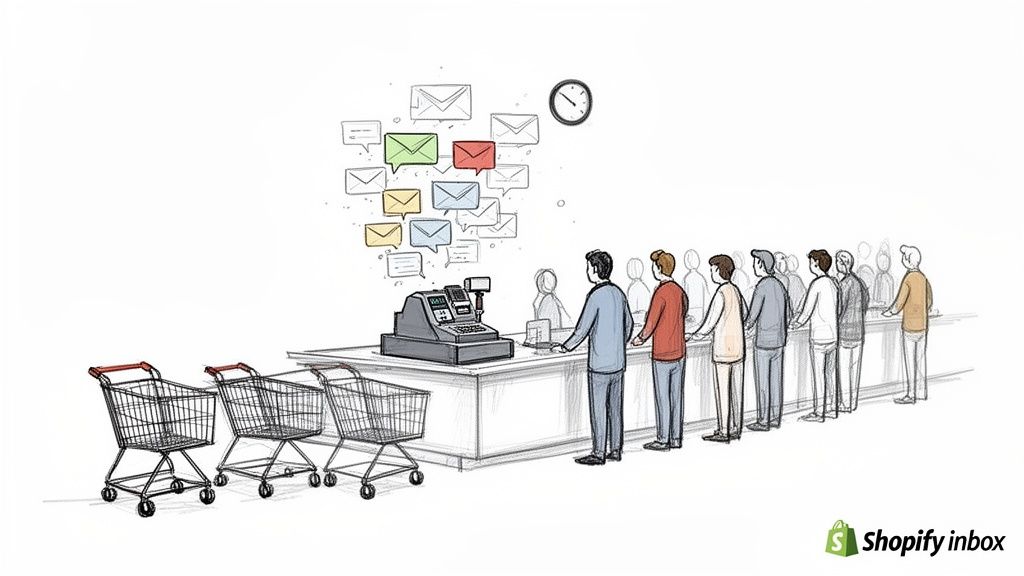
Think about trying to run a busy physical store with just one, completely disorganized cash register. You've got people lining up with questions, others trying to make returns, and a few ready to buy—but there's no system, no priority, no flow. That’s exactly what’s happening inside a standard Shopify inbox. It very quickly becomes a bottleneck where urgent problems get buried under a mountain of minor requests.
This mess isn't just stressful for your team; it hits your bottom line hard. A potential buyer asking about shipping times might just give up and head over to a competitor. A loyal customer with a simple return issue could get so frustrated they never shop with you again. Each unanswered or delayed email is a lost sale or a damaged relationship.
The True Cost of Email Overload
The problem is only getting bigger. The market for email management software is booming, projected to jump from $4.59 billion in 2024 to $5.08 billion in 2025. This growth is happening for one simple reason: businesses are drowning in communication.
AI-powered tools have become a lifeline, capable of cutting manual support workloads by a massive 40-50% by intelligently sorting messages and sending instant replies. This is where specialized software changes the game, transforming your chaotic inbox from a liability into a command center for your entire customer experience.
Think of it like hiring a full-time, expert support team that works 24/7. This system automatically sorts inquiries, gives instant answers to common questions like "Where is my order?", and flags the truly critical issues that need a human touch.
To see the difference in action, let's compare the old way of doing things with a modern approach.
Manual Inbox vs Email Management Software
| Feature | Manual Email (e.g., Gmail/Outlook) | Email Management Software (e.g., Mailo AI) |
|---|---|---|
| Response Time | Slow; dependent on team availability. | Instant for common queries; faster for complex issues. |
| Organization | Basic folders and labels; requires manual sorting. | Automatic categorization and prioritization based on intent. |
| Personalization | Limited to manual lookups and templates. | Deeply personal replies using live Shopify order data. |
| Analytics | None. No insight into inquiry types or team performance. | Detailed dashboards on response times and common issues. |
| Scalability | Poor. More emails mean hiring more people. | High. Manages volume spikes without needing more staff. |
| Integration | Separate from your e-commerce platform. | Directly syncs with Shopify for order and customer info. |
As you can see, it's not just a minor upgrade. It's a fundamental shift in how you manage customer conversations.
From Bottleneck to Growth Engine
Instead of just being a "better inbox," an AI-powered solution like Mailo AI becomes an engine for customer retention. It flips customer service from a reactive cost center into a proactive tool for building loyalty and encouraging repeat business. Understanding the basics of EDM marketing, which is essentially the foundation of all email communication with customers, helps clarify why this is so important.
By delivering fast, accurate, and personalized support, you create an experience that makes customers want to come back. This is the key to scaling your Shopify store without letting customer service quality slip. By automating the repetitive tasks, you free up your team to focus on the high-value conversations that actually grow your business—a core idea behind the popular Inbox Zero method.
The Core Features That Actually Drive Growth
Good email management software doesn't just tidy up your inbox—it's the engine that powers your Shopify store's growth. Forget thinking of it as a digital filing cabinet. The right features don't just shave hours off your workday; they create genuinely better customer experiences, build rock-solid loyalty, and directly pump up your bottom line.
Let's dive into the four pillars that turn a chaotic support inbox into a streamlined, scalable growth machine. These are the make-or-break features that deliver real results, transforming customer service from a necessary expense into your most powerful asset.
AI-Powered Automation for Instant Answers
What's the most common question flooding your inbox? It's almost certainly, "Where is my order?" Answering this by hand is a soul-crushing time-suck. An agent has to drop everything, log into Shopify, hunt down the order, copy the tracking number, and then type out a reply. That five-minute task, repeated dozens of times a day, is a black hole for productivity.
This is exactly where AI-powered automation shines. Modern email tools can spot these common questions and fire back an accurate, helpful response instantly—no human needed.
- Before AI: A customer emails at 10 PM on a Friday. They get antsy all weekend waiting for someone to clock in Monday morning, find their order, and reply.
- After AI: The customer emails at 10 PM. Within seconds, the AI taps into live Shopify data, grabs the tracking info, and sends a personalized "it's on the way!" update.
This kind of immediate gratification is a huge win for the customer. More importantly, it frees up your team to focus their brainpower on the tricky, high-value problems that actually require a human touch.
Deep and Seamless Shopify Integration
Let's be clear: generic email tools just can't do this. They're completely disconnected from your store's most important data. Real email management software for e-commerce needs a deep, native integration with Shopify. Think of this connection as a live data bridge, giving the software a real-time view of everything it needs to know about a customer.
This seamless sync means the platform always has access to:
- Complete Order History: Every single purchase a customer has ever made.
- Live Shipping Status: Up-to-the-second tracking information.
- Customer Contact Details: Names, shipping addresses, and other key info.
Without this, your support tool is flying blind. With it, every automated response and every agent reply is backed by the latest, most accurate customer data.
Poor service is incredibly costly. Globally, businesses lose an estimated $1.6 trillion annually due to bad customer experiences, with email delays being a major factor in 37% of dissatisfaction cases. For Shopify merchants, the stakes are even higher, as nearly 69% of consumers will abandon a brand after just one negative interaction. Smart tools like MAILO AI address this by classifying emails to slash resolution times, preventing the kind of revenue leaks that drain direct-to-consumer brands. Explore more research on the impact of customer service on brand loyalty.
Personalization That Matches Your Brand Voice
Automation without personality is just… robotic. It can feel cold and off-putting, undermining the very brand you've worked so hard to build. That’s why sophisticated personalization isn't a "nice-to-have"—it's a must. The best software lets you train the AI on your team's past support conversations, teaching it to learn and perfectly mimic your unique brand voice.
Whether your tone is witty and casual or buttoned-up and professional, the AI can adopt it. This ensures every automated reply feels authentic and on-brand, building customer trust instead of breaking it. When you get this right, your customers won't even know they're talking to an AI. This has a direct impact on repeat business, a key function of good customer retention software.
Actionable Analytics and Performance Insights
You can't fix what you can't see. A truly robust email management platform gives you a command center—a dashboard with actionable analytics that show you the true health of your support operation. It goes way beyond surface-level stats to deliver real insights into what's working and where you're falling short.
These are the metrics that actually matter:
- Average Response Time: How fast are you getting back to people?
- Customer Satisfaction Scores (CSAT): Are your customers actually happy with the help they get?
- Most Common Inquiry Types: What are people asking about over and over? This can be a goldmine for spotting confusing product descriptions or unclear shipping policies.
- Team Performance: Track individual agent stats to find who needs a high-five and who might need a little coaching.
These insights let you make smart, data-driven decisions. You can continuously fine-tune your support strategy, smooth out bumps in the customer journey, and ultimately, drive more sales.
How To Choose The Right Software For Shopify
Picking the right email management software is a serious decision for your store's future, not just another app subscription. With so many options out there, it’s easy to get sidetracked by flashy features that don't actually solve the core challenges you face in e-commerce.
The real goal is finding a tool that genuinely helps you save time, build customer loyalty, and ultimately, drive more sales. It's about finding a partner for your support team, not just a fancier inbox.
The Shopify Integration Test
First things first: the most critical factor is how deeply the software integrates with Shopify. A generic tool that just plugs into your email account won't cut it. You need software that can pull real-time order history, live shipping data, and customer details directly from your store's backend.
When you're evaluating a tool, ask these make-or-break questions:
- Can an agent see a customer's entire order history without ever leaving the inbox?
- Does it automatically sync shipping status and tracking numbers to give instant "Where Is My Order?" (WISMO) replies?
- Can it use a customer's purchase data to create personalized responses or trigger specific automated workflows?
A tool like Mailo AI is built from the ground up for this. Its deep integration puts every piece of customer data at your fingertips, making both automated and human support faster and more on-point. This is the difference between a nice-to-have tool and a game-changer.
Assessing True AI Capabilities
Lots of platforms toss around the term "AI," but it can mean anything from basic keyword matching to actually understanding what a customer wants. You have to dig a little deeper. A simple system might see the word "return" and just spit out a generic link to your policy page.
A truly smart AI, on the other hand, understands the context and even the emotion behind the message.
Look for an AI that can:
- Understand Intent: It should know the difference between someone asking about your return policy and someone urgently needing to start a return for a specific order.
- Learn Your Brand Voice: The best systems analyze your past support emails to learn your unique tone, so automated replies sound like they came from you.
- Suggest Replies: Look for features that offer AI-generated responses that your team can quickly approve or edit. This is a great way to build trust in the system before you let it run on its own.
This decision tree shows how to build on your email strategy, starting with automation and moving toward genuine personalization.
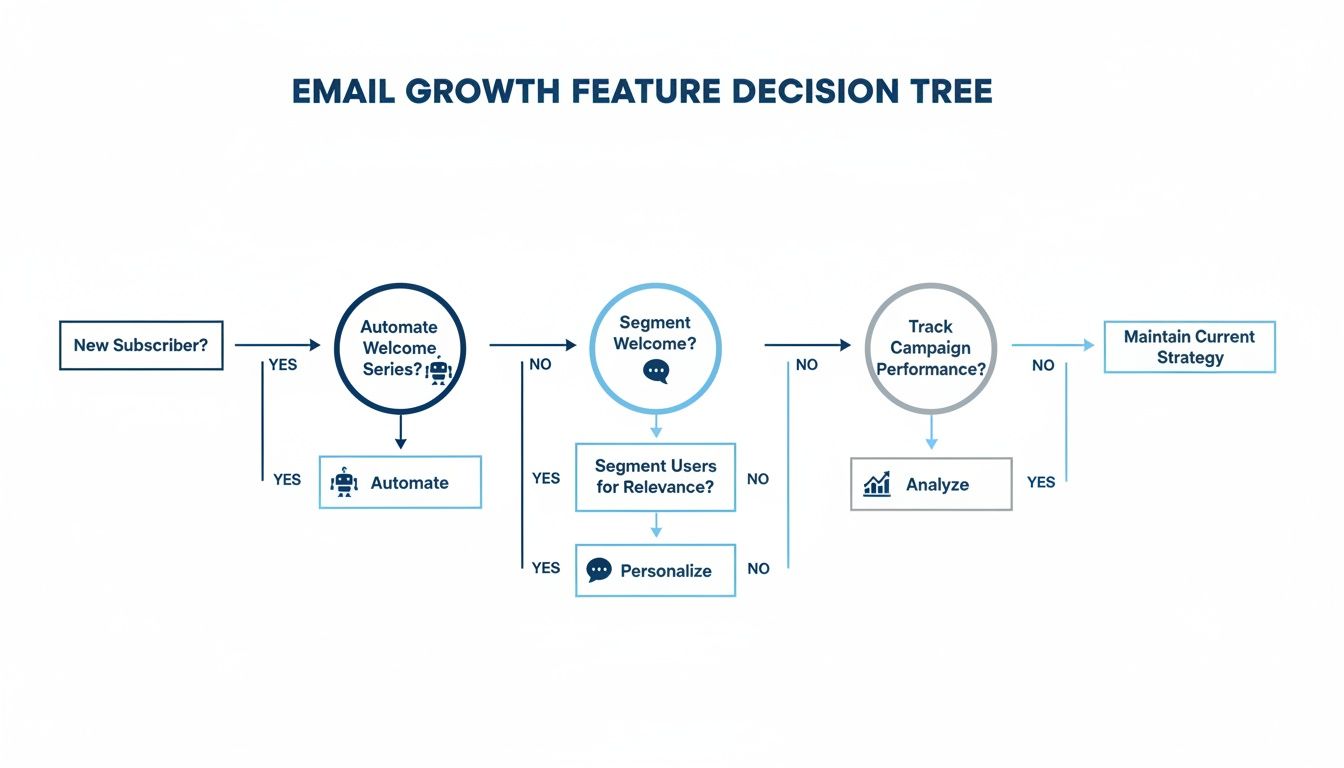
As you can see, it’s a clear progression from just automating repetitive tasks to using data to create truly personal experiences for your customers. Keep this framework in mind when you're comparing software.
Usability And Scalability
Finally, don't forget the people who will be using it every day. The most powerful email management software in the world is useless if your team finds it clunky and confusing. It needs to be intuitive, letting your support agents get started with minimal training. The interface should be clean, fast, and designed to make their jobs easier.
Scalability is just as important. The solution you pick today has to handle a massive spike in holiday emails just as easily as it handles your current volume. You don't want to be forced to switch platforms right as your business is hitting its stride. For a wider view of tools that offer email features, it can be helpful to compare major productivity suites like Microsoft 365 vs Google Workspace.
A truly effective tool is one that empowers your team, not replaces them. By automating the repetitive, low-value tasks, you free up your agents to focus on complex problem-solving and building genuine customer relationships that drive long-term loyalty.
For a deeper dive into this, check out our complete guide on how to choose the right AI customer support software.
An Evaluation Checklist For Shopify Store Owners
To help you stay focused during your research, we've put together a checklist. Use this to systematically compare different tools and ensure you’re choosing a solution that’s truly built for the demands of e-commerce.
| Email Management Software Evaluation Checklist |
| :--- | :--- | :--- |
| Evaluation Criteria | Key Questions to Ask | Why It Matters for Shopify |
| Deep Shopify Integration | Can it pull order history, shipping status, and customer data in real time? | This eliminates tab-switching and gives agents instant context, speeding up resolution times by over 40%. |
| True AI Intent Recognition | Does the AI understand the difference between a general question and a specific order-related problem? | Prevents frustrating, generic responses and ensures customers get the right answer the first time. |
| Brand Voice Adaptability | Can the AI learn from my past emails to match my brand's unique tone and style? | Ensures that even automated messages feel personal and authentic, protecting your brand identity. |
| Automated Workflows | Can I build rules to automatically tag, assign, or respond to common inquiries like WISMO? | Frees up your team from repetitive tasks, allowing them to focus on high-value customer interactions. |
| Ease of Use | Can a new team member learn the basics in under an hour without extensive training? | A simple interface reduces onboarding time and increases team adoption, maximizing your ROI. |
| Scalability | Can the platform handle a 10x surge in ticket volume during peak seasons without crashing or slowing down? | Your support system should support your growth, not hold it back when you need it most. |
By methodically checking these boxes, you can confidently choose a platform that won't just manage your emails, but will become a core part of your growth engine.
Your Implementation and Onboarding Plan
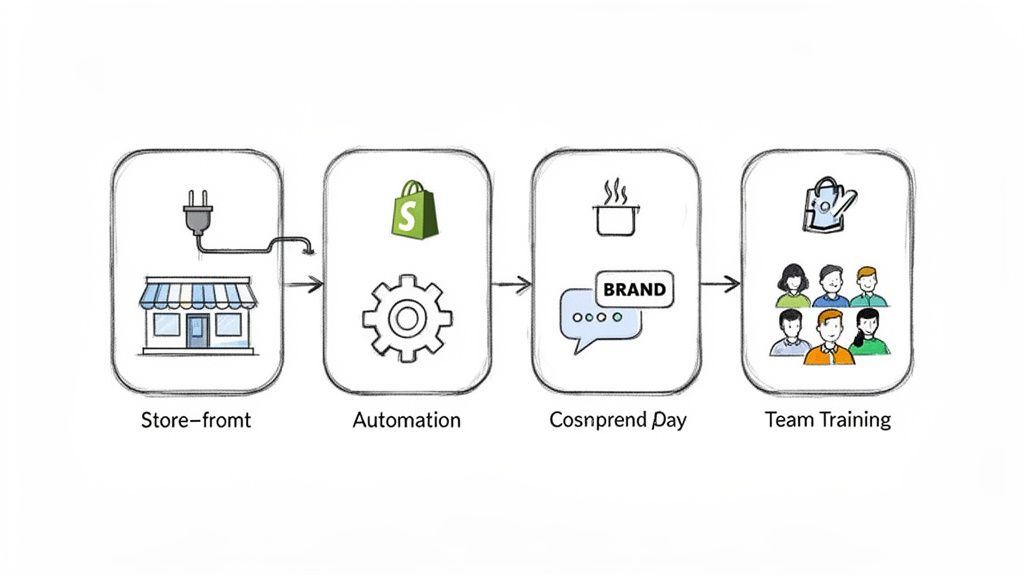
Rolling out a new piece of software shouldn't feel like a major technical headache. The best tools are built for a quick, painless setup that starts paying off immediately. Instead of some long, drawn-out project, think of it as a simple four-phase plan to get your support humming.
This step-by-step approach gives you a controlled, successful launch. Your team can build confidence and see the wins right away without getting buried in complexity. Let's walk through what each phase looks like.
Phase 1: Connect and Migrate
First things first, you need to hook up your Shopify store to the new software. Modern tools like Mailo AI make this dead simple—it’s usually just a couple of clicks to authorize the connection. Once you’re linked up, the platform will start pulling in your past email conversations.
This migration step is crucial. It’s how the AI learns your brand’s unique flavor of communication. By analyzing how your team has handled questions in the past, the system starts to pick up on your tone, common phrases, and go-to solutions.
Phase 2: Configure Your Automation Rules
With your data synced, it’s time to build out automation rules for your most common customer questions. This is where you’ll start clawing back hours of your day. You can create rules that automatically spot, tag, and even answer those repetitive inquiries.
Start with the low-hanging fruit: "Where is my order?" (WISMO).
- Trigger: The system flags emails with keywords like "tracking," "shipping status," or "order update."
- Action: It then automatically pulls live tracking info from Shopify and fires off a personalized email update to the customer.
- Result: You've just wiped out a massive chunk of your manual support tickets.
From there, you can set up similar rules for return requests, product questions, or any other query that fills your inbox. This kind of proactive setup turns your platform into a 24/7 support agent that handles the boring stuff.
Phase 3: Customize the AI Brand Voice
Generic, robotic replies can kill the customer trust you've worked so hard to earn. Phase three is all about making sure every automated message sounds like it came from you.
This is where the AI's learning from Phase 1 really shines. You can review the AI-generated responses and tweak the language until it perfectly matches your best support agent. Whether your brand is fun and casual or more formal, you can fine-tune the templates to keep everything on-brand.
Pro Tip: A great way to ease into automation is by using AI-suggested replies first. Instead of letting the system respond on its own, it can draft a reply for your agent to quickly review, edit, and send. It’s a fantastic way to build trust in the system before going fully automated.
Phase 4: Onboard Your Team
At the end of the day, any tool is only as good as the team using it. Proper onboarding isn’t about showing people which buttons to press; it’s about proving how this new email management software makes their jobs better, not redundant.
Focus on what's in it for them:
- Less Repetitive Work: Show them how automation is taking the monotonous questions off their plate, freeing them up to solve more interesting, complex problems.
- Instant Customer Context: Point out how all the Shopify order data is right there in the inbox. No more jumping between tabs to find what they need.
- Better Performance Insights: Walk them through the analytics dashboard so they can track their own performance and see the direct impact they're having on customer happiness.
By following this simple plan, you can get a powerful support system in place without the chaos, ensuring your team is confident and your customers are happier from day one.
Calculating the Real ROI for Your Store

So, how does email management software actually pay for itself? It's about a lot more than just the relief of hitting inbox zero. The real return on investment (ROI) comes from turning your support team from a reactive cost center into a proactive engine for sales and customer loyalty. It's about hard numbers and measurable growth.
To see what this looks like on the ground, let's walk through the tangible before-and-after for three common types of Shopify stores. We'll uncover the hidden costs of doing things the old way and stack them up against the gains in efficiency, sales, and customer retention.
Scenario 1: The Fast-Growing DTC Brand
Picture a direct-to-consumer brand that's blowing up. They're fielding over 500 support emails a week, and their two full-time agents are completely swamped. The vast majority of these tickets are the classic "Where Is My Order?" (WISMO) requests.
Before Software:
- Hours Down the Drain: Each WISMO ticket takes an agent around 4 minutes to resolve—they have to log into Shopify, find the order, copy the tracking info, and type out a reply. At 300 WISMO emails/week, that’s 1,200 minutes, or a staggering 20 hours per week, just providing tracking updates. That's half of one agent's entire workweek gone.
- Sales Walking Out the Door: While agents are bogged down with repetitive tasks, questions from potential customers about sizing or product features are left waiting. Those delays often lead to abandoned carts and lost revenue.
After Implementing Mailo AI:
- Massive Efficiency Gains: The software instantly handles 90% of those WISMO inquiries on its own, freeing up 18 hours of agent time every single week. Now, your team can focus on helping customers with complex issues and engaging with shoppers who have questions before they buy, which directly boosts conversion rates.
- The Financial Impact: The brand gets those 18 hours back for growth-focused activities without having to hire a third agent. That’s thousands saved every month in salary and overhead costs.
Scenario 2: The Niche Boutique
Now, let's look at a high-end boutique that built its reputation on white-glove customer service. Their email volume is lower—maybe 150 emails per week—but every single interaction is critical. They need to maintain a premium brand feel to keep their loyal customers coming back.
Before Software:
- Inconsistent Service: Without a central system, providing personalized service is a roll of the dice. An agent might not remember a customer’s previous purchases, resulting in generic replies that completely undermine the high-touch experience the brand is known for.
- Missed Opportunities: Manually trying to track post-purchase follow-ups for reviews or feedback just doesn't scale. This means they're missing out on chances to build a community and gather powerful social proof.
After Implementing Mailo AI:
- Effortless Personalization: Agents can see a customer's entire order history right inside the inbox. This allows them to offer deeply personal service, referencing past purchases and making tailored recommendations that make every customer feel like a VIP.
- Higher Customer Lifetime Value (LTV): The software can automate post-purchase review requests and send personalized thank-you notes. This simple touch strengthens customer relationships, leading to more repeat purchases and a measurable jump in LTV.
A support system that remembers customer history and preferences is no longer just a tool; it's a core part of your brand experience. This consistency transforms one-time buyers into loyal advocates who drive sustainable growth through word-of-mouth and repeat purchases.
Scenario 3: The E-commerce Marketing Agency
Finally, imagine an e-commerce marketing agency managing customer support for three different Shopify clients. Their biggest headache is keeping each brand's unique voice and internal processes separate without getting their wires crossed.
Before Software:
- Operational Chaos: The team is constantly juggling multiple inboxes and brand style guides, which leads to frequent, embarrassing errors. Using the wrong sign-off or giving out incorrect policy information erodes their clients' trust—and their customers' trust, too.
- No Real Insight: The agency struggles to give clients data-driven reports on support performance, common customer complaints, or satisfaction trends. This makes it tough to prove their value beyond just "answering emails."
After Implementing Mailo AI:
- Centralized Command: The agency can now manage all of its clients from a single, unified inbox. Each brand’s unique voice, rules, and automations are kept perfectly separate, ensuring communication is always consistent and error-free.
- Demonstrable Value: Armed with detailed analytics dashboards, the agency can give each client crystal-clear reports on response times, satisfaction scores, and the exact number of hours saved by automation. This data-backed approach proves the ROI of their services, making it easy to retain clients and justify their fees.
Frequently Asked Questions
It's smart to ask questions before bringing any new technology into your business. Investing in email management software is a big move for your Shopify store, so let's walk through the common concerns to make sure you feel completely confident.
How Long Does Shopify Setup Actually Take?
This is probably the most common worry we hear, but the good news is that the days of painful, month-long software rollouts are long gone. Modern tools built specifically for Shopify, like Mailo AI, can be up and running in just a few minutes.
The initial setup is usually just a couple of clicks to approve the app inside your Shopify dashboard. Once you do that, the software gets to work right away, automatically syncing your past emails and customer data. You start seeing the benefits almost immediately, no technical headaches required.
Will An AI Assistant Sound Robotic?
Great question. Your brand's voice is everything, and keeping it consistent is non-negotiable. The secret lies in picking an AI that’s smart enough to learn from you. Forget generic, pre-canned responses; the best systems analyze the emails your team has already sent.
By studying your past conversations, the AI picks up on your unique phrasing, your tone, and your style. This means it can generate replies that aren't just correct, but sound like they genuinely came from a member of your team. It’s all about maintaining that personal touch and keeping your customer experience top-notch.
The biggest mistake brands make is choosing generic email tools that lack deep, native Shopify integration. A disconnected system forces your team to constantly switch between tabs to find order information, defeating the entire purpose of the software and leading to slow, context-lacking replies.
Is This Software Affordable For Small Stores?
Absolutely. The top email management platforms are designed to scale right alongside your business. Most offer flexible pricing plans, including starter tiers perfect for smaller stores with big ambitions.
This kind of model means you only pay for what you need right now. As you grow and your email volume picks up, you can easily move to the next plan. It makes powerful automation and smart analytics accessible for everyone, whether you're just starting out or running a massive operation.
Ready to turn your customer support from a cost center into a growth engine? Discover how MAILO AI can automate your inbox, delight your customers, and free up your time to focus on what matters most. Start your free trial today.