

At its heart, customer retention software is a set of tools built to help you build and maintain strong relationships with the people who have already bought from you.
Instead of pouring all your energy into finding new buyers, this kind of software uses smart automation, data-driven personalization, and timely communication to turn a one-time shopper into a lifelong fan. For any Shopify store owner, this is the secret sauce for building a business that lasts.
Why Customer Retention Is Your New Growth Engine
Picture your business as a bucket you're constantly trying to fill with water. Each new customer is another splash you pour in. But what if that bucket is full of holes? If customers make one purchase and never come back, you're just pouring water into a leaky bucket, working hard just to stand still. This is a classic problem for so many Shopify stores—you spend a ton on ads to get customers in the door, only to watch them walk right out the back.
This is where a focus on retention completely changes the game. It’s not just about stopping the leaks; it's your most powerful lever for growth. Instead of desperately trying to fill that leaky bucket, customer retention software helps you patch the holes for good.
Shifting from Acquisition to Loyalty
The fundamental idea is one you've probably heard before: it's far more profitable to keep an existing customer than it is to go out and find a new one. Loyal customers don't just buy again; they buy more often, spend more when they do, and eventually become your best marketers.
This isn't just a niche strategy anymore—it's becoming the standard. The market for customer retention software is expected to double, growing from $11.2 billion in 2025 to $22.0 billion by 2033. This boom is happening for a simple reason: retaining a customer is anywhere from five to 25 times cheaper than acquiring a new one. You can dig into the numbers yourself in recent industry analysis.
"A good retention strategy requires a blend of quality customer-facing interactions and an outstanding customer experience to strengthen a buyer’s relationship with your brand."
This approach fundamentally changes how you think about your business. You stop seeing sales as one-off transactions and start seeing every interaction as a chance to build real trust and loyalty.
This image perfectly captures the difference between a business stuck on the acquisition treadmill and one that's built on a solid foundation of retention.
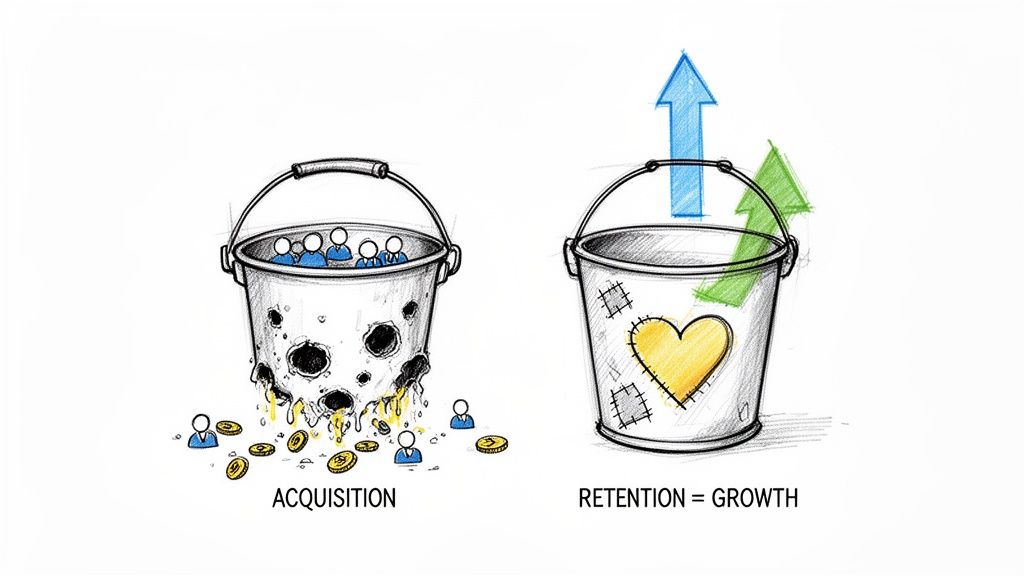
As you can see, without a solid retention plan, all your hard-earned acquisition efforts just leak away. But when you patch those holes, you create a strong base for real, sustainable growth.
How Customer Retention Software Actually Works
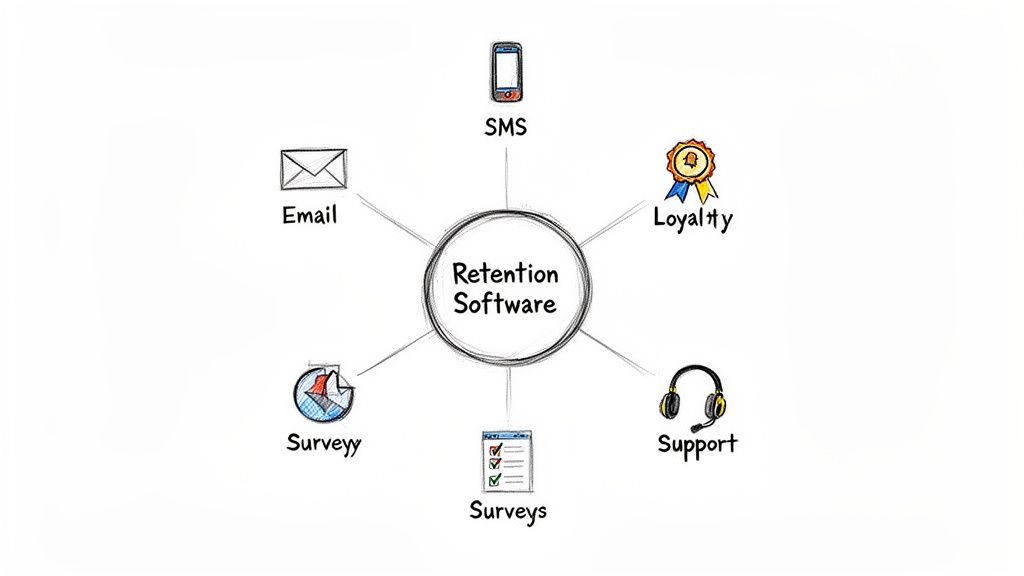
Think of customer retention software as the conductor of an orchestra. Your Shopify store, email marketing, SMS platform, and help desk are all individual instruments. This software is what brings them all together to play a beautiful, cohesive melody for your customers.
It works by plugging directly into your Shopify store's data—purchase history, customer profiles, browsing behavior—and using that information to trigger smart, automated actions. The goal is to nurture the relationship long after that first sale.
Instead of just reacting to problems, you start proactively building a connection. It’s what makes every customer feel like they’re your only customer.
Automating Personalized Communication
At its heart, this software is a communication engine. But we’re not talking about generic, one-size-fits-all email blasts. We're talking about sending the right message to the right person at the perfect moment.
Let's walk through a real-world example. A customer just made their first purchase. Here's what the software can do, all on its own:
- Instantly send a 'Thank You' email: A warm, personalized message arrives in their inbox, confirming the order and thanking them by name. You could even pop in a small discount for their next purchase to plant the seed for a return visit.
- Trigger shipping notifications: The moment you fulfill the order in Shopify, an automated SMS or email goes out with tracking info. This simple step heads off tons of "Where's my order?" support tickets.
- Follow up after delivery: A few days after the package is marked as delivered, another email checks in to see if they're happy and asks for a product review.
This hands-off workflow ensures no one ever feels forgotten. It builds trust through reliable, helpful communication from the very beginning.
To get a clearer picture, let's break down some of the most common capabilities and see how they play out in a real Shopify store.
Core Functions of Customer Retention Software for Shopify
| Core Function | Description | Example for a Shopify Store |
|---|---|---|
| Data Integration | Pulls real-time data (purchase history, customer info, order details) directly from your Shopify store. | A customer who just bought a coffee machine is automatically added to a "Coffee Lovers" segment. |
| Automated Workflows | Triggers pre-built sequences of actions based on specific customer behaviors or events. | A "win-back" email sequence is automatically sent to customers who haven't purchased in 90 days. |
| Personalized Messaging | Uses customer data to customize emails, SMS, and other communications with dynamic content. | An email subject line reads, "Hey Jane, how are you enjoying your new running shoes?" |
| Loyalty Program Management | Manages points, rewards, VIP tiers, and referral programs to incentivize repeat purchases. | A customer earns 10 points for every dollar spent, which they can redeem for a $5 coupon after reaching 500 points. |
| Feedback Collection | Automates sending surveys (like NPS or CSAT) at key moments in the customer journey. | A satisfaction survey is sent 24 hours after a customer support ticket is closed. |
These functions work together to create a seamless experience that keeps customers coming back.
Building Community and Fostering Loyalty
Great retention software does more than just send messages; it helps you build a genuine community. This is where you set up loyalty and reward programs that give people a real reason to stick with your brand.
This isn't just about handing out discounts. It's about making your customers feel like they're part of an exclusive club. Think points-based systems, VIP tiers with special perks, or early access to new product drops. The software handles all the tracking and reward distribution automatically, so it feels effortless for you and your customers.
A well-designed loyalty program isn't just a marketing tactic. It's a feedback loop: you recognize customers for their loyalty, and in return, they feel more connected and committed to your brand.
This approach turns a simple transaction into an engaging, gamified experience.
Streamlining Support and Gathering Insights
Finally, these tools are a massive help for your customer support team. By connecting with your help desk, the software gives agents a 360-degree view of every customer's history. This means faster, more personal, and far more effective problem-solving. If you want to dive deeper, our guide on AI customer support software shows just how powerful this integration can be.
Many platforms also make it easy to gather customer feedback through automated surveys. By sending a quick Net Promoter Score (NPS) or Customer Satisfaction (CSAT) survey after a purchase or support interaction, you get a direct line into what your customers are thinking. This data isn't just for show—it helps you spot trends, fix pain points, and truly understand what makes your customers stick around.
What to Look for in a Retention Toolkit
Picking the right customer retention software can feel like a huge task, but it really just boils down to a few core features that actually move the needle for a Shopify store. A lot of platforms look impressive on the surface, but you need to cut through the marketing fluff and focus on the tools that will genuinely build loyalty and boost your bottom line.
First things first, a seamless, native Shopify integration is non-negotiable. I can't stress this enough. It's not a "nice-to-have"; it's the absolute foundation of your entire retention strategy. Without it, you're just making things harder for yourself.
A deep integration means your customer data, order history, and product catalog are always in sync. This is what allows your software to do its magic—like automatically sending a review request exactly one week after an order is delivered, or suggesting a complementary product based on what a customer just bought.
AI-Powered Personalization and Automation
Real personalization is so much more than sticking a {{first_name}} tag in an email. Modern retention software uses AI to figure out what your customers want before they even know they want it, and then automates the conversations that make them feel seen. This is how you go from a good retention strategy to a great one.
AI-driven features are a game-changer for e-commerce, enabling predictive analytics and intelligent automation that can lead to 18% higher retention rates and 20-30% conversion uplifts. Considering the average e-commerce retention rate hovers at a tough 38%, it’s no wonder that 45% of companies now prioritize automation in their CRM tools. You can dig into more of this data on how automation is shaping CRM strategies over at BigContacts.com.
This kind of intelligence powers a few key functions:
- Predictive Product Recommendations: The software looks at a customer’s past purchases and browsing habits to suggest other items they're almost certain to love.
- Smart Segmentation: Customers are automatically sorted into dynamic groups like "VIPs," "at-risk of leaving," or "new buyers," so you can tailor your messaging perfectly.
- Proactive Support: The system can spot potential problems, like a shipping delay, and automatically send a heads-up to the customer before they even have a chance to get frustrated.
By automating these personalized touchpoints, you create a customer experience that feels incredibly attentive and valuable. You’re building a genuine connection with your brand, all without adding a mountain of manual work for your team.
Advanced Analytics and Reporting
If you can't measure it, you can't improve it. The best retention software gives you a clear, easy-to-understand dashboard that turns mountains of data into actionable insights. Forget generic vanity metrics; you need analytics built specifically to track customer loyalty and health.
Your software’s reporting tools should make it dead simple to monitor the key performance indicators (KPIs) that show whether your efforts are paying off. This is how you prove your ROI and make smart, data-backed decisions to tweak your strategy.
Look for a platform that lets you easily track and visualize:
- Customer Lifetime Value (CLV): Watch how the average value of your customers grows over time.
- Repeat Purchase Rate: Measure the percentage of customers who come back to buy a second, third, or fourth time.
- Customer Churn Rate: Keep an eye on how many customers you're losing and spot trends that might signal a bigger problem.
- Campaign Performance: See the open rates, click-through rates, and conversions from your retention-focused email and SMS campaigns.
Multi-Channel Communication Capabilities
Your customers aren't just in one place, so your retention strategy shouldn't be either. They might find you on Instagram, buy on your Shopify store, and ask for help over email. Great software meets them wherever they are, creating a consistent experience across every single channel.
This means your toolkit needs to manage communications across email and SMS from one central hub. You need email automation for things like welcome series and win-back campaigns, and SMS marketing for time-sensitive pings like shipping alerts or flash sale announcements.
When you bring these channels together, your messaging becomes cohesive and powerful. A customer who abandons their cart might get an email reminder an hour later, and if that doesn't work, a text with a small discount the next day. This unified approach keeps your brand top of mind and makes it incredibly easy for customers to re-engage and buy again.
Connecting Retention Efforts to Real Revenue Growth
Putting money into customer retention software isn't just about warm, fuzzy feelings. It's a direct line to your bottom line. Every feature—from an automated email sequence to a loyalty program—is a tool designed to produce real financial results. You see this connection crystal clear when you start focusing on what truly drives sustainable e-commerce growth.
The whole point is to turn one-time buyers into repeat customers who become more valuable over time. A loyalty program might look like a simple rewards system on the surface, but it's really an engine for increasing how often people buy. In the same way, proactive support doesn't just solve problems; it builds the trust that stops customers from even thinking about your competitors.
Boosting Customer Lifetime Value
Customer Lifetime Value (CLV) is the total amount of money you can expect a customer to spend with your brand over their entire relationship with you. Think of it as your retention north star. When CLV goes up, it means your customers are sticking around longer and spending more—the most profitable kind of growth there is.
Retention software is the fuel for CLV growth because it creates more opportunities to engage. For example, a perfectly timed email offering a special discount on a related product can easily trigger another purchase. A direct measure of retention success and a key driver of profitability is found in a practitioner's guide to improving customer lifetime value, which transforms one-time buyers into loyal advocates.
By systematically increasing how often customers buy and how much they spend per order, you directly elevate their lifetime value. This turns your existing customer base into your most reliable and predictable source of revenue.
The diagram below shows how different software features come together to create a powerful retention toolkit.
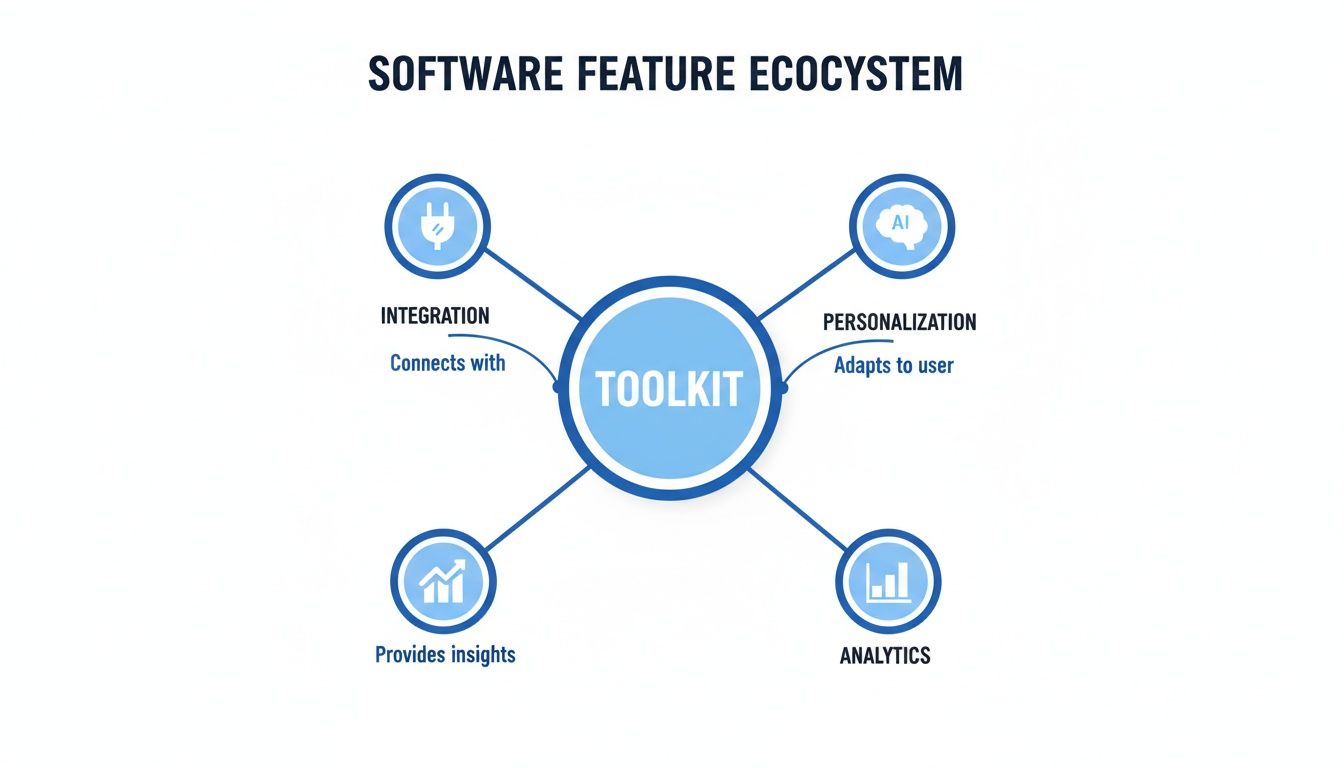
This map highlights how seamless integration, smart personalization, and clear analytics form the foundation of any solid retention strategy.
Increasing Repeat Purchase Rates
A high repeat purchase rate is a flashing sign that your products and customer experience are really connecting with people. This is where personalized communication becomes a revenue-generating machine.
Picture this: a customer buys a new skincare product from your Shopify store. Your customer retention software can kick off an automated workflow that:
- Sends a thank-you email with tips on how to use the product right away.
- Follows up two weeks later to ask for a review.
- Triggers a reminder email with a 10% discount one month later, right around the time they might be running low.
This simple, automated sequence keeps your brand at the forefront of their mind and gives them a gentle nudge to make that all-important second purchase. That's how you directly boost your repeat customer numbers.
Slashing Customer Churn
Customer churn—the rate at which you lose customers—is a silent growth killer. When churn is high, you're stuck on an expensive acquisition treadmill, constantly spending just to replace the customers walking out the door. One of the best ways to fight churn is with proactive, high-quality support.
Let’s walk through a common problem: a customer’s package is delayed. Without the right software, you might not know anything is wrong until an angry email hits your inbox. But with an integrated retention tool, you can automatically spot the delay and send a proactive message first.
- Example Message: "Hi Alex, we noticed your order is taking a little longer than usual to arrive. We're so sorry for the delay! We're looking into it and have added 50 loyalty points to your account for the inconvenience."
That one message can turn a potential one-star review into a moment that builds serious loyalty. It shows you're paying attention and that you care, which is invaluable for building long-term trust and keeping churn rates down.
The table below breaks down the difference between a manual support process and one powered by an AI retention tool like Mailo AI.
Manual Support vs. AI-Powered Retention Workflow
| Task | Manual Approach (Without Software) | Automated Approach (With Mailo AI) |
|---|---|---|
| Issue Detection | Wait for the customer to file a complaint. | Proactively flag shipping delays or order issues in real-time. |
| Customer Communication | A support agent manually drafts and sends a one-off email. | Trigger an automated, personalized message apologizing for the issue. |
| Resolution | Offer a discount or refund after the customer is already upset. | Instantly add loyalty points or a coupon to the customer's account. |
| Outcome | High risk of a negative review and customer churn. | Strengthened customer trust and a higher chance of a repeat purchase. |
As you can see, the automated approach isn't just faster; it completely changes the customer's experience from a negative one to a positive one. This is a game-changer for retention.
You need to know your numbers to make progress. Learning to track the right figures is fundamental, and our guide on the most important customer retention metrics is the perfect place to start.
Putting Your Retention Strategy Into Action
It's one thing to talk about a great retention strategy, but it’s another thing entirely to actually make it happen. The good news is that moving from a plan on paper to real-world results doesn't have to be a massive undertaking. The key is to break it down into simple, actionable steps that let you build momentum without getting bogged down.
Everything starts with one simple question: What are we actually trying to accomplish? If you don't set clear goals, you're just guessing. Forget vague ideas like "we want more loyal customers." You need specific, measurable targets that your customer retention software can help you hit.
Setting Clear and Measurable Goals
Think of your goals as the destination you’re plugging into your GPS. They guide every decision and let you know if you're on the right track. Your first set of objectives should be direct and aimed at solving common e-commerce problems.
Here are a few solid examples to get the ball rolling:
- Reduce First Response Time: Aim to cut down the average time it takes to reply to a customer's first message by 25% this quarter.
- Increase 5-Star Reviews: Set a goal to get 15% more 5-star product reviews over the next six months by automating your review requests.
- Improve Repeat Purchase Rate: Try to lift the percentage of customers who buy a second time within their first 90 days by 10%.
Goals like these give your strategy a real purpose and make it incredibly easy to see what’s working. Plus, they make it much easier to justify investing in new tools and processes.
Choosing the Right Software and Workflows
Once you know where you're going, it’s time to pick your tools. If you're running a Shopify store, finding a platform with a native Shopify connection is non-negotiable. A direct integration means no more data headaches—all your customer, order, and product info stays perfectly in sync without any manual work.
After you have the right software, you can start building your first automated workflows. These are the workhorses of your retention strategy, running quietly in the background to engage customers at just the right moment. For some great best practices, check out these 10 Proven SaaS Customer Retention Strategies.
Start small with a few high-impact automations:
- Post-Purchase Check-In: A simple email that goes out a few days after an order arrives. It just checks in, makes sure the customer is happy, and gives you a chance to solve any problems before they start.
- Review Request Sequence: This workflow automatically asks for a product review a week or two after an order is fulfilled. It's a low-effort way to build that all-important social proof.
- Basic Win-Back Campaign: An email that triggers when a customer hasn't bought anything in a while (say, 90 days). A small discount can be all it takes to bring them back.
These initial workflows are easy to set up and start delivering value right away. They're the foundation for a much more advanced strategy down the road. For a deeper dive, you can explore how e-commerce marketing automation is the engine behind these kinds of results.
"A well-executed retention plan relies on proactive, automated communication. It's about anticipating customer needs and being there with the right message at the right time, turning transactions into relationships."
Finally, you have to track your performance. Keep a close eye on your metrics and compare them to the goals you set. This data tells you what’s working and what isn’t, allowing you to fine-tune your approach and prove just how much your retention efforts are contributing to the bottom line.
How Mailo AI Puts Your Retention Strategy into Action
Having the right strategy is one thing, but bringing it to life requires the right tools. This is where modern software can turn your customer support from a reactive cost center into a proactive retention engine. Let's look at Mailo AI as a real-world example of how an AI-powered platform turns everyday interactions into genuine opportunities to build loyalty.
Instead of simply closing tickets, Mailo AI uses smart automation to create genuinely positive experiences. Its AI can generate instant, personalized replies to common questions, which frees up your human agents to focus their expertise on more complex or sensitive issues. That speed and accuracy are crucial for retention; a Zendesk report found that 73% of business leaders see a direct connection between their customer service quality and overall business performance.
Turning Data into Personalized Conversations
The real magic of great customer retention software is how it uses data. Mailo AI’s native Shopify integration is the powerhouse behind this, pulling real-time customer and order information directly into every support conversation. This isn't just a fancy feature—it's what makes truly personal, context-aware support possible.
Think about it. A customer asks, "Where's my package?" Instead of a vague, scripted answer, Mailo AI can instantly check their order history and provide the exact tracking details. That simple, seamless flow of information turns a routine query into a moment that builds trust.
When you connect support directly to your store's data, you get rid of the friction that drives customers crazy. Every response is faster, more accurate, and more personal—and that's the foundation of a great customer experience.
This screenshot from the Mailo AI dashboard shows just how integrated this feels for an agent. The interface gives agents immediate access to AI-generated responses that are already packed with the right context, which dramatically speeds up the time it takes to solve a problem.
Automating Social Proof and Getting Smarter Over Time
Beyond just solving problems, Mailo AI helps you actively build your brand's reputation. You can set it up to automatically send review requests after a customer has a great support experience. This is a brilliant way to systematically gather the social proof that convinces new shoppers to buy. You're turning happy customers into your best marketers without lifting a finger.
This kind of automation is a core function of modern retention tools. It makes sure you never miss a chance to capture positive feedback or a glowing review.
Finally, Mailo AI gives you the analytics you need to spot trends and keep improving. You can track key metrics like:
- Response Times: Quickly find any bottlenecks and make sure your team is hitting the speed targets your customers expect.
- Customer Satisfaction Trends: See which issues are causing the most frustration and fix them at the source.
- Hours Saved: Put a real number on the efficiency you've gained from automation and prove the ROI of your investment.
This data-driven approach lets you fine-tune your workflows, train your team on what matters most, and make smart decisions that directly boost customer loyalty. It’s how you build a retention strategy that doesn't just work today but gets better tomorrow, making your customer service a true engine for growth.
Frequently Asked Questions
You've got questions about customer retention software, and that's a good thing. It means you're thinking about how to grow your Shopify store smarter, not just harder. Let's clear up some of the most common questions merchants have before they dive in.
We'll cover everything from what you can expect to pay to how quickly you can get things up and running.
How Much Does Customer Retention Software Cost?
There’s no single price tag. The cost really depends on the size of your store and the features you need. Most platforms use a tiered pricing model, so you only pay for what you use, whether that’s based on your customer count or how many messages you send.
For a smaller shop just getting started, you might find plans in the $20 to $50 per month range that cover the basics like email automation. As you scale up, you'll look at more powerful plans with AI, advanced analytics, and multi-channel support, which can run anywhere from $200 to over $1,000 a month.
A great way to start is with a free trial. Many platforms, including Mailo AI, offer one so you can see the tool in action and make sure it's the right fit before you spend a dime.
How Long Does It Take to Set Up?
This is a big one for busy store owners, and the answer is usually "less time than you think." Modern retention tools are built to play nice with Shopify, and most offer a one-click integration. You can genuinely have the basics live in under an hour.
Once you’re connected, you can immediately launch a few high-impact, pre-built campaigns. Think about things like:
- An automatic thank-you email the moment a customer makes a purchase.
- A follow-up asking for a product review a week after delivery.
- A gentle "we miss you" campaign for customers who haven't shopped in a while.
Sure, building out a super-customized, multi-step workflow will take a bit more time. But you can start getting value from the foundational features right away.
What Is the Real ROI of This Software?
The return on investment here isn't just a fuzzy feeling of "better customer loyalty." It's about real, hard numbers you can track in your Shopify dashboard.
The whole game is turning a one-time shopper into someone who comes back again and again. Research shows that just a 5% boost in customer retention can increase your profits by anywhere from 25% to 95%. That’s the kind of leverage we’re talking about.
You’ll see a direct return in a few key areas:
- Higher Customer Lifetime Value (CLV): Your existing customers will simply buy more from you over time.
- Lower Customer Acquisition Cost (CAC): When repeat buyers drive your revenue, you can spend less on ads to find new ones.
- A Healthier Churn Rate: You'll lose fewer customers to your competitors, which creates a more stable, predictable business.
This is how retention software pays for itself. It connects your efforts directly to your bottom line, turning loyalty from a nice-to-have into a core financial strategy.
Ready to turn your customer support into your most effective retention tool? Mailo AI offers a smarter way to manage your Shopify store's email, with AI-powered replies, proactive automation, and deep analytics. Start your free trial today.