

If you've ever felt buried under the day-to-day grind of running your online store, you're not alone. The constant stream of customer emails, order processing, and administrative tasks can quickly pull you away from what really matters: growing your business. This is where an e-commerce virtual assistant comes in.
These aren't just remote helpers; they are your secret weapon. They can be skilled human specialists who handle complex problems or tireless AI agents that manage repetitive queries around the clock. Either way, they give you back your most valuable asset—time.
What Are E-Commerce Virtual Assistants?
Picture this: You wake up, and instead of a chaotic inbox, you see that orders have been processed, customer questions have been answered, and your product listings are perfectly updated. This isn't just a dream scenario; it's what e-commerce virtual assistants do. They act as strategic partners, turning a frantic one-person show into a scalable, well-oiled machine.
It’s like building an expert team for your store without the costs and hassle of a physical office. You stop juggling marketing, customer service, and inventory all at once. Instead, you delegate specific jobs to specialized assistants who work remotely, freeing you to focus on strategy, new products, and the big-picture moves that actually drive growth.
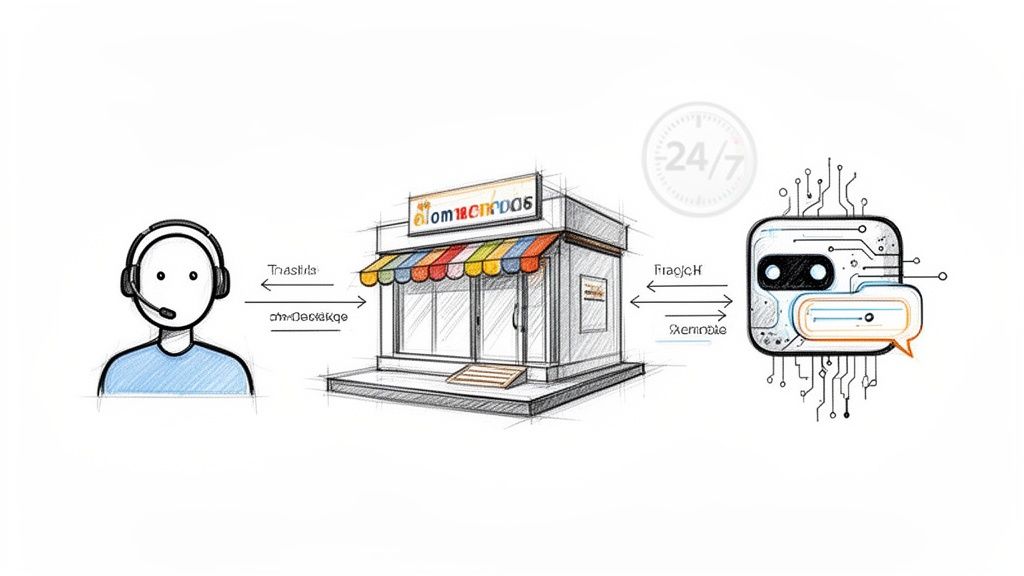
Human VAs vs. AI Assistants
The term "virtual assistant" covers two very different but equally powerful options: human VAs and AI assistants. Knowing when to use each is the key to creating a truly unbeatable support and operations system for your store.
A human virtual assistant is your go-to for anything requiring empathy, creativity, or complex problem-solving. They bring a level of nuance and emotional intelligence that technology just can't replicate yet.
- Handling Tricky Customer Issues: Think about calming down a frustrated customer or untangling a complicated shipping mistake with a personal touch.
- Creative & Strategic Work: This is where humans shine—managing your social media community, writing compelling product descriptions, or digging deep into market research.
- Building Relationships: Negotiating with suppliers or coordinating with marketing agencies requires genuine human connection.
On the other hand, an AI virtual assistant, like MAILO AI, is your 24/7 automation powerhouse. It's designed for speed, perfect accuracy, and handling a massive volume of work without ever needing a coffee break. It excels at the repetitive, data-driven tasks that eat up so much of a human's day.
An AI assistant isn't here to replace human empathy; it's a tool that creates more time for it. By automating up to 80% of common queries, it frees your human team to focus on the high-value conversations that build real customer loyalty.
When a customer asks, "Where is my order?" they don't want a long, heartfelt chat. They want an immediate, accurate answer. This is the perfect job for AI. It can integrate directly with your Shopify store, pull the tracking data in real-time, and send an update in seconds.
Human VA vs. AI Assistant: A Quick Comparison
To make the distinction clearer, here’s a quick breakdown of how these two types of assistants stack up against each other. This should help you see where each fits best in your e-commerce operations.
| Attribute | Human Virtual Assistant | AI Virtual Assistant (like MAILO AI) |
|---|---|---|
| Best For | Complex, nuanced, and creative tasks that require emotional intelligence and strategic thinking. | High-volume, repetitive, and data-driven tasks that require speed and 24/7 availability. |
| Key Strengths | Empathy, critical thinking, relationship-building, adaptability, and strategic input. | Speed, accuracy, scalability, cost-effectiveness, and instant responses. |
| Typical Tasks | Handling escalated customer complaints, social media management, content creation, supplier negotiation. | Answering "Where is my order?", processing returns/exchanges, responding to product questions. |
| Availability | Typically standard business hours; 24/7 coverage requires multiple people and is costly. | 24/7/365, providing instant support anytime, anywhere. |
| Cost Model | Hourly rate or monthly retainer. Can become expensive as you scale. | Flat-rate subscription. Far more cost-effective for handling large volumes of queries. |
Ultimately, the smartest e-commerce brands aren't choosing one over the other. They're blending the efficiency of AI with the irreplaceable expertise of a human team. This powerful combination turns a reactive customer support desk into a proactive engine for growth.
The Hybrid Model: Human Expertise Meets AI Efficiency
The smartest e-commerce brands have stopped asking, “Should I hire a human or use an AI?” Instead, they’re asking, “How can I combine them for the best results?” This is the foundation of the hybrid model, a strategy where human expertise and AI efficiency work hand-in-hand to create a customer experience that’s better than either could deliver alone.
Think of it like a highly skilled pit crew in a Formula 1 race. The AI is the high-speed pneumatic wrench, built to do one thing—change a tire—with incredible speed and precision. The human crew chief is the strategist, making complex decisions, talking to the driver, and solving the unexpected problems that a simple wrench could never handle.
In this model, your human and AI e-commerce virtual assistants aren't competitors. They're collaborators. Each one is assigned the work that plays to its strengths, creating a support system that’s far more powerful than the sum of its parts.
The Human Touch: Where Empathy Wins
Some customer situations demand a level of nuance, emotional intelligence, and creative problem-solving that today's AI just can't replicate. This is where your human virtual assistant becomes your MVP.
Their job is to manage the exceptions—the high-stakes interactions that can make or break a customer relationship. They bring that uniquely human ability to read between the lines, show genuine empathy, and build real rapport.
Key areas where human VAs are essential:
- De-escalating Frustrated Customers: When a customer is genuinely upset about a delayed package or a damaged product, they need to feel heard. A human VA can offer a sincere apology, show they understand, and find a creative solution that turns a bad experience into a great one.
- Managing Complex or Multi-Part Inquiries: Imagine a customer asking about product sizing, a past order, and a future exchange all in one email. A human VA can untangle this, address each point thoughtfully, and provide a single, comprehensive response.
- Building Your Brand Community: Engaging with followers on social media and fostering a sense of community requires an authentic personality. A human VA can embody your brand's voice and build lasting relationships with your audience.
The AI Engine: Where Speed and Data Dominate
While your human VA is focused on these high-touch interactions, your AI assistant is the tireless workhorse handling the massive volume of predictable, data-driven questions. For most Shopify and DTC brands, these simple queries make up the vast majority of support tickets.
Using a tool like MAILO AI, you can automate the repetitive tasks that don't need human emotion but do demand immediate, accurate answers. The AI shines by using data to deliver instant gratification.
The goal of the hybrid model is simple: let AI handle the predictable, high-volume tasks instantly, which frees up your human team to dedicate their time and energy to the high-value conversations that drive loyalty and revenue.
AI assistants are perfect for:
- Instant Order Tracking: Answering "Where is my order?" (WISMO) is the number one e-commerce query. An AI can connect to Shopify, pull live tracking data, and give an update in seconds, 24/7.
- Processing Returns and Exchanges: An AI can kick off a return, generate a shipping label, and answer questions about your return policy without any human help.
- Categorizing and Routing Tickets: Before a human agent even sees an email, the AI can analyze its content, tag it (e.g., "Refund Request," "Urgent"), and send it to the right person or department. Nothing falls through the cracks.
By creating this intelligent workflow, your support becomes both incredibly efficient and deeply personal. To get a better sense of the strengths and weaknesses of each component, it's worth exploring a comparison of AI receptionist vs. voicemail vs. human options.
Ultimately, the hybrid approach gives you the best of both worlds. You get the operational efficiency and cost savings of automation while keeping the crucial human element that builds true brand loyalty. As you grow, this model ensures you can scale support without sacrificing quality, turning customer service from a cost center into a powerful growth engine. You can explore a deeper dive into how this works in our guide to AI customer support software.
Key Tasks E-Commerce Virtual Assistants Can Master
Knowing you need help is one thing; figuring out what to actually hand off is a completely different ballgame. The real magic of e-commerce virtual assistants happens when you match the right tasks to the right type of assistant. This isn't just about getting work off your plate—it's about building an intelligent system where your business runs like a well-oiled machine.
Think of your store as a busy kitchen. You wouldn't ask your top chef to handle reservations, and you certainly wouldn't ask the host to cook the main course. Every role is specialized. In the same way, a human VA and an AI assistant have their own unique strengths. When you use them correctly, the chaos starts to feel a lot more like a smooth, coordinated dance.
Let's get practical and break down the day-to-day tasks you can delegate to your virtual team, organized by the core areas of your business.
Overhauling Your Customer Support
Customer support is often the biggest time-suck for any e-commerce brand, but it's also your single greatest opportunity to create loyal fans. A hybrid team of human and AI assistants can transform your support desk from a frustrating bottleneck into a powerful conversion tool.
It’s no surprise the global virtual assistant market is exploding, projected to hit $19.5 billion this year alone. This growth is being driven by e-commerce founders desperate for smarter support as their sales climb. Administrative VAs make up the biggest piece of this pie, accounting for 38.4% of market revenue, and they focus on the exact tasks—like order tracking and email management—that MAILO AI was built to automate.
Tasks for an AI Virtual Assistant (like MAILO AI):
- Instant WISMO Answers: Immediately resolves "Where is my order?" tickets 24/7 by pulling live tracking data straight from Shopify. No more manual lookups.
- Automated Returns & Exchanges: Guides customers through your return process, generates shipping labels, and answers policy questions without a human lifting a finger.
- Product & Policy FAQs: Delivers instant, accurate answers to common questions about sizing, materials, shipping costs, or your return window.
Tasks for a Human Virtual Assistant:
- Handling Tough Complaints: When a customer is genuinely upset, a human VA can step in with real empathy, calm the situation down, and offer a personal touch to fix the problem.
- Managing Complex Questions: Tackles multi-part inquiries that require digging into order histories, understanding unique situations, and crafting a thoughtful, comprehensive response.
- Proactive Customer Outreach: Follows up with customers who had a bad experience to make sure the issue is truly resolved and to help rebuild trust in your brand.
This diagram shows exactly how this hybrid model works, with human and AI VAs collaborating to cover all the bases.
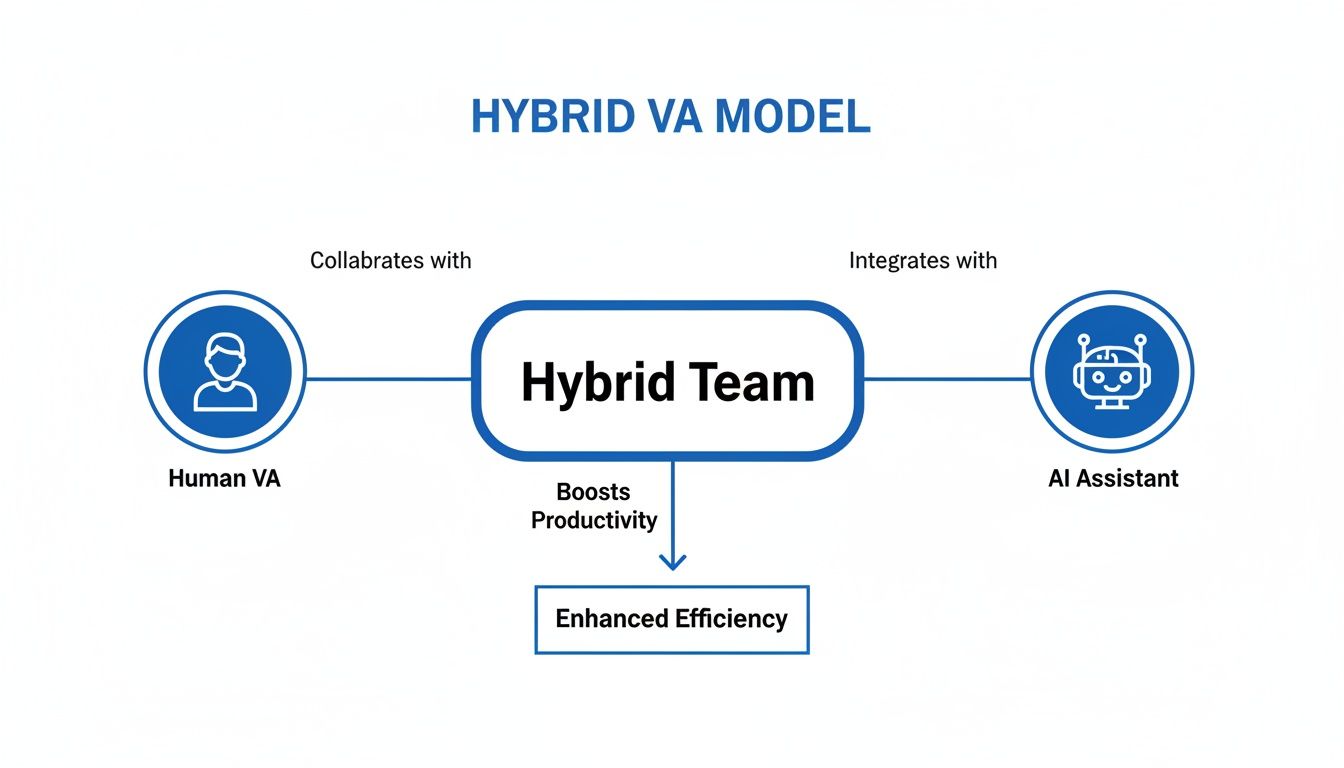
With this setup, routine questions get an instant AI-powered answer, while the tricky, emotional issues get the nuanced attention only a person can provide.
Streamlining Your Store Operations
Behind every successful storefront are the smooth, efficient operations that most customers never see. An e-commerce virtual assistant can take over the repetitive but absolutely critical tasks that keep your store humming, preventing the stockouts, errors, and delays that kill the customer experience.
Your store's operations are its backbone. Delegating these tasks to a VA is like hiring a dedicated site manager—they ensure everything from inventory to order fulfillment is handled with precision while you focus on the bigger picture.
Here’s a typical breakdown of roles:
- Product Listing Management: A human VA can write compelling, SEO-friendly product descriptions, upload new products to your Shopify or Amazon store, and double-check that all images and variants are perfect.
- Inventory Monitoring: They can keep a sharp eye on stock levels, give you a heads-up when popular items are running low, and even coordinate with suppliers to place reorders before you sell out.
- Order Processing and Fulfillment: Your VA can manage the daily flow of orders, verify customer info, liaise with your 3PL or shipping partner, and troubleshoot any fulfillment snags that pop up.
- Managing Returns and Refunds: Once a return is initiated (often by your AI assistant), a human VA can process the refund, update inventory levels, and ensure the customer's account is credited correctly.
Amplifying Your Marketing Efforts
Marketing is what drives growth, but so much of it involves small, consistent tasks that are perfect for a virtual assistant. Offloading these jobs means your brand stays visible and engaged, even when your attention is pulled in a dozen other directions. For a deeper look, check out our guide on how to automate customer service and reap the marketing benefits.
Common marketing tasks to delegate:
- Social Media Scheduling: A VA can create and schedule posts across your social channels, keeping a consistent stream of content flowing and your audience engaged.
- Customer Review Management: They can monitor product reviews, respond professionally to both glowing and critical feedback, and flag recurring issues for product improvements.
- Basic Email Marketing: Your VA can help manage your email list, set up straightforward campaigns in a tool like Klaviyo, and report back on key metrics like open rates and clicks.
- Influencer Outreach: They can research potential influencers in your niche, handle the initial outreach emails, and coordinate sending out products for collaborations.
Measuring the True ROI of Your Virtual Assistant
A virtual assistant isn't just another expense—it's an investment, and like any good investment, it should deliver a clear return. Sure, getting your time back feels great, but the real value is in the cold, hard numbers that impact your bottom line. To truly understand the business case, you have to look past the feeling of relief and focus on the data.
Thinking about a VA's contribution means going beyond the hours you save. It’s about connecting their work directly to cost savings, smoother operations, and, most importantly, real revenue growth. By tracking the right metrics, you can see just how much value your assistant—whether human or AI—is actually bringing to the table.
Cost Savings and Financial Impact
The most obvious way an e-commerce virtual assistant boosts your ROI is by cutting costs right off the bat. Bringing a full-time employee in-house is expensive. You're on the hook for salary, benefits, payroll taxes, office space, and all the other overhead that comes with it. A virtual assistant gets rid of most of that.
Instead of a long, expensive hiring process, you get access to skilled help without the heavy financial commitment. In fact, some studies show that businesses can slash their operational costs by up to 78% by working with virtual assistants instead of hiring full-time staff. That’s not just a small saving; it’s a major financial win that frees up cash you can pour back into marketing, inventory, or developing your next big product.
Efficiency Gains and Key Performance Indicators
Efficiency is where the value of a VA really starts to multiply. When you hand off or automate those repetitive, time-sucking tasks, your whole operation gets faster and more accurate. This is where keeping an eye on specific Key Performance Indicators (KPIs) is critical.
These metrics give you a clear snapshot of how things are running:
- First Response Time (FRT): How long does it take for a customer to get a reply? An AI assistant can cut this down to seconds, which immediately improves a customer's first impression.
- Ticket Resolution Rate: What percentage of support issues actually get solved? A good VA will close out tickets efficiently, keeping your queue clear and making sure no customer gets left behind.
- Customer Satisfaction (CSAT): Are your customers actually happy with the help they're getting? Higher CSAT scores almost always lead to more repeat business and better reviews.
When an AI assistant can handle up to 80% of common questions, your human team is suddenly free from the constant ping of the inbox. They can finally focus on the tricky, high-value conversations that need a real human touch, which in turn boosts the quality of your support and builds serious customer loyalty.
Revenue Growth and Customer Lifetime Value
Finally, a great virtual assistant doesn't just save you money—they help you make more of it. Top-notch customer service is one of the most powerful tools you have for driving revenue. When an AI instantly sorts out a shipping question or a human VA turns a complaint into a positive experience, you're doing more than just fixing a problem. You're building trust.
That trust is what increases Customer Lifetime Value (LTV), because happy customers come back again and again. A proactive support team can even turn a simple service chat into a sale by suggesting the right product or offering a personalized discount.
The market is already voting with its dollars. The intelligent virtual assistant market recently hit $20.21 billion and is expected to explode to $178.80 billion by 2034. This growth is being fueled by the massive number of daily customer interactions that modern e-commerce brands have to manage—a volume that’s nearly impossible to handle manually. You can read more about these virtual assistant market trends on startus-insights.com.
Once you start measuring the impact on LTV and conversion rates, you'll see that your VA isn't just a helper; they're a vital part of your growth engine.
How to Hire and Onboard Your First Human VA
So, you're ready to hire your first human virtual assistant. This is a huge step—one that can genuinely give you back your time and help you scale your store. But let's be honest, finding the right person can feel like looking for a needle in a haystack. The trick is to stop guessing and start being strategic. You're not just filling a seat; you're building a partnership, and that begins with getting crystal clear from day one.
Before you even think about posting a job ad, you have to map out exactly what this person will be doing. Vague requests attract mismatched candidates. Get specific. Are you drowning in customer support tickets? Do you need someone to wrangle your Shopify product listings? Or is your social media presence basically a ghost town?
Defining the Role and Crafting the Job Post
First things first: make a detailed list of every daily, weekly, and monthly task you want to offload. This simple exercise forces you to get specific about the role, which is the foundation of a killer job description. A great job post doesn’t just list duties; it sells your vision and attracts pros who are actually excited about e-commerce.
Your job description should cover:
- A Clear Title: Be specific. Something like "Shopify Customer Support VA" or "E-commerce Operations Assistant" works way better than a generic title.
- Key Responsibilities: Use bullet points to lay out the exact tasks. Think: "Respond to customer emails within 24 hours," "Update product inventory levels daily," or "Schedule 5 social media posts per week."
- Required Skills and Tools: Name the platforms they need to know, like Shopify, Klaviyo, or a specific helpdesk software. This immediately weeds out anyone who isn't a good fit.
- Your Brand's Mission: A short blurb about what your business stands for can attract candidates who genuinely connect with your values.
Once your job description is polished, you need to post it where the right people will see it. While you can find people on general freelance sites like Upwork, specialized agencies often deliver a much higher caliber of pre-vetted talent.
Top Platforms for Finding E-commerce VAs:
- Specialized Agencies: Companies like Wow Remote Teams or EcomVA live and breathe e-commerce virtual assistants. They do the heavy lifting on sourcing and training, which saves you a ton of time.
- Nearshore Staffing Partners: Virtual Latinos is great for finding bilingual talent in Latin America, which is a huge plus for time-zone alignment with the U.S.
- Managed VA Services: Platforms like Wing Assistant offer a fully managed service, handling things like payroll and even finding a replacement if your first hire doesn't work out.
The Interview and Vetting Process
When it's time to interview, skip the generic questions. Your mission is to dig into their real-world experience and see how they solve problems. Ask them about specific scenarios they’ll actually run into on the job.
The interview is your best shot to gauge not just their skills, but also their communication style and reliability. A candidate who communicates clearly and proactively during the hiring process is likely going to do the same once they’re on your team.
Sample Interview Questions:
- "Tell me about a time you handled a really tough customer. What was going on, and how did you turn it around?"
- "Walk me through how you'd optimize a new product listing on Shopify."
- "In your opinion, what are the most important metrics for tracking success in this role?"
And whatever you do, don't skip a small, paid test project. It's the single best way to see their work quality, attention to detail, and ability to follow instructions before you make an offer.
Creating a Seamless Onboarding Experience
A great partnership starts with a great first week. If you rush the onboarding or it's a disorganized mess, you're just setting your new VA up to fail. A smooth, structured process, on the other hand, empowers them to start adding value from day one.
Think of your onboarding checklist as a living document you can improve over time.
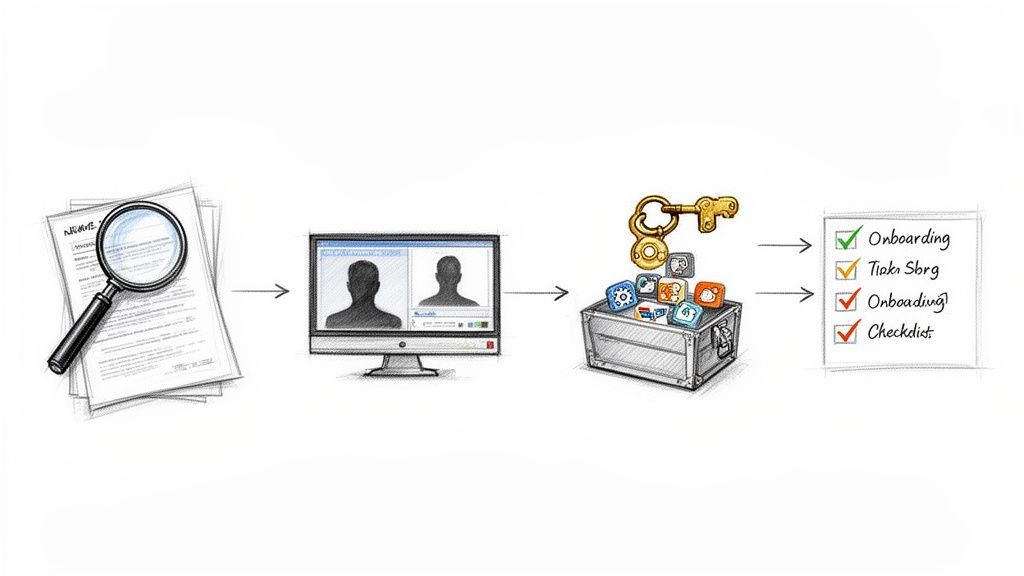
Essential Onboarding Checklist:
- Grant Secure Access: Set them up with a staff account in Shopify with limited permissions. Give them access to other key tools like your helpdesk, project manager (Trello, Asana), and comms channels (Slack).
- Share Your SOPs: Hand over clear, step-by-step Standard Operating Procedures (SOPs) for their main tasks. If you don’t have any, now's the time to create them. Pro tip: video walkthroughs using a tool like Loom are incredibly effective.
- Introduce the Brand: Give them a brand guide that covers your mission, voice, and tone. This is non-negotiable for keeping things consistent, especially in customer-facing roles.
- Set Clear Expectations: Spell out how you'll communicate (e.g., daily check-ins), their expected work hours, and the key performance indicators (KPIs) you’ll be watching.
- Schedule a Kick-off Call: Run through everything together, answer their questions, and introduce them to anyone else on the team. That personal touch makes all the difference.
Automate and Scale with an AI-Powered Assistant
While human virtual assistants are fantastic at handling nuance, the real path to scaling your e-commerce brand is through smart automation. This is where a specialized AI tool like MAILO AI comes into play, acting as your smartest and most tireless virtual assistant. It's built specifically to solve the support headaches that bog down Shopify stores, delivering immediate, practical results.
Picture your support inbox on a chaotic Monday morning. Instead of a jumbled mess of emails, an AI-powered Smart Inbox has already sorted and prioritized everything for you. An urgent refund request from a VIP customer is flagged right at the top, while dozens of simple "where is my order?" questions have already been answered automatically. This isn't some far-off dream; it's how top e-commerce teams are getting ahead right now.
From Manual Work to Intelligent Automation
At its core, an AI assistant is designed to take over high-volume, repetitive tasks and execute them with perfect accuracy, every single time. It plugs directly into your store’s live data, turning a basic customer question into a highly personalized and helpful interaction.
For instance, when a customer asks, "Where is my package?" MAILO AI doesn’t just spit out a generic template. It instantly fetches the live order data from Shopify, crafts a perfectly on-brand reply with the customer's specific tracking information, and closes the ticket in seconds. Think about how many hours that one simple workflow can save your team each week.
By automating the predictable, you free up your team to focus on the exceptional. An AI assistant handles the noise, so your human experts can manage complex issues, build real customer relationships, and focus on growing the business.
Proactive Support That Builds Loyalty
A truly great e-commerce virtual assistant doesn’t just wait for problems to happen—it actively creates positive experiences for your customers. This is another area where AI shines, using data to anticipate what customers need and keep them engaged.
- Automated Review Requests: The AI knows exactly when an order has been delivered and can automatically send a polite, personalized email asking for a product review.
- Post-Purchase Follow-Ups: It can also check in with customers a week or so after delivery just to make sure they’re happy with their purchase, opening the door for valuable feedback or even an upsell opportunity.
This kind of automation helps everyone. Founders get their time back from the support queue, managers get clear analytics on team performance, and agencies can ensure a consistent brand voice across all their client stores. To really get an edge, you can look into integrating the best AI tools for ecommerce to work alongside your support system.
When you're ready, you can explore our guide on how to use ecommerce marketing automation to turn your support desk into a genuine revenue driver. This is where you move from just understanding VAs to seeing the powerful results of AI in action.
Your Top Questions About E-Commerce VAs, Answered
If you're thinking about bringing on a virtual assistant, you've probably got a few questions. Let's tackle some of the most common ones that DTC founders ask so you can get a clearer picture of what to expect.
How Much Does an E-Commerce Virtual Assistant Cost?
The price tag for a VA can swing wildly. A human virtual assistant might cost anywhere from $5 to over $50 an hour, all depending on where they're based, what they know, and how complex their work is. For top-tier talent in the United States, you could be looking at an annual salary around $40,842.
AI assistants, on the other hand, play a different game. Tools like MAILO AI run on a subscription fee tied to how much you use them, giving you a predictable monthly cost that can grow with your store. The real question isn't just about the upfront cost; it's about figuring out how much your time is worth and weighing that against the investment.
What Tools Do I Need to Work With a VA?
Getting set up is usually pretty simple. For a human VA, you'll need the basics: a communication channel like Slack, a way to manage tasks with something like Trello, and a staff account for them to securely access your e-commerce platform.
If you’re hiring a VA for customer support, a proper helpdesk system is a must-have. An AI assistant like MAILO AI plugs right into your Shopify store and email provider, so there’s almost no extra setup involved—it becomes the central hub for support.
The goal is seamless collaboration. A good tool stack ensures your VA has everything they need to operate efficiently without compromising your store’s security or data.
How Do I Make Sure My Brand Voice Stays Consistent?
This is a big one. Your brand's voice is its personality, and you can't afford to lose it. When working with a person, you’ll need a rock-solid brand style guide and some dedicated training upfront to get them on the same page.
This is where modern AI really shines. Platforms like MAILO AI are built to learn your specific brand voice. You can actually tune its personality, from the tone it uses to the exact phrases it prefers, making sure every automated email sounds like it came straight from you.
Ready to transform your support and reclaim your time? MAILO AI integrates with Shopify to automate up to 80% of your customer emails with on-brand, accurate answers. Start your free trial today!