

Average Handling Time (AHT) isn't just another piece of support jargon. Think of it as the total time, from start to finish, that an agent spends on a single customer issue. This clock starts the second a customer reaches out and only stops after the agent has finished all the follow-up work, like adding notes or tagging the ticket.
It's one of the most fundamental KPIs in customer service because it’s a direct measure of your team's efficiency. A consistently high AHT is often a red flag, pointing to deeper issues that can quietly drain your budget and chip away at customer loyalty.
What Average Handling Time Reveals About Your Business
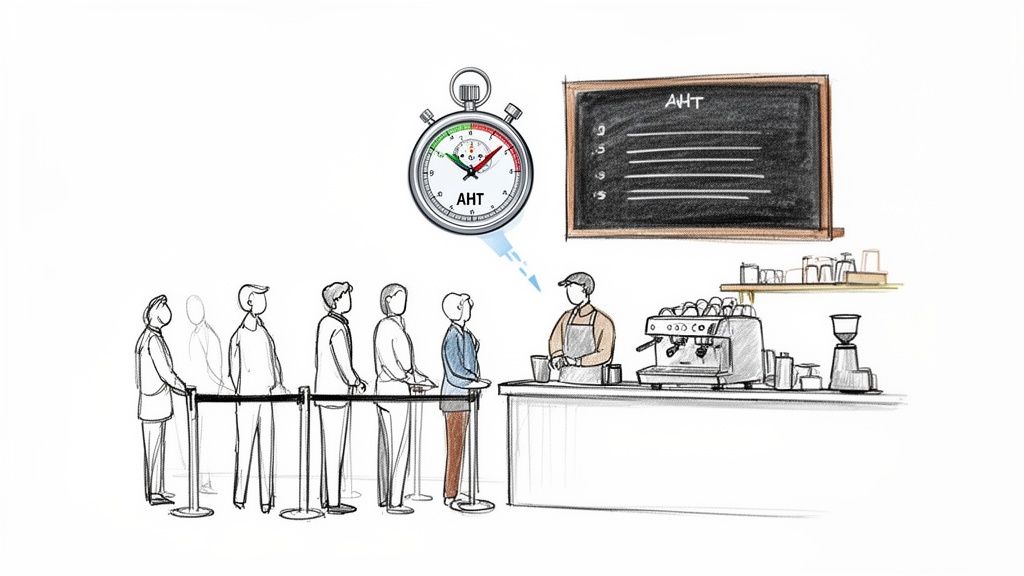
Picture your support desk as a busy downtown coffee shop. The AHT is the entire time it takes for one person to get through the line—from ordering and paying to waiting for their drink and walking away, freeing up the barista for the next customer.
If that line is moving painfully slow, it's probably not just because the barista is slow. It could be a confusing menu, a clunky payment system, or a disorganized workspace.
The same is true for your e-commerce store. A high AHT is rarely just about "slow agents." It’s a powerful diagnostic tool that shines a light on hidden friction points in your entire operation. It’s a direct pulse check, telling you that something is making it harder than it needs to be for your team to solve customer problems quickly.
Breaking Down the Components of AHT
To really get what AHT is telling you, you have to look at what it's made of. Every customer conversation—whether it's on the phone, via email, or in a live chat—is built from three key phases that add up to your final AHT number.
- Total Talk Time: This is the hands-on time your agents spend communicating directly with the customer. On a call, it's the actual conversation. For an email, it's the time spent actively composing the response.
- Total Hold Time: This is all the dead air. It’s any time a customer is left waiting while your agent scrambles to find information, checks with a supervisor, or digs through another system to find order details.
- Total Wrap-Up Time: Also known as After-Call Work (ACW), this is the "cleanup" time after the conversation is over. It includes logging notes in the CRM, updating the ticket status, or tagging the issue for reporting.
A high AHT can be traced back to a problem in any of these areas. For example, long hold times might mean your team can't easily access Shopify order data. Extended wrap-up times could point to clunky internal processes that desperately need an overhaul.
By dissecting AHT into these parts, you move beyond a simple time-based metric and start uncovering actionable insights. You can pinpoint exactly where the bottlenecks are in your support workflow.
Ultimately, getting your AHT down isn't about rushing your agents or compromising on quality service. It's about systematically removing the roadblocks that frustrate both your team and your customers. When you get this right, your support team transforms from a cost center into a powerful engine for building loyalty and driving scalable growth—a must-have for any brand serious about competing online.
How to Accurately Calculate and Track Your AHT
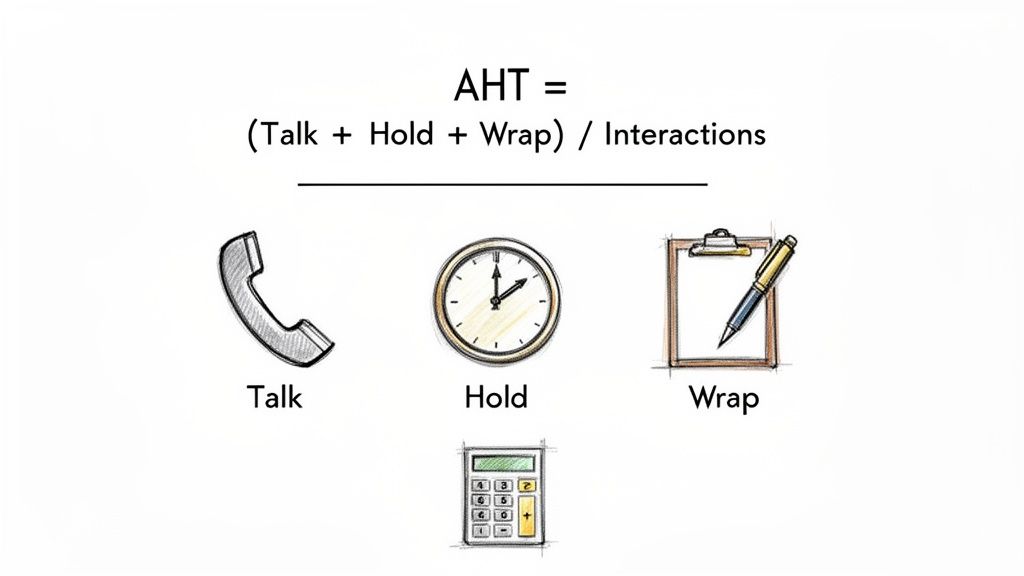
Ready to move past guesswork? Improving your support efficiency starts with understanding exactly where your team's time is going. Calculating your Average Handling Time is straightforward once you know the formula, which captures the entire lifecycle of a customer ticket.
The classic formula looks like this:
AHT = (Total Talk Time + Total Hold Time + Total Wrap-Up Time) ÷ Total Number of Interactions
This equation gives you the full picture. It accounts for every second an agent spends on a customer's problem—from the moment they start a conversation to the final notes they add after it's resolved.
Let's see how this plays out in a real e-commerce store.
AHT Calculation Example for an Ecommerce Store
Imagine your Shopify store's support team—let's say it's just two people—handled 100 email tickets in one day. To get their AHT, you just need to add up the time they spent on the three core activities.
Here’s a practical breakdown of what their day might look like.
| Metric | Total Time (Minutes) | Calculation |
|---|---|---|
| Total Talk Time | 250 minutes | The combined time agents spent actively writing replies to customers. |
| Total Hold Time | 100 minutes | Time spent waiting for info from other teams or looking up order details. |
| Total Wrap-Up Time | 150 minutes | Time spent tagging tickets, adding notes, or updating the customer’s profile. |
| Total Interactions | 100 tickets | The total number of unique conversations handled. |
Now, we just plug these numbers into the AHT formula:
(250 minutes + 100 minutes + 150 minutes) ÷ 100 tickets = 5 minutes
So, the average handling time for email support on this day is 5 minutes per ticket. This simple number is your baseline. It's the starting point you'll measure against as you bring in new tools or train your team. AHT is just one of several key metrics, and you can learn more about how to measure customer service performance in our comprehensive guide.
Common Tracking Mistakes to Avoid
Here’s where a lot of brands go wrong. Calculating a single, store-wide AHT number can be incredibly misleading. The real insights come from tracking it with more nuance.
One of the biggest mistakes is failing to segment your data. Think about it: the AHT for a simple "Where is my order?" (WISMO) request will always be lower than for a complex technical issue or a damaged product claim. Lumping them all together just gives you a blurry average that doesn't really tell you anything useful.
To make AHT a truly valuable metric, you have to steer clear of these common pitfalls:
- Ignoring Channel Differences: Your AHT for live chat, email, and phone calls will never be the same. Each channel moves at a different pace. You absolutely must calculate and benchmark them separately.
- Not Segmenting by Issue Complexity: Start creating ticket categories like "Billing," "Shipping," or "Product Defect." Tracking AHT for each category will immediately show you which types of inquiries are eating up the most time. This is how you spot opportunities for better FAQs or agent training.
- Focusing Only on Speed: This is the most dangerous mistake of all. If you pressure agents to lower their AHT without also looking at customer satisfaction (CSAT), you’re setting yourself up for failure. Rushed interactions create unresolved issues, which means frustrated customers will just contact you again.
By avoiding these traps, you can turn AHT from a vanity metric into a powerful diagnostic tool. When you track it correctly, you get a clear view of what’s happening on your support front lines, empowering you to make smart decisions that help your team, your customers, and your bottom line.
Why AHT Is a Critical Ecommerce Performance Metric
Let’s be honest, a high average handling time isn't just another number on a dashboard. It’s a bright red warning light for your entire business. While it looks like a simple measure of speed, AHT is actually a powerful window into the health of your customer experience and your operational efficiency. Think about it: long, drawn-out support conversations and frustrating wait times are the perfect recipe for a terrible customer journey.
When a customer is stuck waiting for a resolution, their patience quickly evaporates. That frustration often leads them straight to abandoning their shopping cart and, if it's bad enough, your brand for good. A clunky, slow support process sends a clear message: you don't respect their time. In the cutthroat world of e-commerce, that’s a mistake you can't afford to make.
The True Cost of Inefficiency
The damage from a high AHT doesn't stop at a single lost sale. It creates a ripple effect that can seriously harm your business from multiple angles.
- Skyrocketing Operational Costs: Every extra minute an agent spends on a ticket is money out of your pocket. A team bogged down by inefficient workflows can't handle as many tickets, which means you’re forced to either hire more people or let response times slip. Both options are expensive.
- Plummeting Customer Satisfaction (CSAT): Speed is a huge part of what makes customers happy. When they get quick, helpful answers, they feel seen and valued. On the flip side, long hold times and endless email chains almost always lead to bad reviews and tanking loyalty.
- Spiking Agent Burnout: Imagine constantly dealing with unhappy customers while fighting with clunky software. It's a fast track to burnout. When agents don't have the tools to solve problems quickly, morale drops, turnover increases, and you're stuck with the high cost of hiring and training new staff.
And this isn't a problem that's going away. As customers get better at using self-service for simple questions, the tickets that actually land in your agents' inboxes are the tough ones—more complex, more emotional, and more time-consuming. This shift has pushed handling times up across the board.
In fact, AHT in call centers has nearly doubled over the past two decades, climbing from 220 seconds in 2004 to a staggering 426 seconds in 2022. This has a direct impact on how long people wait, contributing to a 9.1% call abandonment rate as shoppers simply give up. One study even found that 48% of customers will jump to a competitor after just one bad service experience. You can explore more data on these industry standards to see the full picture.
AHT as Your Secret Diagnostic Tool
Instead of seeing a high AHT as a sign of failure, think of it as your secret weapon for finding what's broken. It's an unbiased metric that points directly to the cracks in your internal processes. By digging into why your AHT is high, you can uncover hidden problems that are secretly holding your business back.
For example, if you notice agents are spending a lot of time in the wrap-up phase, it could mean they're bogged down with manual data entry or that your documentation process is a mess. Or maybe your hold times are through the roof. This often signals that agents can’t quickly pull up crucial customer data from your Shopify store, forcing them to waste time switching between different systems.
When you start optimizing your average handling time, you're doing more than just making things faster. You're fundamentally shifting your support from a costly, reactive fire-drill to an efficient, proactive operation. This change doesn't just save you money—it transforms your customer service team into a powerhouse for building brand loyalty and driving repeat business. It's about creating a support experience so seamless it becomes one of your biggest competitive advantages.
Setting Realistic AHT Benchmarks for Your Store
You've crunched the numbers and calculated your store's Average Handling Time. Now what? Is that number a reason to pop the champagne or a signal that something's off?
Truthfully, there’s no single, universal "good" AHT. What’s considered fantastic for a simple t-shirt store might be a disaster for a shop selling complex, customizable furniture. It all comes down to your products, your customers, and the support channels you use.
Setting the right benchmarks isn't a race to the bottom. If you push your team for an impossibly low AHT, you'll almost certainly see quality suffer. Agents rush, mistakes are made, and customers have to call back because their issue was never truly solved. The real goal is to find that sweet spot between efficiency and a great customer experience.
Average Handling Time Benchmarks By Industry and Channel
To get your bearings, it helps to see what’s considered typical out in the wild. Looking at industry-wide and channel-specific benchmarks gives you a solid starting point and helps you understand where you fit in the broader e-commerce landscape.
Here’s a look at some common AHTs across different channels and industries to give you some context.
| Channel / Industry | Average Handling Time (AHT) | Key Considerations for E-commerce |
|---|---|---|
| Phone/Voice Support | 6 - 8.5 minutes | Complex order issues (e.g., damaged goods, detailed product questions) often take longer. This is the highest AHT channel. |
| Live Chat | 2.5 - 5 minutes | Great for quick questions and real-time troubleshooting. Agents often handle multiple chats, which can influence this number. |
| Email Support | 10 - 20 minutes | While it seems high, this reflects the total active time an agent spends reading, researching, and composing a thorough response. |
| Social Media Support | 5 - 10 minutes | Requires a blend of speed and brand voice. AHT can vary wildly depending on the platform and complexity of the public query. |
| Retail & E-commerce | Around 4.7 minutes | This is a general blended average. Your AHT will likely differ based on your product's technicality and your support channel mix. |
While these numbers provide a useful yardstick, remember they are just averages. A store selling high-end electronics will naturally have a longer AHT than one selling stickers, and that’s perfectly okay.
This chart drives home what happens when AHT isn't managed effectively. It's not just a metric on a dashboard; it has a real, tangible impact on your bottom line and your team's well-being.
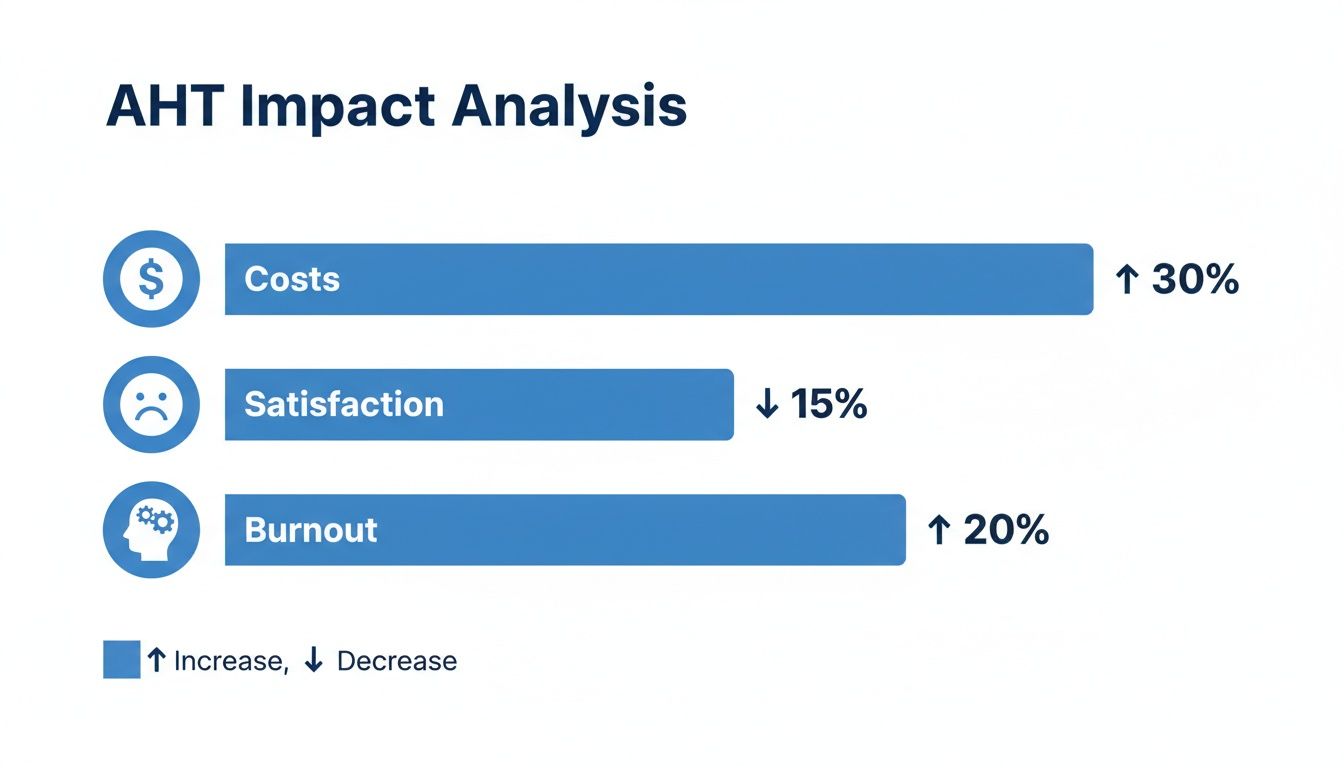
As you can see, letting AHT creep up leads to higher operational costs, a noticeable drop in customer satisfaction, and an increase in agent burnout. It's a triple threat you want to avoid.
Finding the Right Balance
A great AHT isn't just about the final number—it's about what goes into it. Think of it like a recipe. You need the right balance of ingredients: talk time, hold time, and after-call work (or wrap-up time).
For a typical customer support call, a healthy breakdown often looks like this:
- Talk Time (65-75%): This is the main event. The bulk of the interaction should be the agent and customer working together toward a solution.
- Hold Time (10-20%): Keep this to a minimum. Every second a customer is on hold feels like an eternity, so aim to keep it under 60 seconds per call.
- Wrap-Up Time (10-20%): This is the time agents spend logging notes and finishing tasks after the customer hangs up. If this number is high, it’s a red flag for inefficient processes.
By looking at AHT this way, you can spot the real problems. Is hold time too long? Maybe your agents can't find order information fast enough. Is wrap-up time dragging on? You might need better software or automation to handle the post-call busywork.
Ultimately, the most important benchmarks are your own. Use industry standards to get started, but then dive into your own data. Track your AHT over time, see how it changes by issue type, and pinpoint the numbers that signal both peak efficiency and happy, loyal customers for your store.
Actionable Strategies to Reduce Your Average Handling Time
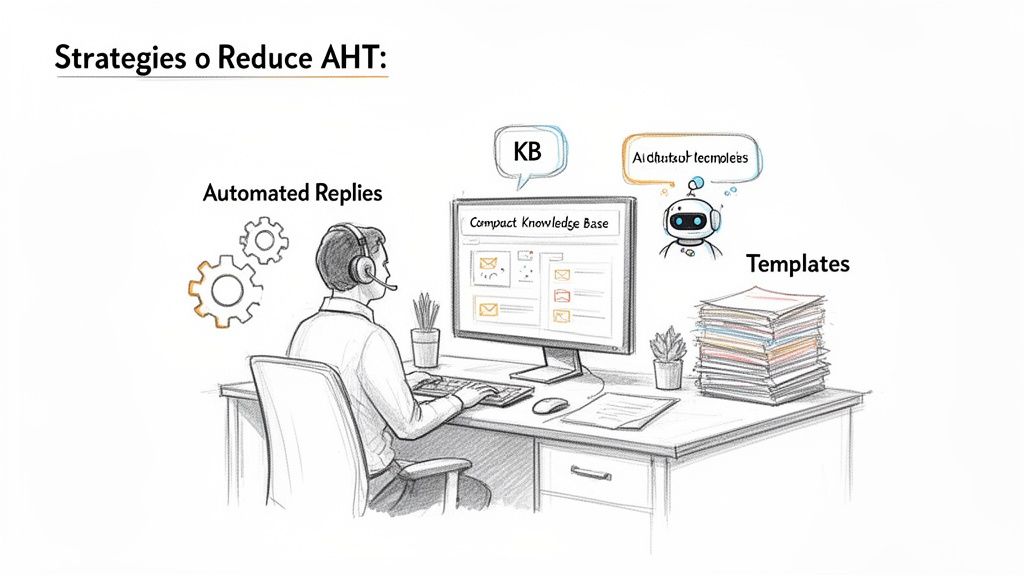
Knowing your AHT is one thing, but actually improving it is where the magic happens. The goal isn't to rush your agents or sacrifice quality for speed. It’s about finding and eliminating the friction points that drag out customer conversations.
When you do it right, you empower your team to solve problems faster, which makes for happier customers and a more efficient operation. Many of the culprits behind high AHT—like agents digging for information or typing the same reply for the tenth time that day—are completely fixable. Let's dig into some proven tactics you can put into action.
Build a Powerful Internal Knowledge Base
One of the biggest time-sinks for any support team is the dreaded information hunt. Every second an agent spends putting a customer on hold to ask a manager about a return policy or track down a product spec, your AHT ticks upward.
An internal knowledge base solves this by creating a single source of truth for your entire team. Think of it as your company's private encyclopedia.
A great knowledge base should be packed with everything your agents need to answer questions with confidence:
- Standard Operating Procedures (SOPs): Simple, step-by-step guides for handling everyday tasks like refunds, exchanges, or warranty claims.
- Product Information: All the nitty-gritty details, from specs and FAQs to troubleshooting steps for every item you sell.
- Company Policies: The latest info on shipping, returns, current promotions, and more.
When this resource is well-maintained, new hires get up to speed in record time, and your entire team delivers consistent, accurate answers. Focusing on ways to improve workplace productivity is a surefire way to boost overall efficiency and get that AHT down.
Create and Refine Your Email Templates
If you run an e-commerce store, you know that many customer questions are repeats. "Where is my order?," shipping cost inquiries, and return instructions probably fill up your inbox daily. Typing out a thoughtful, detailed response to each one is a huge drain on your team's time.
This is where email templates and macros (or canned responses) are an absolute lifesaver. By crafting high-quality, pre-written answers to your most frequent questions, you can slash the AHT on those tickets from minutes down to seconds.
A great template isn't just a generic block of text. Effective templates use placeholders for customer names and order numbers, allowing for quick personalization that still feels human and helpful.
Don't just set them and forget them. Make a habit of reviewing which templates get the most use and tweak them based on customer feedback. It’s a simple process that keeps your team armed with the best possible answers.
Embrace AI and Automation for Maximum Impact
Ultimately, the fastest way to lower AHT is to take the tedious, manual work off your agents' plates. Modern AI tools are built to do exactly that, automating repetitive tasks and giving agents the information they need the second they need it. The right technology isn't just a nice-to-have; it's a total game-changer.
For Shopify stores, a platform like Mailo AI is built from the ground up to tackle these exact challenges. It plugs directly into your store's data, delivering instant, context-aware support that can dramatically cut your handling time.
Here’s what that looks like in the real world:
- AI-Generated Replies: Instead of relying on static templates, AI can draft personalized, on-brand responses to common questions in a flash. Your agent can simply review and send, or you can let the system run on full auto-pilot for certain inquiries.
- Instant Order Context: Mailo’s Shopify integration places all key customer and order details right inside the support ticket. No more jumping between tabs to find order numbers, check shipping status, or look up a customer's purchase history.
- Automatic Ticket Classification: The system instantly reads, categorizes, and prioritizes incoming emails. Urgent issues like order cancellations can get flagged for immediate attention, while simpler questions are handled with automation, freeing up your agents to focus on the tricky stuff.
While the average AHT for global call centers hovers around 6 minutes and 10 seconds, customers on digital channels expect even faster service. A Salesforce survey of 17,000 consumers found that 48% will switch brands for a better customer experience. Tools like Mailo AI directly address this by using integrated order data to eliminate manual lookups, helping brands cut their AHT by 9% while boosting resolutions per hour by 14%. The first step is to learn how to automate customer service and see how it can transform your support workflow.
Bringing It All Together: A Smarter Approach to AHT
So, we've covered a lot of ground—from what Average Handling Time actually is, to how you can calculate and benchmark it, and finally, how to start chipping away at that number. It’s pretty clear by now that AHT isn't just about timing your support agents with a stopwatch. When you manage it thoughtfully, it becomes one of your sharpest tools for growing your business.
The old-school view of customer support as a cost to be minimized is completely outdated. In the cutthroat world of e-commerce, your support team is your front line for building real brand loyalty and getting customers to come back. Every single ticket is a chance to make a fan or lose a customer, and AHT tells you how efficiently you’re handling those critical moments.
The real magic isn't just in making the number smaller, but in digging into what it’s telling you. Is your team spending ages on hold? Maybe they need better training or a more robust knowledge base. Is after-call work taking forever? Your internal systems might be clunky and slow. Answering these questions is the first real step toward making things better.
Efficiency That Puts the Customer First
Look, the goal isn't just speed for speed's sake. If you push your team to hit an aggressive AHT target, you’ll likely end up with rushed answers, unresolved problems, and customers who have to contact you again. That completely misses the point. The focus should be on empowering your team to be both fast and good.
This really boils down to a few key things:
- Better Tools: Give agents a solid internal knowledge base so they can find accurate answers without having to ask a manager.
- Smarter Workflows: Set up great templates and macros that let your team handle common questions quickly, but still with a personal touch.
- The Right Tech: Use AI and automation to handle the repetitive, manual tasks, freeing up agents and giving them all the order info they need in one place.
An optimized support team isn't just faster—it's smarter. When you get rid of the friction that slows agents down, you give them the space to tackle the tough problems and deliver the kind of service people remember.
To really get this right, weaving in some best practices for performance management will give you a solid foundation. It helps shift the entire team’s mindset from "How fast can I close this ticket?" to "How well can I solve this customer's problem?"
When you adopt this approach, you turn your support team from a simple cost center into a powerhouse that drives customer loyalty. You won't just see your AHT go down; you'll build a stronger business with happy customers who feel like you actually value their time. And that’s what really matters.
Your AHT Questions, Answered
Even when you've got a handle on the basics, a few specific questions about average handling time always seem to pop up. Let's tackle the most common ones we hear from e-commerce managers to clear up any lingering confusion.
Is a Lower AHT Always Better?
Absolutely not. It's a tempting trap to fall into, but chasing the lowest possible AHT can be incredibly destructive. A number that looks too good is often a huge red flag. It usually means agents are rushing through conversations, leaving customers with unresolved problems and a bad taste in their mouths.
Think about it. A complex issue, like troubleshooting a defective product or navigating a tricky international return, simply takes more time to get right. If an agent spends seven minutes solving a tough problem on the first try, saving that customer from ever having to contact you again, that's a massive win. It’s far more valuable than a two-minute call that solves nothing and forces the customer to call back angry.
The real goal isn't the lowest AHT; it's the optimal AHT. It’s about finding that sweet spot where your team is working efficiently but still delivering a high-quality, satisfying experience. Sacrificing customer happiness for speed is a trade-off that will always come back to bite you in the form of frustrated customers and higher churn.
How Does AHT Differ Across Support Channels?
Average handling time is not a one-size-fits-all metric. It varies wildly from one channel to the next, so setting different goals for each is crucial for getting an accurate read on performance.
Here’s a quick breakdown of what to expect:
- Phone Support: This is almost always the channel with the longest AHT. Conversations are live, in-depth, and often involve walking a customer through a complicated process. There's no hiding here.
- Live Chat: AHT tends to be much quicker in chat. Experienced agents can often juggle a few conversations at once, and many chats are for simple questions that can be answered with a quick template or a link to a help article.
- Email Support: Email is the odd one out. The actual time an agent spends typing a single response might be short, but the full resolution time can stretch out over several back-and-forth messages. The key is to track the active handling time for each reply, not the total ticket lifespan.
Benchmarking each channel on its own gives you a much more honest view of your team's efficiency. A five-minute AHT on a phone call might be fantastic, but that same five-minute AHT on a simple chat could signal a problem.
What Is the Best First Step to Improve My Team's AHT?
Before you start trying to fix things, you need to know what’s actually broken. The best first step is always the same: dig into your data to understand where your team’s time is really going. Don't guess.
Start by breaking your AHT down into its three parts: talk time, hold time, and after-call work (or wrap-up time). This simple act will immediately point you to your biggest time sink.
- Is wrap-up time through the roof? Your agents might be bogged down with manual data entry or clunky internal processes. Automation could be a quick win here.
- Are conversations themselves just too long? This often points to knowledge gaps. Maybe your team needs better training or a more robust internal knowledge base to find answers faster.
- Is hold time the real villain? This is a classic sign that agents are struggling to find information. They might be toggling between five different tabs just to find an order status, a problem that better tool integrations can solve.
By first identifying your main bottleneck—like agents manually searching through Shopify for order details—you can focus your energy on the solution that will make the biggest impact right away.
Ready to slash your AHT without sacrificing quality? MAILO AI integrates directly with Shopify to give your team instant order context, AI-generated replies, and powerful automation that eliminates manual work. Start your free trial today and see how much time you can save.