

When we talk about customer service KPIs, we're really talking about the vital signs of your support team. They're the specific, measurable numbers that tell you how effective and efficient your whole operation is. Think of them as a check-up for your business, revealing everything from how happy your customers are to how productive your team is, which helps you make smart decisions that actually lead to growth.
Why KPIs in Customer Service Are Your E-commerce Growth Engine
Trying to run an e-commerce business without data is like trying to sail a ship without a compass. Sure, you're moving, but are you headed in the right direction or straight into a storm? Key Performance Indicators (KPIs) are the tools that guide you, giving you the critical information you need to steer your business toward loyal customers and healthy profits.
It really boils down to this: what gets measured gets managed. If you ignore these metrics, you're flying blind. You're risking lost sales, a damaged reputation, and customers leaving for your competitors. This isn't just about collecting numbers for the sake of it; it's about understanding the story those numbers are telling. A sudden dip in your satisfaction scores or a spike in how long it takes to solve a problem? Those are red flags that something needs your attention, and fast.
The Foundation of Strategic Support
In this guide, we won't just cover what to track—things like response times, resolution rates, and satisfaction scores. We'll show you how to turn that data into real, strategic action. Getting a handle on these metrics is the first step to building a support team that doesn't just put out fires but actively contributes to your bottom line.
This shift toward data-driven support is happening everywhere. The global customer service software market was valued at $14.9 billion in 2024 and is expected to rocket to $68.19 billion by 2031. That kind of explosive growth tells you that businesses, especially e-commerce brands on platforms like Shopify, are all-in on using data to improve their support.
To truly connect the dots between your support efforts and long-term profitability, you need to go a step further. It's about mastering Customer Lifetime Value calculation, an essential metric that ties your support performance directly to revenue.
Visualizing Your Performance
To make good decisions, you have to be able to see your data clearly. Having a single dashboard that shows your key metrics in real-time isn't a luxury anymore; it's a must-have for any modern e-commerce brand.
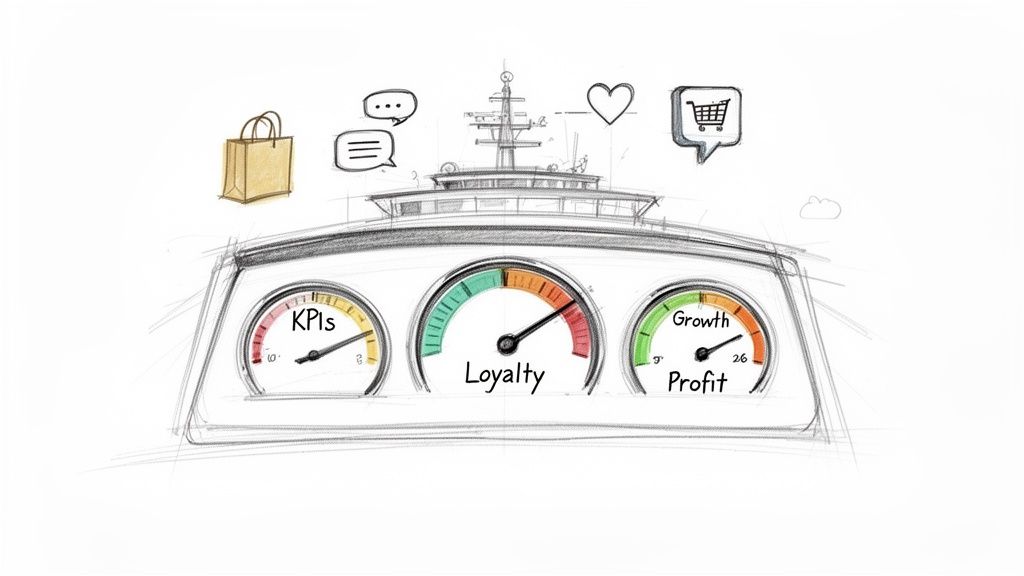
This is where tools like MAILO AI really shine. They take all that complex data and turn it into a simple, visual overview, so you can check your performance at a glance. Instead of wasting time digging through spreadsheets, you can instantly spot trends, identify problems, and figure out what’s causing them. This kind of visibility allows your team to shift from just reacting to problems to proactively building a better customer experience—turning customer support from a cost center into a powerful engine for growth.
The 8 Core Customer Service KPIs Every Shopify Store Must Track
Alright, we’ve established that tracking performance isn’t optional—it’s essential. Now, let’s get into the nitty-gritty: the actual metrics that will tell you if your support operation is sinking or swimming.
Think of these eight KPIs as the dashboard for your customer service engine. Each one tells a crucial part of the story, from how fast your team is to how happy your customers are. They’re all connected, too. Push too hard on one—say, speed—and you might see another, like customer satisfaction, take a hit. The real magic happens when you find the right balance, creating a support experience that’s both a well-oiled machine for you and a delight for your customers.
To give you a quick overview, here’s a handy table that breaks down the essentials.
Essential Customer Service KPIs at a Glance
| KPI | Formula | What It Measures |
|---|---|---|
| First Response Time (FRT) | Total Time to First Response / Total Tickets | How quickly you acknowledge a customer's request. |
| Average Resolution Time (ART) | Total Resolution Time / Total Tickets | The total time it takes to fully solve an issue. |
| Customer Satisfaction (CSAT) | (% of "Satisfied" Responses) x 100 | Immediate happiness with a specific interaction. |
| Net Promoter Score (NPS) | % Promoters - % Detractors | Overall brand loyalty and willingness to recommend. |
| Ticket Volume | Total number of support requests | The total demand placed on your support team. |
| Automation Rate | (Tickets Resolved by Automation / Total Tickets) x 100 | The percentage of tickets solved without human touch. |
| Ticket Reopen Rate | (Reopened Tickets / Total Tickets) x 100 | How often "solved" issues aren't actually solved. |
| Cost Per Ticket | Total Support Costs / Total Tickets | The average expense to resolve a single inquiry. |
This table is your cheat sheet. Now, let's dive deeper into each of these metrics to understand what they really mean for your business.
1. First Response Time (FRT)
First Response Time (FRT) is exactly what it sounds like: how long does a customer have to wait for your team to say, "I'm on it"? It's the digital equivalent of a friendly greeting when someone walks into a physical store. A fast FRT immediately tells your customer, "We see you, we value your time, and we're here to help."
This metric is so important because it sets the tone for the entire conversation. A long, silent wait can breed frustration before your team even gets a chance to work their magic.
Formula: Total Time to First Response for All Tickets / Total Number of Tickets = Average First Response Time
For e-commerce email support, a good target to shoot for is under 6 hours. But let's be real, the top brands are often replying in under an hour. This is where tools like MAILO AI can be a game-changer, automatically sending intelligent acknowledgments in seconds to confirm receipt and set clear expectations.
2. Average Resolution Time (ART)
While FRT is about the first hello, Average Resolution Time (ART) measures the entire journey from "hello" to "problem solved." It tracks the full lifecycle of a ticket, from the moment it's created until it’s officially closed for good. This KPI is a powerful reflection of your team’s efficiency and how well they know your products and processes.
Is your ART creeping up? It could be a sign that your agents are struggling to find information, that your internal workflows are clunky, or that you just don't have the right tools in place.
Formula: Total Resolution Time for All Tickets / Total Number of Tickets = Average Resolution Time
Getting this number down is a huge driver of customer happiness. A closely related metric, First Contact Resolution (FCR), shows that modern shoppers expect speed and quality. In fact, 45% of consumers demand their issues be solved in the very first interaction. You can find more details about how crucial first interactions are in this analysis of customer service metrics from globalresponse.com.
3. Customer Satisfaction Score (CSAT)
CSAT is your most direct line to understanding customer happiness. It’s that simple, post-chat survey asking, "How satisfied were you with the support you received?" Customers usually answer on a simple scale, like 1-5.
This metric gives you instant, granular feedback on specific interactions. It helps you pinpoint exactly which agents are knocking it out of the park and where there might be opportunities for coaching. A consistently high CSAT score is one of the clearest signs that your team is firing on all cylinders.
Formula: (Number of "Satisfied" Responses / Total Number of Survey Responses) x 100 = CSAT Score (%)
4. Net Promoter Score (NPS)
If CSAT is about a single interaction, Net Promoter Score (NPS) zooms out to measure a customer's overall loyalty to your brand. It’s all based on one powerful question: "On a scale of 0-10, how likely are you to recommend our brand to a friend or colleague?"
Responses sort customers into three camps:
- Promoters (9-10): These are your die-hard fans who will sing your praises.
- Passives (7-8): They're happy enough, but not loyal enough to shout from the rooftops.
- Detractors (0-6): These are unhappy customers who might actively tell others to stay away.
NPS is a great predictor of future growth. It’s a reflection of the entire customer journey—product, shipping, and service all rolled into one.
Formula: % of Promoters - % of Detractors = Net Promoter Score
5. Ticket Volume
This one seems basic, but don't underestimate its power. Ticket Volume is simply the total number of support requests you get over a certain period (day, week, month). It's the foundation for all your staffing and resource planning.
A sudden spike in tickets is your early warning system. It could mean anything from a bug on your website to a new product causing confusion or a widespread shipping delay. By tracking and categorizing these tickets, you can spot trends and tackle the root cause before things spiral.
6. Automation Rate
For any e-commerce brand looking to scale, this is one of the most important KPIs in customer service. Automation Rate measures the percentage of questions that are resolved completely without a human agent ever touching them.
A high automation rate is a beautiful thing. It means your self-service resources and AI tools are successfully handling the simple, repetitive stuff. This frees up your human experts to focus on the complex, emotionally charged conversations where they can really make a difference. We've published an in-depth guide with more examples of customer support KPIs that can help you dial in your automation strategy.
Formula: (Number of Tickets Resolved by Automation / Total Number of Tickets) x 100 = Automation Rate (%)
7. Ticket Reopen Rate
Ticket Reopen Rate is a critical quality check. It measures how often a customer replies to a ticket after an agent has already marked it as "solved."
Think of a high reopen rate as a big red flag. It’s telling you that your team's first answers aren't hitting the mark. Maybe agents are closing tickets too quickly, or the solutions they're providing are incomplete. Getting this number as low as possible means you’re truly solving problems the first time around, which is a win for both efficiency and customer trust.
8. Cost Per Ticket
Finally, we have to talk about the money. Cost Per Ticket calculates the average expense to resolve a single customer issue. This is how you measure the financial health and ROI of your entire support operation.
To figure this out, you need to add up all your monthly support costs—agent salaries, software subscriptions (like your helpdesk), and any other overhead—and divide it by the number of tickets you handled that month.
Formula: Total Monthly Support Costs / Total Number of Tickets in That Month = Cost Per Ticket
By keeping a close eye on this metric, you can make smarter decisions about where to invest. For example, if an AI tool like MAILO AI can boost your automation rate and cut down agent handling time, you'll see a direct drop in your Cost Per Ticket. That’s how you prove its value.
Matching KPIs to Your Business Stage
Tracking customer service KPIs isn't a "one-size-fits-all" game. The metrics you obsess over as a scrappy startup will—and should—be completely different from the ones that drive a mature, scaled-up brand. If you don't align your focus with your business stage, you're just collecting numbers. The goal is to use the right data to make smart decisions.
Think of it like building a house. At first, you're all about getting the foundation right (that's your customer feedback). You're not worried about the color of the curtains (profitability per ticket) just yet. As you grow, your priorities naturally shift from just getting the structure up to making sure everything runs efficiently.
Startup Stage: Finding Your Footing
In the early days, your entire mission is to prove your product has a place in the market and to build a small, fiercely loyal following. You’re not worried about hyper-efficiency; you’re focused on creating an incredible experience that gets people talking. This is the time for rich, qualitative insights, not just quantitative scale.
The main goals are simple: understand your customers on a deep level and perfect their experience.
- Primary KPI Focus: Customer Satisfaction (CSAT) is king. Every single piece of feedback, good or bad, is gold. A high CSAT score tells you you're on the right track, while any negative comments give you a clear roadmap for what to fix.
- Secondary KPI to Watch: Ticket Volume by category. This is your early warning system. It helps you spot recurring issues with your product, shipping, or website before they snowball into major problems.
A tool like MAILO AI can be a lifesaver here. It automatically tags incoming emails, giving you an instant, organized view of what customers are asking about most. This frees you from the manual grind of sorting feedback so you can focus on fixing the root causes.
Growth Stage: Building for Scale
Once you've got a solid product and a growing customer base, the game changes. Ticket volume starts to climb, and the manual, high-touch processes that worked with a small team begin to crack under the pressure. The focus has to shift toward efficiency and creating repeatable systems that don't sacrifice quality.
You simply can't afford to have your small team spending hours on every single ticket anymore. The new goal is handling more conversations, more effectively.
At the growth stage, you move from asking "Are our customers happy?" to "Can we keep our customers happy at scale?" This is where speed and automation become critical.
The key is finding that sweet spot between keeping customers happy and managing the increasing demand with operational speed.
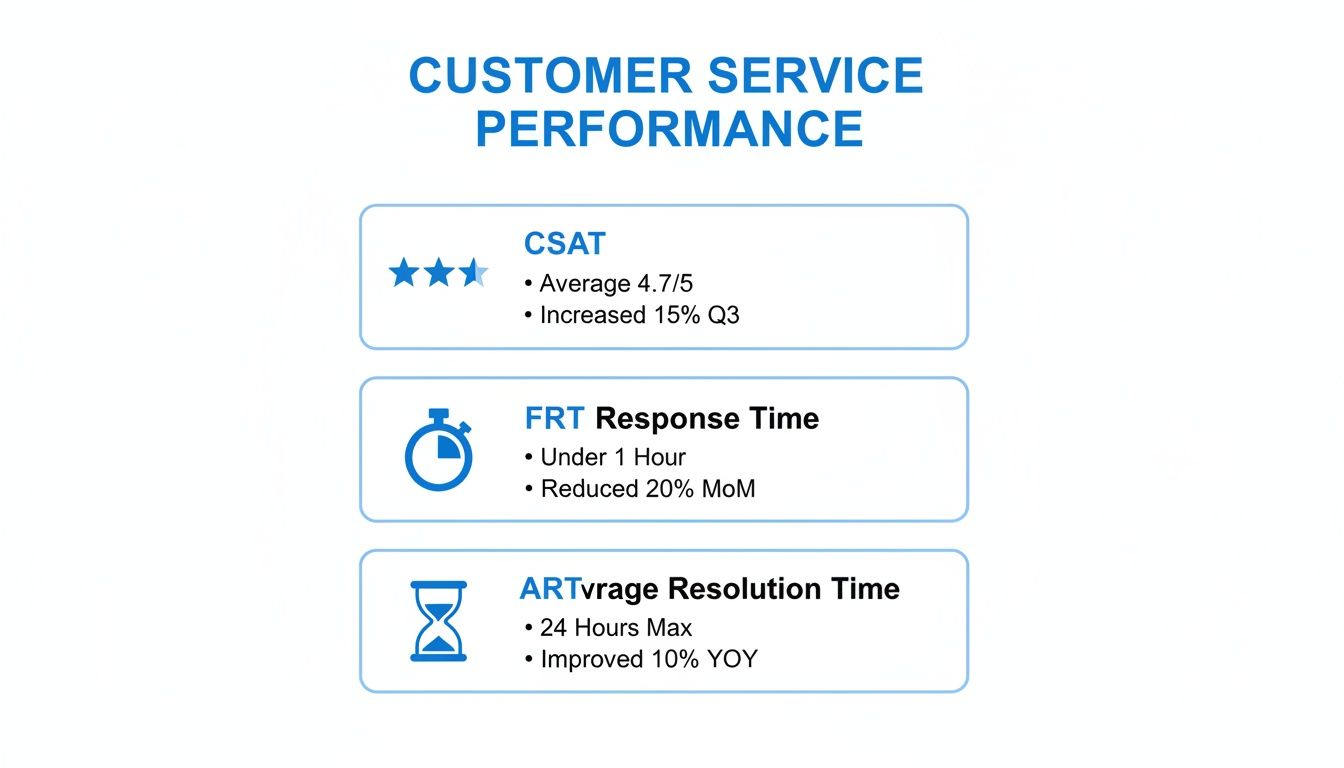
- Primary KPI Focus: First Response Time (FRT) and Average Resolution Time (ART). Today's customers expect quick answers, and long wait times can absolutely kill your momentum.
- Secondary KPI to Watch: Automation Rate. How many simple, repetitive questions can you answer automatically? A rising automation rate is a direct measure of improved efficiency.
Using MAILO AI’s analytics dashboard, you can watch FRT and ART in real-time, letting you spot bottlenecks before they start hurting your customer experience. This gives you the insight to set up smart automations for common queries, freeing up your human agents for the more complex, high-value issues.
Mature Stage: Optimizing for Profitability
For an established business, the focus broadens again. You're now looking at long-term health, profitability, and customer loyalty. You've already built efficient systems, but the next step is to optimize them for financial return and sustainable growth. Every support interaction gets viewed through the lens of its impact on the bottom line and overall brand perception.
- Primary KPI Focus: Net Promoter Score (NPS) and Customer Lifetime Value (CLV). The big question is: are you creating loyal brand advocates who will stick with you for years and tell their friends?
- Secondary KPI to Watch: Cost Per Ticket. This metric is crucial for understanding the financial efficiency of your entire support operation. Driving this number down through strategic automation and better agent training has a direct impact on your profitability.
Mature brands use MAILO AI to analyze sentiment trends and connect support interactions to customer order history from platforms like Shopify. This creates a crystal-clear picture of how service quality affects repeat purchases and loyalty, finally turning the support team from a cost center into a proven revenue driver.
Actionable Strategies to Improve Your Key Metrics
Alright, so you’ve got your numbers. But let's be honest, knowing your First Response Time is high doesn't actually fix anything. The real magic happens when you turn that data into a concrete plan of attack. This is where we move from diagnosis to treatment.
Think of this section as your playbook. We're going to walk through tangible workflows, smart staffing ideas, and the kind of tech that actually moves the needle. These are clear, actionable steps you can start using today to build a support operation that’s faster, smarter, and far more effective.
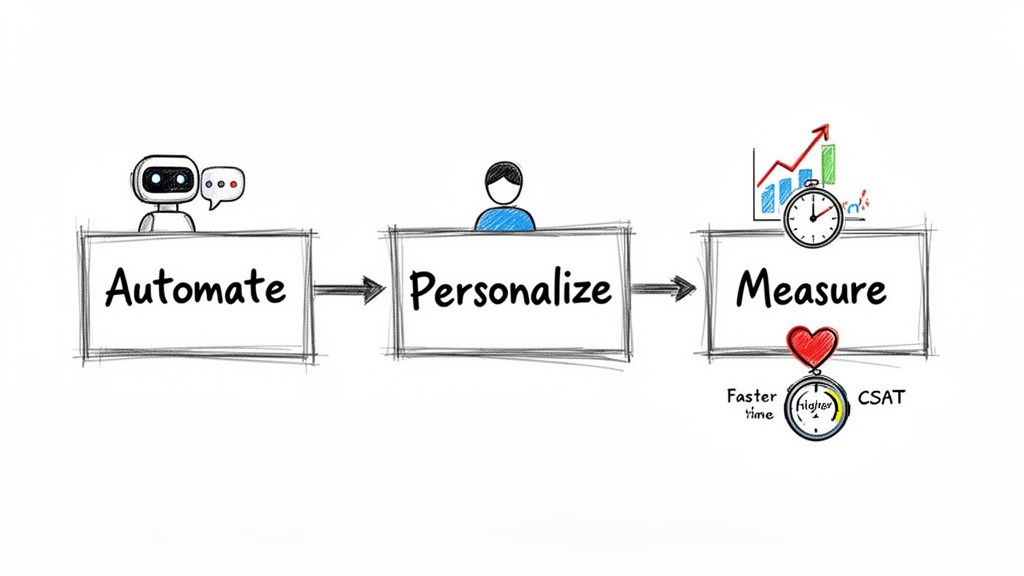
The best part? These strategies create a positive ripple effect. When you improve your resolution time, for instance, you'll almost certainly see a nice bump in your customer satisfaction scores. Let's dive in.
Slash Response and Resolution Times
Slow replies are poison to the customer experience. Speed isn’t just an operational metric; it’s a direct reflection of how much you value a customer's time. When people feel heard quickly and get their problems solved without a drawn-out back-and-forth, their entire perception of your brand improves.
Here are three powerful ways to bring down your First Response Time (FRT) and Average Resolution Time (ART):
-
Send Instant Automated Acknowledgments: The second a customer’s email hits your inbox, an automated reply should go out. This isn't just a simple confirmation—it's your first chance to set expectations. MAILO AI can fire off an instant, on-brand message that says, "We've got your query and will be back with you in X hours." This simple step immediately lowers the customer's perceived wait time and gives your FRT a boost.
-
Use Smart Inbox Routing: Stop letting critical tickets get buried in a general queue. Set up rules to automatically categorize and assign emails based on keywords like "refund," "damaged," or "shipping," or even by customer value. This gets the right ticket to the right agent instantly, cutting out the soul-crushing manual triage time.
-
Arm Your Team with AI-Powered Reply Suggestions: Give your agents superpowers. Tools like MAILO AI analyze incoming emails and draft complete, accurate responses that match your brand voice, pulling from historical data. Your agents can then quickly review, tweak if needed, and hit send. This dramatically cuts down the time it takes to get a resolution.
Elevate Customer Satisfaction Scores
Getting better CSAT and NPS scores is about so much more than just being polite. It’s about creating consistently positive and personal interactions that make customers feel seen, not just processed. Turn a good experience into a great one, and you’ll create loyal fans who do your marketing for you.
Building a great experience requires a deep understanding of the customer's journey. By connecting support interactions with their order history and past conversations, you move from transactional support to relational service.
To create these kinds of standout experiences, you need to focus on a few key things:
-
Personalize with Real Shopify Data: Connect your helpdesk directly to your e-commerce platform. The native Shopify integration from MAILO AI, for example, puts a customer’s entire order history, shipping details, and past conversations right beside their ticket. This means agents can provide context-aware support without asking a dozen repetitive questions.
-
Proactively Ask for Feedback: Don’t just sit back and wait for customers to complain. Use automated workflows to send out a CSAT or NPS survey a few hours after a ticket is resolved. It shows you care about their opinion and gives you a constant stream of feedback to work with.
-
Actually Act on the Feedback: Use analytics to spot trends in what your customers are telling you. If you see a recurring issue dragging down your scores—maybe a confusing policy or a product flaw—you now have a clear mandate to go fix the root cause.
Maximize Efficiency Through Automation
Your team's most valuable asset is their brainpower. Wasting it on answering the same five questions over and over again is a fast track to burnout and bloated costs. Smart automation frees up your agents to handle the complex, high-empathy problems where they can truly shine.
The industry is already heading this way. One recent study found that 39% of companies are already using generative AI to write to customers. Even more telling, 90% of leading CX organizations believe automation will soon handle eight out of every ten customer issues without a human ever touching them. You can read more about the future of customer service from Nextiva to see where things are headed.
Here’s how you can boost your Automation Rate and shrink your Cost Per Ticket:
-
Find Your Most Repetitive Questions: Use a tool like MAILO AI to analyze your ticket volume and pinpoint your greatest hits. Questions like "Where is my order?" or "What's your return policy?" are perfect candidates for automation.
-
Build Automated Workflows: Create flows that can handle these common queries from start to finish. For a simple order status question, MAILO AI can automatically pull the tracking info from Shopify and send a complete, personalized update without any human involvement.
-
Use a Semi-Automated "Approve and Send" Model: For conversations that still need a human touch but follow a predictable script, use AI to do the heavy lifting. The AI drafts the reply, and your agent simply reviews it, clicks "approve," and moves on. It’s the perfect blend of automation’s speed and a human’s quality check.
KPI Improvement Playbook
Sometimes, it helps to see the direct line between a problem, the metric it affects, and the solution. This table is a quick-reference guide to help you connect common e-commerce support challenges with the right KPIs and a practical fix using a tool like MAILO AI.
| Problem | Related KPI | Solution with MAILO AI |
|---|---|---|
| "Customers complain about slow responses, especially after hours." | First Response Time (FRT) | Implement 24/7 automated acknowledgments that set clear expectations for when a human will reply. |
| "Our agents spend too much time on simple, repetitive questions." | Cost Per Ticket, Automation Rate | Use AI to identify and automate the top 3-5 most common queries (e.g., "Where is my order?") to deflect ticket volume. |
| "Customers say they have to repeat their order info all the time." | Customer Satisfaction (CSAT) | Use the Shopify integration to display full customer context next to every ticket, enabling personalized, context-aware replies. |
| "Resolving a single issue requires a long back-and-forth." | Average Resolution Time (ART) | Leverage AI-suggested replies that draft complete, accurate answers, allowing agents to resolve tickets in a fraction of the time. |
| "We aren't sure which issues are causing the most frustration." | Net Promoter Score (NPS) | Analyze CSAT/NPS feedback within the analytics dashboard to pinpoint recurring negative trends and address their root causes. |
Think of this playbook as your starting point. By targeting specific problems with the right tools, you can create a system that not only resolves issues faster but also builds stronger customer relationships along the way.
How MAILO AI Helps You Track and Improve Your KPIs
Knowing your numbers is one thing, but actually being able to track and improve them without a massive headache is another. This is where theory hits the real world. If you're stuck wrestling with spreadsheets to figure out your KPIs, you're not just slow—you're always looking in the rearview mirror. Growth happens when you have live insights that let you act right now.
MAILO AI is built to be the central nervous system for your e-commerce support. The goal is to get you out of the manual tracking grind and into a world where managing your KPIs is automated and intelligent. Let's break down exactly how it changes the game for the metrics that matter most.
Get an Instant Pulse on Your Performance with an Analytics Dashboard
Forget about spending hours exporting data. The Analytics Dashboard in MAILO AI gives you a live, at-a-glance view of all your core customer service KPIs. You can immediately see your First Response Time, Average Resolution Time, Ticket Volume, and CSAT scores without lifting a finger.
Think of it as your command center. You can spot a sudden spike in ticket volume, see which topics are causing the most customer friction, and track how your team’s performance is trending over time. It’s all about making data-driven decisions on the fly instead of waiting for a weekly report. This is how modern brands connect their support efforts to real business outcomes. For a deeper dive, check out our guide on finding the right e-commerce customer service software.
Work Smarter, Not Harder, with a Smart Inbox
A cluttered inbox is where good intentions and efficiency go to die. MAILO AI’s Smart Inbox directly tackles this problem by automatically organizing every customer conversation that comes in. Using AI, it classifies and tags each email by its topic—like "returns," "shipping," or "product question"—so your team knows exactly what they're walking into before they even open a ticket.
This automatic organization has a huge ripple effect on your KPIs. It slashes the time spent on manual triage, which helps bring down your Average Resolution Time. By flagging and prioritizing urgent issues, it also ensures you hit those critical queries faster, boosting your First Response Time.
Below you can see how the Smart Inbox automatically categorizes and prioritizes conversations.
This kind of clean, organized workflow means high-priority tickets never get buried, and agents can spend their valuable time actually solving problems instead of just sorting them.
Drive Real Satisfaction with Deep Shopify Integration
Generic, copy-paste replies are a fast track to a low CSAT score. Customers expect you to know who they are and what they’ve ordered. MAILO AI’s native Shopify integration puts all that critical context right at your agents' fingertips. When an email arrives, your agent instantly sees the customer’s entire order history, shipping status, and past conversations, all in one place.
Having this data right where you need it completely changes the quality of support you can offer.
- Boost CSAT and NPS: Agents can give personalized, context-aware replies that make customers feel heard and valued. That’s how you build loyalty.
- Lower Cost Per Ticket: With AI-suggested replies that are pre-filled with specific order details, agents resolve tickets in a fraction of the time. That directly reduces your labor costs.
- Increase Automation Rate: For common questions like "Where is my order?", MAILO AI can pull tracking info directly from Shopify and fire off a fully automated, accurate response without a human ever touching it.
By connecting your support platform directly to your store data, you’re not just answering questions—you’re building relationships. This is how you turn a simple support interaction into a brand experience people remember.
Ultimately, MAILO AI connects the dots between what your team does and the results you see. It gives you the tools to not only measure your KPIs in customer service but to actively make them better, turning your support team from a cost center into a powerful, data-driven engine for growth.
Here’s the rewritten section, designed to sound natural, human-written, and expert-led.
Turning Customer Service Data into a Competitive Advantage
At the end of the day, all these KPIs in customer service aren't just numbers to stick on a dashboard. Think of them as your strategic roadmap for growth. In an e-commerce world where everyone is fighting for attention, exceptional support—backed by solid metrics—is how you truly stand out. It’s what turns a one-time buyer into a loyal fan who keeps coming back to your Shopify store.
This creates a powerful feedback loop. When you consistently keep an eye on your core metrics, you can pinpoint exactly where things are breaking down and then roll out fixes that actually work. This cycle of measure, learn, and improve is the secret sauce behind every world-class support team. It’s how you shift your customer service from being just another business expense into a powerful engine that actively drives revenue.
The real value of KPIs isn’t just about watching the scoreboard; it’s about using the data to get a strategic edge. In today's market, data-driven service isn't a "nice-to-have"—it's a requirement for survival and growth.
Ready to stop guessing and start growing? The first step is to really get a handle on what your data is telling you. Dive deeper into measuring customer service effectiveness to sharpen your strategy. Then, when you're ready, you can start a free trial of MAILO AI and see for yourself how simple it can be to track, analyze, and boost your performance.
Your Top Questions About Customer Service KPIs, Answered
Once you start digging into customer service metrics, a few common questions always pop up. Let's tackle them head-on, based on what we've seen work for thousands of e-commerce brands.
I’m Just Starting My Shopify Store. Which Single KPI Should I Obsess Over?
If you can only track one thing, make it Customer Satisfaction (CSAT). Seriously.
In the early days, you're not just selling a product; you're testing a hypothesis. Is your product actually good? Is your shipping reliable? CSAT gives you the unfiltered, immediate truth straight from the people who matter most—your first customers. Positive feedback confirms you've got a winner, and any negative comments are pure gold, giving you a clear roadmap for what to fix before you even think about scaling.
How Do I Track All This Without Getting Lost in Spreadsheets?
Forget spreadsheets. Manual tracking is a one-way ticket to frustration and mistakes. The smart move is to use a customer service platform with analytics baked right in, like MAILO AI.
These systems do the heavy lifting for you, automatically logging every key metric we've discussed: First Response Time, Resolution Time, Ticket Volume, CSAT, you name it. It's all presented in a clean, visual dashboard. This means you can spot a problem or an opportunity in seconds, without ever having to manually crunch a number again.
Using a dedicated platform transforms KPI tracking from a tedious chore into a strategic advantage. It frees up your time to focus on what the data is telling you—a shift that's absolutely critical for any growing e-commerce brand.
What's a Realistic First Response Time for an E-commerce Brand?
While it depends on the channel, a great target for email support is to respond in under 6-12 hours. If you really want to impress your customers and stand out from the crowd, aim for under one hour.
The real secret, though, is consistency. Customers care less about a specific number and more about knowing their message has been received. This is where automation is a game-changer. Using a tool like MAILO AI to send an instant, automated acknowledgment can bring your official First Response Time down to just a few minutes, buying your team the time they need to craft a perfect, personalized solution.
Ready to turn your support team from a cost center into a growth engine? With MAILO AI, you can automate routine responses, get powerful insights from your support conversations, and empower your team to deliver incredible customer experiences. See what data-driven support can do for your brand by starting your free trial at https://mailo.ai.