

Imagine having a customer support agent who works around the clock, never takes a break, and can instantly recall every single customer's order history. That's the idea behind an automated service desk. For a Shopify store, it's a game-changer, providing immediate answers to common questions like "Where is my order?" without needing a human to lift a finger.
What Is an Automated Service Desk Anyway?
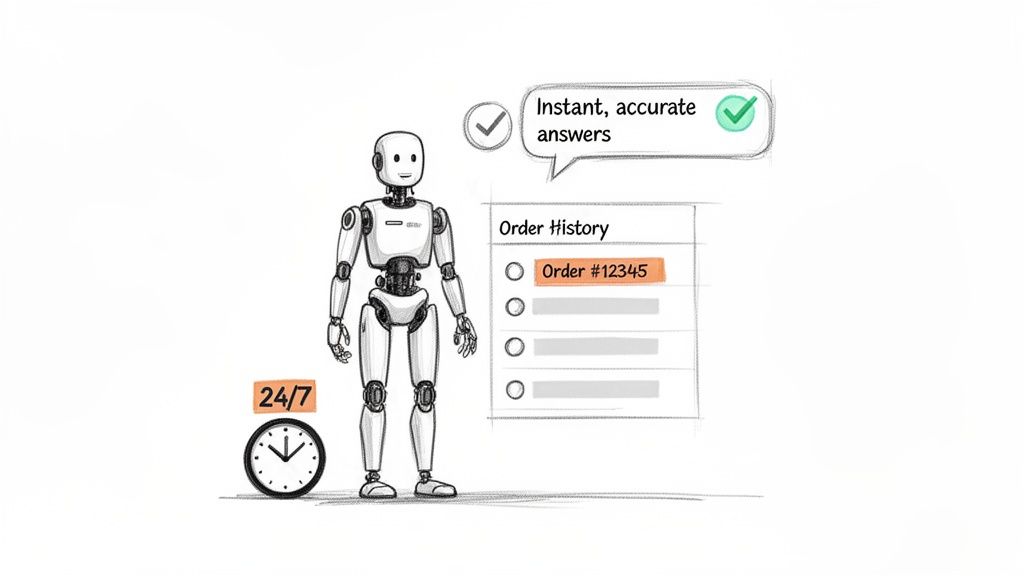
Think of an automated service desk as more than just a chatbot. It's a smart, proactive support engine that's deeply connected to your e-commerce store. It fundamentally shifts your support from a manual, reactive process to an intelligent, automated one.
So, how does it work? This system uses artificial intelligence to plug directly into your store’s backend, like Shopify. When a customer asks about their order status, the system doesn't just guess—it pulls live shipping data in real-time to give a precise, up-to-the-second answer. This turns a routine support task into a smooth, hands-off experience for both you and your customer.
Moving Beyond the Traditional Helpdesk
For decades, customer support has been stuck in a familiar, often frustrating loop. A customer sends an email, a ticket is created, it sits in a queue, and eventually, a human agent gets around to digging up the information and typing out a reply. This old-school approach is slow, creates annoying bottlenecks, and ties up your team with repetitive work.
An automated service desk completely flips that model. It acts as your frontline defense, instantly handling the flood of simple, predictable questions that otherwise overwhelm your inbox. It’s like an intelligent filter that resolves the easy stuff on its own, freeing up your human agents to tackle the complex problems that truly need their expertise. This evolution is key to understanding what a modern ticketing system can truly do.
The Core of Modern E-Commerce Support
Let's face it: today's online shoppers expect instant, helpful answers. It's not a bonus; it's the bare minimum. An automated service desk is built to meet this demand, no matter how much your store grows. By using AI to grasp the context behind a customer's question, it can deliver personalized responses that feel genuinely helpful, not robotic.
This isn't just a fleeting trend. The global digital service desk market is expected to surge from USD 3.31 billion to USD 6.1 billion by 2035. We're already seeing the impact on the ground, with e-commerce stores reporting customer satisfaction boosts of 25-30% simply by slashing resolution times from days to hours.
The goal of an automated service desk isn't to replace your support team. It's to supercharge them. Think of it as giving them a tireless assistant to handle the monotonous work, so they can focus on delivering exceptional service where it counts.
The system learns your brand's unique voice, internalizes your return policies, and can even be trained to proactively ask for a review after a customer's order arrives. The most sophisticated platforms combine several technologies, including components found in an AI Voice Assistant. At the end of the day, it becomes the engine that drives high-quality, scalable customer support that grows right alongside your business.
The difference between sticking with a manual system and adopting an automated one is night and day. Let's break it down.
Manual Support vs. Automated Service Desk in E-Commerce
| Feature | Manual Support Desk | Automated Service Desk (with Mailo AI) |
|---|---|---|
| Response Time | Hours or days, depending on agent availability and queue size. | Instant, 24/7 responses to common queries. |
| Ticket Handling | Agents manually categorize, prioritize, and respond to each ticket. | AI automatically resolves up to 70% of tickets without human input. |
| Order Tracking | Requires agents to log into Shopify to find and copy-paste tracking info. | Pulls live order status and tracking info automatically for the customer. |
| Personalization | Limited to the agent's memory or manual lookup of customer history. | Hyper-personalized answers based on real-time order data and history. |
| Scalability | Hiring more agents is the only way to scale, which is costly and slow. | Scales effortlessly to handle any volume of inquiries without extra cost. |
| Agent Focus | Agents spend most of their time on repetitive, low-value questions. | Agents are freed to focus on complex issues and building customer relationships. |
As you can see, the shift isn't just about efficiency—it's about creating a fundamentally better and more scalable customer experience that benefits everyone involved.
How a Modern Automated Service Desk Works
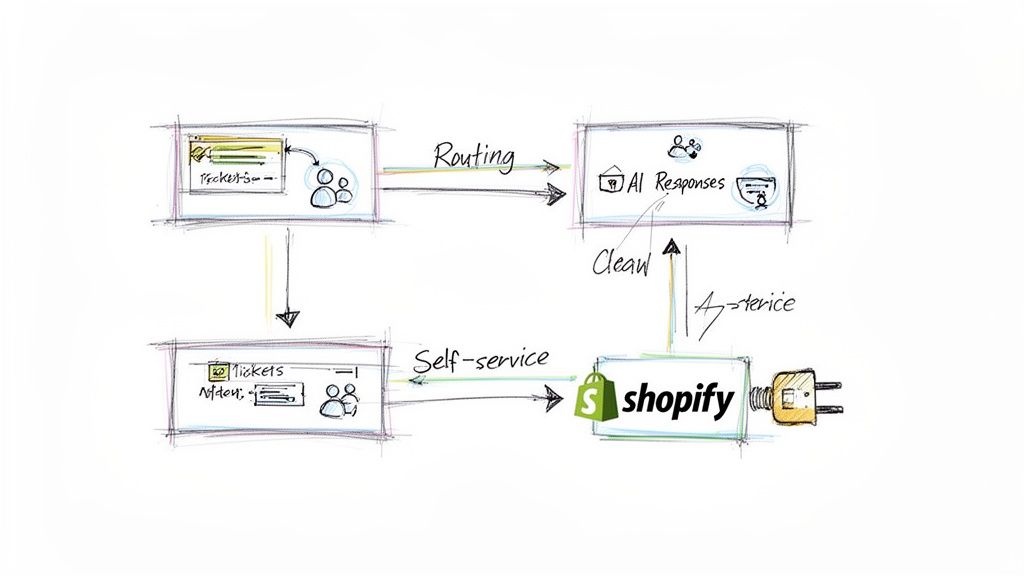
To really get what makes an automated service desk tick, you have to look under the hood. It’s so much more than a simple chatbot. It’s a smart ecosystem where several key pieces work together to create a smooth, intelligent support experience for your e-commerce brand.
Think of it like an orchestra. Each instrument has its part, but it's how they play together that creates the symphony. In this case, that symphony is effortless customer support.
AI-Powered Ticket Routing and Triage
First up is the smart mailroom of your support system. When a customer email lands in your inbox, an AI doesn't just toss it into a general pile. It instantly reads and understands the content to figure out the customer's intent and how urgent their issue is.
This is called intelligent ticket classification. The system is trained to spot patterns, keywords, and even the customer's sentiment to automatically sort and prioritize every single message that comes in.
- An angry email about a damaged product? That gets flagged as high priority and shot straight to a senior agent.
- A simple question about your return policy? That’s tagged for an automated response.
- A classic "Where Is My Order?" (WISMO) request is identified and queued up for an instant data lookup.
This initial sorting ensures your team's brainpower is focused on the most critical issues, while the repetitive, easy-to-answer questions get handled without ever hitting an agent's queue. By some estimates, this automated triage alone can slash service desk calls by more than 40%.
Intelligent Response Generation
Once a ticket is sorted, the system gets to work on crafting the perfect reply. A modern automated service desk uses advanced AI, much like the tech behind ChatGPT, to generate genuinely human-like responses that are perfectly in sync with your brand's voice.
This isn't about firing off robotic, canned replies. The AI actually learns from your brand's history—your past support conversations, your knowledge base articles, and your product descriptions. It picks up on your tone, whether you're friendly and casual or more formal and professional, and mirrors it in every interaction.
The goal is simple: The AI acts like your best support agent—one that’s been trained on your specific business rules and communication style and is ready to draft perfect replies in seconds.
For an e-commerce store, this means the system can explain your shipping policy, break down product features, or walk a customer through a return, all while sounding exactly like it came from you. That consistency is key to building trust and delivering a seamless experience.
Self-Service Portals and Knowledge Management
A great automated service desk also gives customers the tools to help themselves. It can power smart self-service portals or FAQ pages, giving shoppers immediate access to information without ever needing to write an email or pick up the phone.
The AI is always learning, too. It can analyze the most common questions your customers ask and automatically suggest new articles for your knowledge base. If it sees a sudden spike in questions about a specific product, it can flag the need for a more detailed FAQ, turning your support data into a proactive tool for improvement.
The Secret Sauce: Native Shopify Integration
For any e-commerce business, this is the real game-changer. A native integration with a platform like Shopify is what connects the AI's brain directly to your store's live operational data. It’s what lets a platform like Mailo AI do more than just talk; it can actually act.
When a customer asks about their order, the system doesn't need to ping an agent. It communicates directly with Shopify's database to:
- Fetch real-time order status and tracking numbers.
- Verify shipping addresses and delivery estimates.
- Pull up a customer’s order history to provide personalized context.
This deep integration transforms the automated service desk from a simple communication tool into a genuine operational partner. It’s the engine that handles the heavy lifting, resolving the vast majority of common e-commerce questions instantly and accurately. You can dig deeper into how these integrations work in our guide to AI customer support software.
What Support Automation Actually Does for Your Business
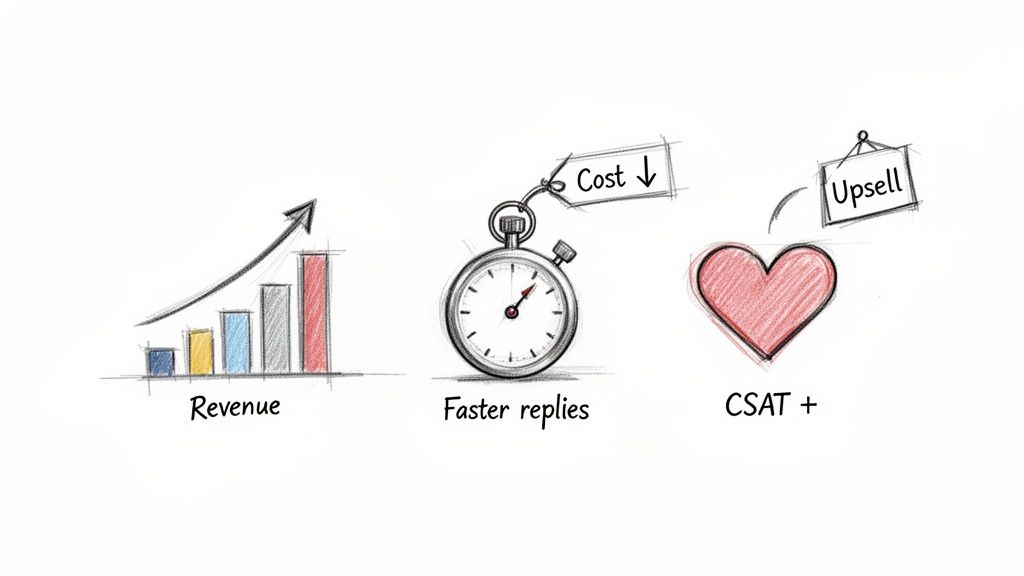
Sure, faster replies are nice. But let's be real—the true value of an automated service desk runs much deeper than just speed. It's about fundamentally changing how your customer support operates, turning it from a necessary cost into a legitimate growth engine for your e-commerce store.
By letting AI handle the endless flood of repetitive questions, you're not just getting a small efficiency bump. You're giving your human agents their most valuable asset back: time. This frees them up to tackle the complex, high-stakes issues that actually require a human touch and sharp problem-solving skills.
Drastically Reduce Support Costs
Every single time an agent has to manually type out a response, it costs you money. An automated service desk takes a sledgehammer to that cost by instantly resolving the most common, predictable questions. Just think about all those "Where is my order?" or "What's your return policy?" tickets that clog up your inbox every single week.
When an AI can handle 70% or more of those tickets on its own, the savings pile up fast. This means you can scale your support as your store grows without having to constantly hire more people, protecting your margins along the way.
The market sees this shift, too. The helpdesk automation space is expected to rocket from $5.7 billion in 2024 to $21.5 billion by 2030. For Shopify merchants, that translates to real-world savings: cutting down operational time by up to 40% and hitting first-contact resolution rates as high as 85%.
Boost Customer Satisfaction and Loyalty
Today's shoppers want answers now, not tomorrow. One study found that 66% of adults believe the single most important thing a business can do is value their time. Making them wait is a surefire way to send them running to a competitor.
An automated service desk kills the queue. It delivers immediate, correct answers 24/7, which is exactly what your customers expect. That kind of consistent, reliable service builds trust and sends your Customer Satisfaction (CSAT) scores through the roof.
Happy customers don't just come back; they become your best advocates. By consistently delivering a fast and frictionless support experience, you're not just solving a problem—you're building brand loyalty that pays dividends for years.
A customer who gets their tracking link at 11 PM on a Sunday is far more likely to leave a glowing review than one who has to wait until your team clocks in on Monday morning. That positive experience is everything.
Turn Support from a Cost Center to a Revenue Driver
Now for the really cool part. A smart automated service desk doesn't just play defense; it plays offense. It can be set up to spot opportunities within customer conversations and act on them to generate revenue.
Think about it. After the AI successfully resolves an issue, it can trigger other valuable, money-making actions. These workflows are surprisingly simple to build but can have a massive impact.
- Ask for Reviews Proactively: A few days after a customer's order is delivered, the system can automatically send a friendly, personalized email asking them to leave a review. This is how you build social proof that convinces new shoppers to buy.
- Find Upsell Opportunities: If a customer asks about a specific feature, the AI can answer the question and then suggest a complementary product. A simple support ticket just became a sales opportunity.
- Send Targeted Promotions: The system can identify your most loyal customers and automatically send them an exclusive discount to thank them and encourage another purchase.
By weaving these kinds of smart actions into your support, every customer interaction becomes a chance to build a stronger relationship and grow your bottom line. To see what tools make this happen, check out our guide on the best e-commerce customer service software.
Putting Automation to Work: Workflows You Can Set Up Today
Theory is one thing, but seeing an automated service desk in action is where the lightbulb really goes on. Let's move from the "what" to the "how" with a practical playbook of workflows you can build right now with a tool like Mailo AI. These aren't just hypotheticals; they're direct solutions to the most common, time-sucking tasks Shopify merchants face every single day.
One of the best parts is the flexibility. You can set these up to be completely hands-off or design them with a "human in the loop," where your team gives the final nod. This lets you ease into automation, build trust in the system, and make sure everything perfectly aligns with your brand's voice.
Fully Automate "Where Is My Order?" (WISMO) Inquiries
Let’s be honest, "Where is my order?" is the undisputed champion of repetitive support tickets. It's a simple question that can absolutely bury a small team. A fully automated workflow is the perfect counter-punch, delivering instant, accurate answers 24/7 without a single person having to lift a finger.
Here’s the play-by-play in three simple steps:
- AI Catches the Intent: A customer emails asking about their order. The AI reads the message and immediately understands the WISMO intent from keywords and sentence structure.
- Shopify Gets Pinged: The system instantly talks to your Shopify store, using the customer’s email address to find their latest order. It then pulls the real-time shipping status and tracking number straight from the carrier's data feed.
- An Instant, Personalized Reply Goes Out: The AI crafts a friendly, on-brand response with the current order status and a direct link to the tracking page. The entire ticket is resolved in seconds.
This one workflow can seriously reduce your daily ticket count, freeing up your team for the conversations that actually require a human touch.
By automating WISMO tickets, you're not just saving time; you're meeting a core customer expectation. An immediate, accurate answer at 10 PM on a Saturday is a far better brand experience than waiting until Monday morning for a reply.
Semi-Automate Complex Return and Exchange Requests
Returns and exchanges have more moving parts. You’ve got to consider your specific return policy, the condition of the item, and the customer's order history. This is where a semi-automated workflow shines, blending AI's speed with a final human review for quality control.
Here’s how this "human-in-the-loop" approach works:
- AI Drafts the Perfect Response: A return request lands in your inbox. The AI analyzes the customer's order, pulls up your official return policy from its knowledge base, and drafts a complete, personalized reply. It outlines the next steps, includes the correct return address, and even attaches any necessary forms.
- Your Agent Gives the Green Light: Instead of just sending the email, the system places the drafted response in your support queue. Your agent can give it a quick scan for accuracy, maybe add a personal note, and then approve it with a single click.
What used to be a 10-minute task of digging through orders and copy-pasting policy info becomes a 10-second review. You maintain perfect quality control with a fraction of the effort.
Proactively Ask for Reviews from Happy Customers
Great reviews are the lifeblood of any e-commerce store, but chasing them down manually often falls to the bottom of the to-do list. An automated service desk can flip this script, turning review collection into a hands-off process that builds social proof while you focus on other things.
The workflow is usually triggered by the delivery confirmation:
- Delivery is the Trigger: The system keeps an eye on Shopify for orders marked as "Delivered."
- A Smart Delay is Added: A few days after delivery (you can customize the timing), the system triggers the next step. This little delay is key—it gives the customer a chance to actually open the box and try the product.
- Personalized Outreach is Sent: The AI sends a friendly, personalized email thanking the customer and asking if they’d be willing to share their experience. You can even include a direct link to the product review page to make it ridiculously easy for them.
Prioritize and Tag Your VIP Customers
Not all customers are created equal. Your loyal, high-spending shoppers deserve a white-glove experience. An automated workflow can instantly identify these VIPs the moment they reach out and make sure their questions jump to the front of the line.
The system connects to Shopify and flags customers based on rules you create, like:
- Total lifetime spend
- Number of orders placed
- Purchases of a specific product line
When an email comes in from a customer who meets this criteria, the system automatically slaps a "VIP" tag on the ticket and marks it as high priority. This gives your team an immediate visual cue that this inquiry needs extra-special attention, helping you nurture your most valuable customer relationships.
Your Guide to a Smooth Implementation
Getting an automated service desk up and running is probably a lot easier than you think. For busy store owners, the trick is to follow a clear roadmap that gets you quick wins and builds momentum. We can forget about long, complicated setups; the whole point of modern automation is a fast and seamless rollout.
The very first step? Pick a platform that has a native Shopify integration, like Mailo AI. This isn't just a small technical detail—it’s the entire foundation for a quick, painless setup. A native connection means the system instantly syncs with your orders, products, and customer data, which cuts out all the tedious manual configuration.
Kicking Off Your Automation Journey
A great rollout doesn't mean flipping a switch and automating everything overnight. The smartest way to start is with semi-automated workflows. This "human-in-the-loop" approach is perfect for building your team's confidence and letting you fine-tune the AI's performance as you go.
Think of it like training a new team member. The AI might draft a response to a return request, and your agent just gives it a final check before hitting send. This method gives you total quality control while still dramatically cutting down the time spent on each ticket.
The growth in this space is massive. The Automation-as-a-Service market, which is what powers these systems, is on track to hit USD 40.4 billion by 2031. This trend is all about scalable, cloud-based tools that are perfect for e-commerce. We’re already seeing semi-automated workflows cutting support costs by 30-50% while boosting conversions with faster service. If you're interested, you can read more about these market dynamics to get the full picture.
Configuring Your System for Success
Once you've got the basics down and your team is comfortable, you can start dialing in the finer details to really make the system your own. These adjustments are what make the AI work not just efficiently, but in a way that truly represents your brand.
-
Define Your Brand Voice: You need to teach the AI to talk to your customers just like you would. Give it examples of past emails and your brand guidelines so its tone is always on-point, whether you're fun and casual or more formal.
-
Set Up Smart Ticket Routing: Create a few simple rules that automatically prioritize and assign incoming emails. For example, any email with words like "damaged" or "wrong item" can be immediately flagged as high-priority and sent straight to your lead support agent.
-
Establish Clear Escalation Paths: Let's be real—AI can't solve every problem. Set up clear guidelines for when a ticket needs to be handed over to a human. This ensures tricky or sensitive issues always get the personal attention they deserve.
This diagram shows just how simple it can be to have automated workflows handle your most common e-commerce questions.
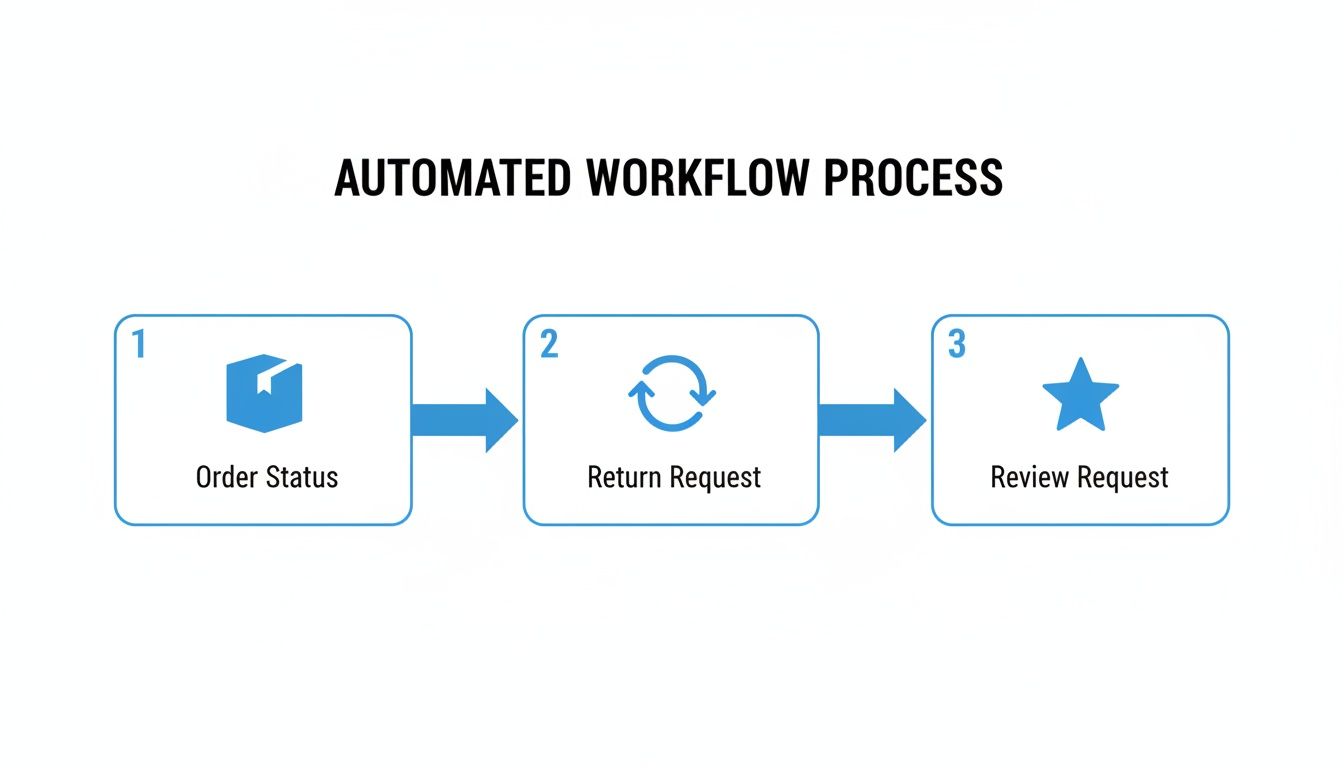
By automating these core tasks like order status updates and return requests, you create an incredibly efficient first line of support.
A great implementation empowers you to get up and running quickly for a measurable impact. The goal isn't just to install software; it's to build a smarter, more scalable support system that grows with your business from day one.
How Do You Know If Your Automation Is Actually Working?
Putting an automated service desk in place is a big move. But once the switch is flipped, how can you be sure it's actually making a difference? To get a real sense of its impact, you have to look past the obvious and track the metrics that truly signal business growth and happier customers.
There's an old saying: "If you can't measure it, you can't improve it." This couldn't be more true for customer support. Keeping a close eye on the right numbers helps you prove the return on your investment and gives you the hard data needed to fine-tune your strategy. A platform like Mailo AI brings this all together in a single dashboard, so you always know where you stand.
Key Efficiency Metrics: Is Your Team Working Smarter?
The first and most immediate changes you'll notice will be in your team's day-to-day efficiency. These metrics tell you just how much faster and more effective your entire support operation has become.
- First Response Time (FRT): How long does a customer have to wait for that first acknowledgment? With an AI handling things around the clock, your FRT should plummet. Instant answers mean no more waiting.
- Average Resolution Time: This is the big one—the total time it takes to solve a customer's problem from start to finish. When automation instantly resolves all the common, repetitive questions, your average resolution time will drop dramatically.
- Ticket Volume Reduction: Keep a close watch on the number of tickets that still need a human to step in. A well-tuned automated system should deflect a huge chunk of incoming queries, freeing up your team's bandwidth.
True success isn't just about closing tickets faster. It's about fundamentally reducing the number of tickets your team has to touch in the first place. That’s what gives them the breathing room to focus on the complex, high-value conversations that really build loyalty.
Gauging the Customer Experience: Are Your Shoppers Happy?
A faster support desk is great, but it’s only half the picture. The real goal is to create a genuinely better, smoother experience for your customers. This is where satisfaction metrics are crucial.
The most important one? Your Customer Satisfaction (CSAT) score.
It's simple: after an interaction is closed, automatically send a quick survey asking customers to rate their experience. If your CSAT score starts climbing, that's solid proof that your automation isn't just quick—it's also genuinely helpful.
Tracking this trend over time gives you direct, unfiltered feedback straight from your customers. It confirms your new system is hitting the mark and provides the evidence you need to show that your automated service desk is a win for everyone.
Got Questions? Let's Clear Things Up
Whenever you bring a new tool into your business, especially one that touches customer support, you’re going to have questions. It’s totally normal to want to be sure before you make a change. Let's tackle some of the most common concerns we hear about bringing an automated service desk into an e-commerce brand.
My goal here is to cut through the noise and show you how this kind of technology actually helps your team, rather than replacing them. Think of this as the last few questions you need answered before you feel great about leveling up your customer support.
Will This Make My Brand Sound Like a Robot?
This is the big one, right? You've worked hard to build a brand with a unique personality, and the last thing you want is for your support to sound generic and cold.
Here's the good news: a well-designed automated system does the exact opposite. It doesn't rely on stale, pre-written templates. Instead, it actually learns your specific brand voice by analyzing thousands of your past customer conversations.
It figures out how you talk to customers and then creates replies that sound like they came straight from your best agent. You can tune its tone to be casual, professional, witty, or whatever fits your brand, making sure every single customer interaction feels authentic.
The point isn't to fool a customer into thinking they're chatting with a person. The goal is to give them a fast, accurate, and on-brand answer so efficiently that the experience feels fantastic, no matter who—or what—is on the other end.
Are You Saying I Should Fire My Support Team?
Not a chance. In fact, this is how you make them even better. An automated service desk is designed to take on the mountain of repetitive, simple questions that eat up your team's day. All those "Where's my order?" and "What's your return policy?" tickets? The machine can handle them.
By clearing the easy stuff off their plate, your human agents are freed up to focus on the work that truly matters:
- Tackling complex issues that need real problem-solving skills.
- Navigating sensitive situations that require empathy and a human touch.
- Building real relationships with customers who need a little extra attention.
This isn't about replacement; it's about partnership. Your automation handles the volume, and your team provides the value. It's a model that's catching on fast—Gartner predicts that by 2025, 70% of businesses will have this kind of structure in place, a huge jump from just 20% back in 2021.
How Hard Is This to Set Up and Keep Running?
Getting started is surprisingly straightforward, especially if you choose a platform built specifically for e-commerce. A tool with a native Shopify integration, for example, can be connected and running in just a few minutes because it pulls in all your product, order, and customer data automatically.
The initial setup is mostly about pointing the AI to your past conversations to learn your brand voice and establishing a few simple rules for how tickets get handled. After that, the system is built to get smarter on its own with very little hand-holding. It’s not another piece of software you have to constantly manage; it’s a tool that works for you from day one.
Ready to see how an automated service desk can give your support team their time back and help grow your Shopify store? Mailo AI takes care of the repetitive questions so your team can focus on what they do best. Start your free trial today and see the difference for yourself.