

When we talk about email etiquette in the workplace, we’re really talking about a set of unwritten rules for professional digital communication. It's more than just spelling and grammar; it’s about making sure your messages are respectful, clear, and efficient. This is especially true in ecommerce, where email isn't just a tool—it's one of your most direct connections to your customers.
Why Email Etiquette Matters Now More Than Ever
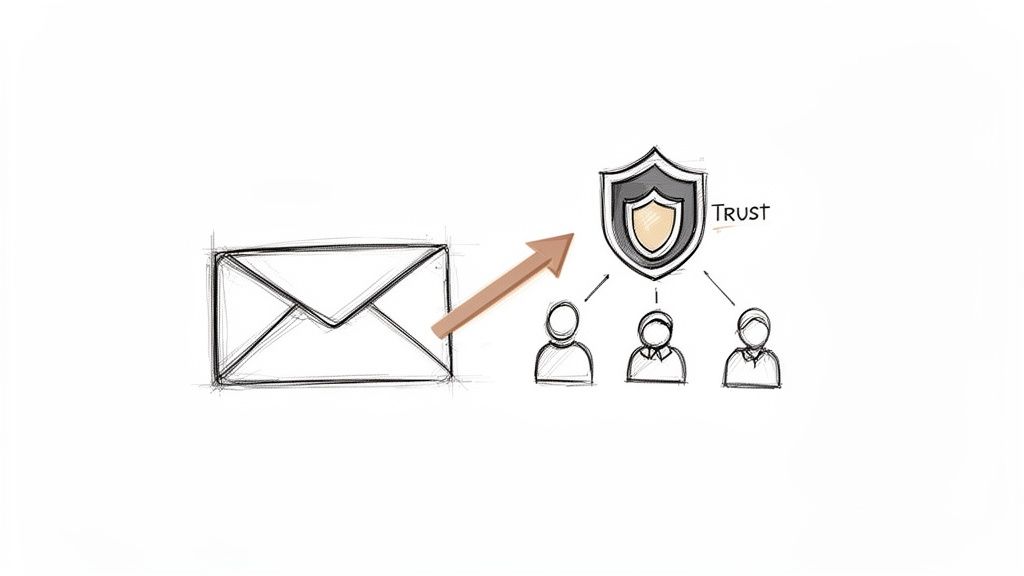
In ecommerce, your inbox is the digital frontline. Nearly every key customer moment, from an order confirmation to a support ticket, lands there. That’s why mastering email etiquette has moved from a "nice-to-have" soft skill to a core business strategy that directly shapes how customers see you, whether they stick around, and ultimately, your bottom line.
Think about it: each email is a mini-interaction with your brand. A clear, helpful, and professional message can transform a frustrated customer into a loyal fan. On the flip side, a sloppy, confusing, or delayed reply can quickly break that trust, leading to bad reviews and lost sales. It’s all about building solid relationships, one well-written email at a time.
The Unwavering Dominance of Email
Even with all the chat apps and social media DMs out there, email is still the king of professional communication. When employers need to share information, 92% turn to email, and it scores an impressive 89% effectiveness rate. It’s still the most reliable channel for detailed, documented customer service conversations.
Of course, the debate over using specific employee communication apps vs email is ongoing, and it's smart to know where each platform shines for your team's specific needs.
The Tangible Business Impact
Good email etiquette isn't just about being polite—it delivers real, measurable results for your business.
- Reducing Support Tickets: When you communicate clearly, you solve problems faster. This cuts down on the frustrating back-and-forth that jams up your support queue.
- Building Customer Trust: Professionalism tells customers you're reliable and know what you're doing. That confidence is crucial when they're deciding whether to buy from you.
- Enhancing Brand Perception: Every single email is a chance to reinforce your brand's voice and show you care about quality. It’s a small detail that sets you apart from the competition.
By making these principles a core part of your system, your support emails stop being a simple chore and start becoming a powerful engine for growth. You can learn more about this by reading our article on how AI is transforming ecommerce.
The Five Pillars of Unforgettable Ecommerce Emails
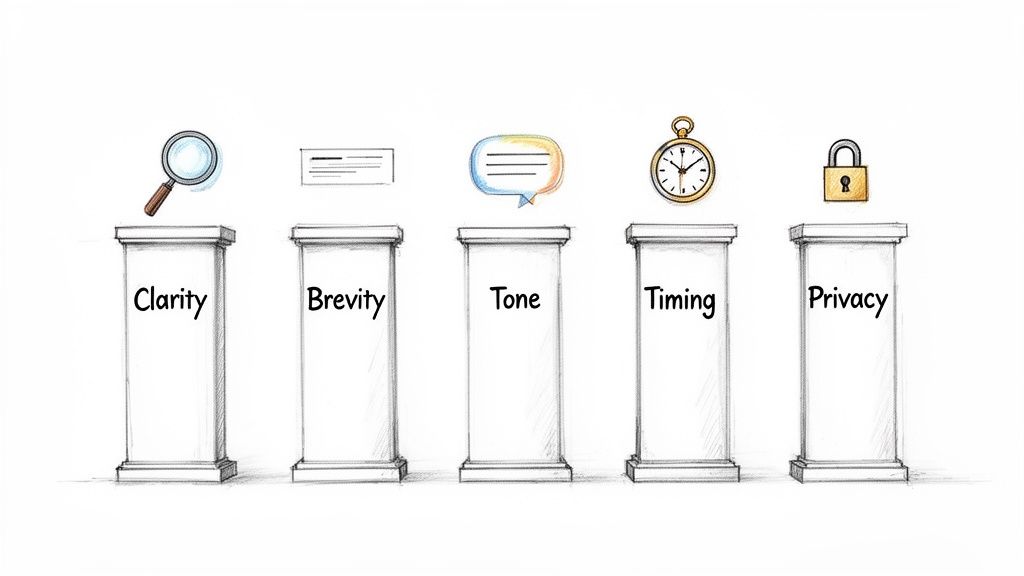
Think of a great customer support email like a perfect product page—it’s clear, helpful, and leaves the customer feeling great about their choice. Instead of getting bogged down in a long list of rules, we can boil down professional email etiquette to five core pillars. Mastering these turns your support inbox from a source of stress into a powerful tool for building real customer loyalty.
These aren't just abstract ideas. They’re the foundation of every positive customer interaction, guiding your team to craft messages that solve problems fast while reinforcing that you’re a brand that cares.
Let's break them down.
1. Clarity and Brevity
Clarity is all about making your message impossible to misunderstand. When a customer asks about their order status, a clear email gives them the tracking number, the carrier, and an expected delivery date, all laid out simply. This is how you stop that frustrating back-and-forth that wastes everyone’s time.
Brevity is clarity’s best friend. It means getting straight to the point without sounding cold or leaving out key details. You're respecting the customer's time. Short paragraphs and bullet points are your secret weapons here—they make information easy to scan and absorb.
2. Tone and Professionalism
Your tone is where your brand's personality really comes through. It’s the difference between a robotic, copy-paste response and a warm, empathetic message that makes a customer feel genuinely heard. The right tone can completely de-escalate a tense situation and turn a complaint into a rave review.
Professionalism is the bedrock of that tone. Standards for workplace emails are higher than ever, and for good reason. Recent research shows that a staggering 87% of people believe proper grammar is essential in email. Interestingly, the same study found that 58% of people don't find clichés like "Kind regards" to be genuine, which really drives home the need for authentic communication.
3. Timing and Responsiveness
In ecommerce, speed is everything. A timely response shows customers you value their business and are on top of their issue. Even if you don't have the final answer right away, a quick reply to acknowledge their message and set expectations can make all the difference. It prevents anxiety and shows you're on the case.
A prompt and professional response can be the single most important factor in retaining a customer's loyalty after they've experienced an issue. It communicates respect for their time and urgency in resolving their problem.
Ultimately, this is about managing expectations, which is a huge part of great email etiquette in any workplace.
4. Privacy and Security
Customers hand over their personal information with the expectation that you'll protect it. Every single email you send has to honor that trust. That means never including sensitive data like full credit card numbers and always double-checking the "To:" field before hitting send. A rock-solid commitment to privacy is non-negotiable and builds long-term confidence in your brand.
5. Deliverability and Reach
What good is the world's most perfect email if it lands in the spam folder? For any ecommerce business, getting your messages past spam filters is just as crucial as the content inside them. To make sure your thoughtful emails actually get read, it helps to start with understanding what potential spam means. Good etiquette practices directly contribute to a healthy sender reputation, keeping you in the inbox where you belong.
By building your email strategy on these five pillars, you're not just writing better emails—you're building a stronger, more trusted brand. To see these principles in action, check out our guide on how to write a professional business email.
Turning Difficult Customer Scenarios into Positive Experiences
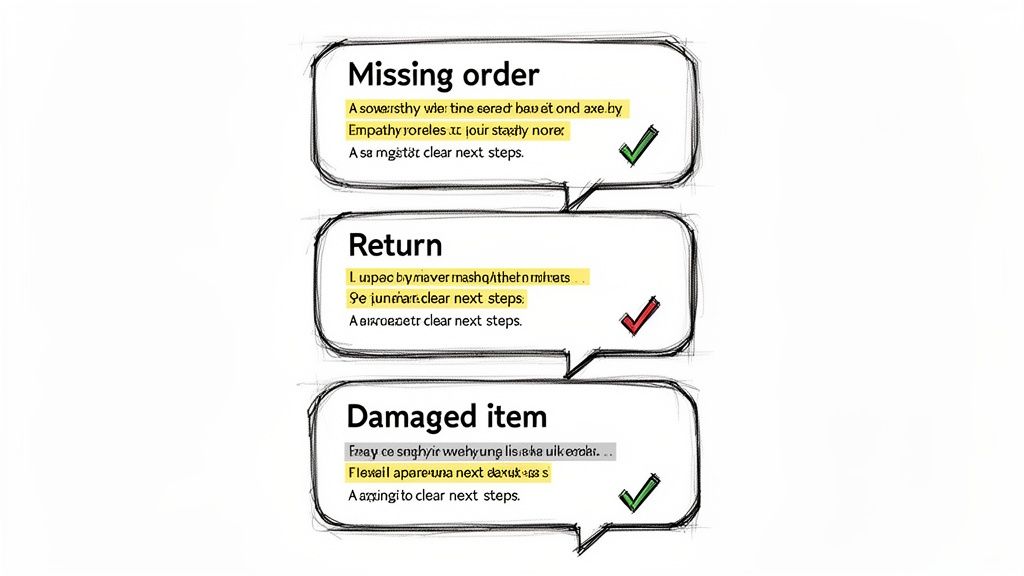
Theory is one thing, but the real test of your email etiquette is what happens when a customer is genuinely upset. A thoughtful response can turn a bad situation completely around, giving that person a reason to trust you and come back. It all comes down to mixing real empathy with a clear, no-nonsense solution.
Let’s walk through three of the most common—and often stressful—scenarios that every online store deals with. Think of these templates as more than just scripts. They’re practical blueprints that put the five pillars of great email etiquette into action, helping you strengthen customer relationships even when things go wrong.
Scenario 1: The Missing Order
When a customer's package is late or just plain missing, their frustration is completely valid. Your first job is to let them know you hear them and immediately jump into problem-solving mode. Resist the urge to blame the shipping carrier; instead, own the problem and focus on what you are going to do to fix it.
Subject: An update on your order [Order Number]
Hi [Customer Name],
Thanks for getting in touch. I’m so sorry to hear you haven't received your order yet. I know how frustrating it is to be waiting for something to arrive, and I'm going to get this sorted out for you right away.
I've just checked your order details and can see it shipped on [Date]. I've already opened an investigation with [Carrier Name] to track down your package.
Here’s what you can expect next:
- I’ll be keeping a close eye on the investigation and will have an update for you within 24-48 hours.
- If we can’t locate the package by then, we'll immediately send you a replacement at no extra cost.
Thank you for your patience while we figure this out. Please let me know if you have any other questions in the meantime.
Best,
[Your Name]
Scenario 2: The Return Request
A return request isn't a failure—it's your chance to show a customer how easy you are to do business with. The key is to make the process incredibly simple and transparent. Confusing return policies are a huge pain point for shoppers, so your email needs to cut right through that.
Subject: Your return request for order [Order Number]
Hi [Customer Name],
Of course! We can definitely help you with your return. We want to make this as easy as possible for you.
I’ve gone ahead and approved your return for the [Product Name]. Here are the simple steps to get started:
- Print Your Label: A prepaid return shipping label is attached to this email.
- Package Your Item: Please place the item back in its original packaging.
- Drop It Off: You can drop the package off at any [Carrier Name] location.
Once we get your return, we'll process a full refund within 3-5 business days. We’ll send you another email as soon as it's been issued.
Thanks,
[Your Name]
Scenario 3: The Damaged Product
There's nothing more disappointing than opening a package to find a broken item. This is the moment that calls for instant empathy and a swift, no-hoops solution. Your reply should lead with a sincere apology and immediately present a fix that requires zero effort from the customer.
When a customer receives a damaged item, the goal isn't just to replace the product; it's to restore their faith in your brand's quality and commitment to their satisfaction. A quick, empathetic solution is non-negotiable.
Subject: Regarding your recent order [Order Number]
Hi [Customer Name],
Thank you for sending over the photos of your [Product Name]. I am so sorry to see it arrived damaged—that’s definitely not the experience we want for our customers, and I sincerely apologize for the disappointment.
We are shipping you a brand-new replacement right away, completely free of charge. You should get a shipping confirmation email with tracking info within the next 24 hours.
There’s no need for you to return the damaged item. Please feel free to dispose of it however you see fit.
We really appreciate your business and your understanding. If there is anything else at all I can help with, please don't hesitate to ask.
Sincerely,
[Your Name]
How AI Can Systemize Your Email Professionalism
Let's be honest: keeping your team's tone consistent and professional is a huge challenge. It’s tough when you're onboarding new people and even tougher during the chaos of a holiday rush. Even with the best training, people are people, and mistakes happen.
This is where you can stop relying on manual checklists and start using technology to automatically enforce your email etiquette in the workplace.
Think of AI-powered platforms as a tireless quality control manager for your inbox. They do more than just spot typos; they make sure every single message hits the right notes for your brand and actually solves the customer's problem. This isn’t about replacing your team—it’s about giving them a smart assistant to handle the routine stuff, freeing them up to focus on making real human connections.
Automating Consistency and Tone
The real magic of AI here is its knack for learning and applying your ideal communication style. It can analyze thousands of your past customer conversations to figure out exactly what a "good" email looks like for your brand.
Once it learns your voice, it can get to work:
- Generate On-Brand Drafts: A customer asks, "Where is my order?" The AI can instantly whip up a reply that’s grammatically perfect, empathetic, and already includes all the right tracking details.
- Maintain a Consistent Voice: It doesn't matter if the reply comes from a seasoned pro or your newest hire. The AI ensures the tone is always professional, helpful, and unmistakably yours.
- Personalize at Scale: The AI connects directly with your store's data, pulling customer names, order numbers, and shipping info to make every automated response feel like it was written just for them.
This kind of system turns customer support from a potential bottleneck into a reliable engine for keeping customers happy.
From Manual Effort to Smart Workflows
Putting AI to work doesn't mean you just flip a switch and walk away. It's about designing smarter workflows where automation and your team work together. You can set up rules so the AI handles all the simple, repetitive questions on its own, but flags the more complex or sensitive issues for a human to handle personally.
The goal of AI in customer support is to handle the predictable so your team can master the exceptional. It frees up human talent for high-value interactions that truly build customer loyalty.
This approach gives you the best of both worlds: the lightning speed and consistency of automation paired with the empathy and critical thinking of your support pros. Every conversation is measured, tracked, and optimized, making sure your email etiquette standards are not just met but constantly getting better.
Curious about how this works in practice? You might want to check out our guide on AI customer support software. A system like this transforms professional communication from a vague goal into a measurable, scalable part of your business.
Building an Email Etiquette Strategy Your Team Can Follow
Great email etiquette doesn't just happen on its own. It’s the direct result of a well-designed and deliberate system. Simply crossing your fingers and hoping your team follows best practices isn't a strategy—it's a gamble.
To make sure every customer interaction reinforces your brand's professionalism, you need a clear, actionable plan. It's about creating a communication playbook that removes the guesswork, sets clear expectations, and gives your team the confidence to handle any situation with a consistent, on-brand voice.
Define Your Communication Standards
The first step is to create a simple brand style guide for all your communications. This doesn't need to be a massive, hundred-page document. Think of it more as a quick-reference guide that outlines the absolute essentials of your email etiquette in the workplace.
Your guide should cover a few key areas:
- Tone of Voice: Are you friendly and casual, or more formal and direct? Give your team clear examples of phrases to use and, just as importantly, phrases to avoid.
- Greeting and Sign-off: Standardize how your emails begin and end. This small touch creates a surprisingly powerful and consistent brand experience for the customer.
- Response Times: Establish clear service level agreements (SLAs). For example, you could commit to answering all inquiries within 12 business hours.
With these ground rules in place, your team has a clear benchmark for what "good" actually looks like.
Use Workflows and Measure What Matters
Once you’ve defined your standards, the next step is to make them easy to follow. This is where workflows and measurement come into play. Creating standardized templates for common replies—like order tracking questions or return requests—is a great start. It saves a ton of time and keeps your messaging consistent.
But a strategy is only effective if you can prove it works. To show the real business impact of better communication, you need to track the right metrics.
A well-defined email strategy is about more than just maintaining a professional image. It's about turning your customer support from a cost center into a measurable driver of retention and revenue.
Start by focusing on a few key performance indicators (KPIs) that show a clear return on investment (ROI):
- Customer Satisfaction (CSAT): The most direct way to measure success. Just ask customers to rate their support experience right after a ticket is resolved.
- First-Contact Resolution (FCR): Track how often your team solves an issue in a single reply. This is a strong indicator of both clarity and efficiency.
- Sentiment Analysis: Use tools to analyze the overall tone of customer conversations. This helps you spot trends and identify areas for improvement before they become bigger problems.
This is where AI-powered tools can be a game-changer. This flow chart shows how they can help your team analyze incoming emails, generate on-brand drafts, and add that crucial final touch of personalization.
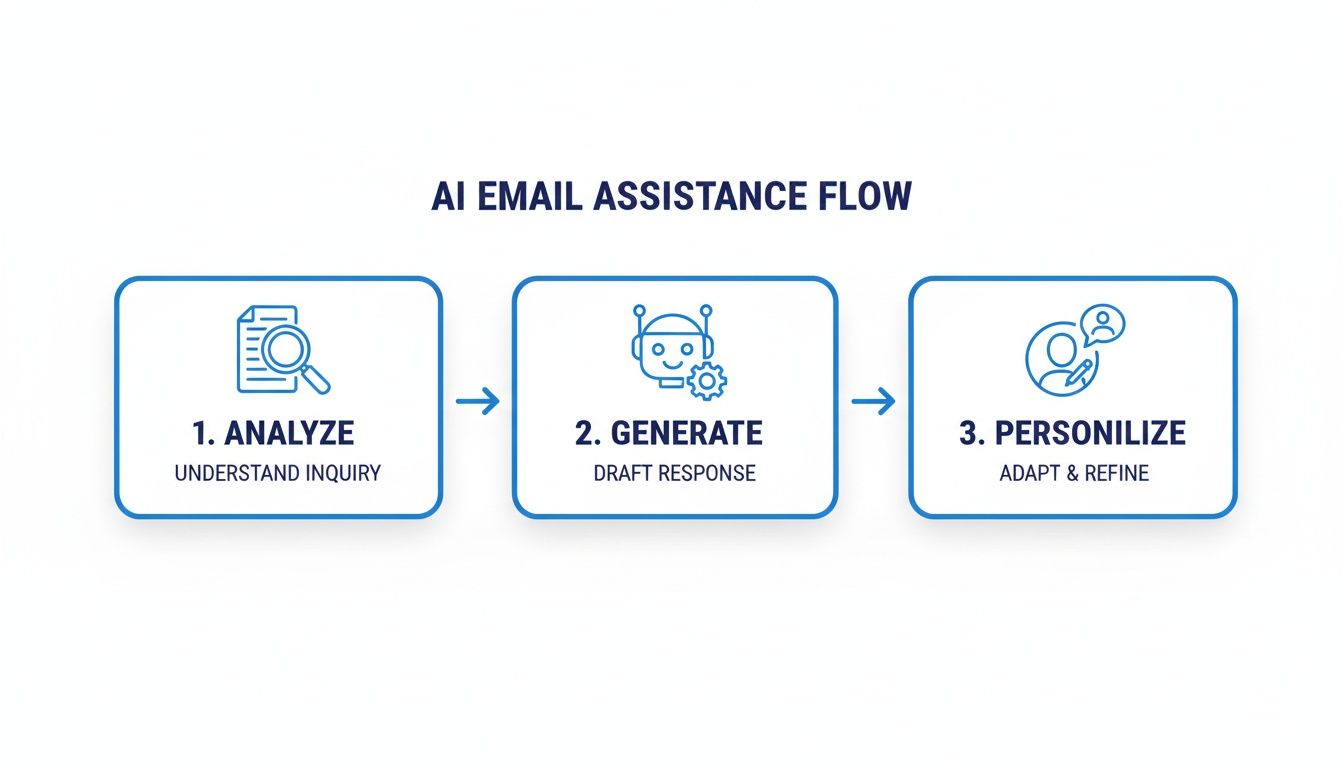
By handling the initial analysis and drafting, this process frees up your support agents to focus their expertise on personalizing the final interaction. You get the best of both worlds: speed and quality.
Your Top Email Etiquette Questions, Answered
Even with the best training, some tricky email situations always seem to pop up. Knowing how to handle these moments is what separates good support from great support. Let's tackle some of the most common questions that support managers and their teams run into.
Think of this as your practical playbook for navigating those gray areas with confidence.
When Is It Actually Okay to Use Emojis?
Emojis can be a great way to add a human touch, but it’s a delicate dance. The golden rule? Let the customer lead. If a customer sends you a friendly emoji, it's usually safe to respond with a simple, positive one, like a smiley face. This mirrors their tone and builds rapport.
However, there are a few hard-and-fast rules for when to keep emojis out of it. Never use them when:
- You're delivering bad news, like a shipping delay or a product being out of stock.
- You're handling a formal complaint or talking to a very frustrated customer.
- It's your very first interaction with a new customer.
In these moments, clear, empathetic language will always serve you better than a cartoon icon.
How Do I Handle Group Emails Without Causing Chaos?
Ah, the group email thread. We’ve all been there. The most important thing here is to respect everyone's inbox. Only hit "Reply All" if your message is truly relevant to every single person on that chain. It's not just a courtesy; a recent study found that a staggering 73% of office workers get annoyed by unnecessary "Reply All" emails.
Here's a pro tip: If a question in a group email is aimed at a specific person, let them answer it. Jumping in to answer for them can accidentally step on their toes and undermine their authority. Give them the space to respond first.
This small act of patience keeps communication lines clear and shows respect for your teammates.
What’s the Best Way to Follow Up on an Email?
Following up is all about finding that sweet spot between being persistent and being a pest. A great follow-up email is always polite, gives a little context, and makes it clear what you need.
Here’s a simple, non-pushy way to structure it:
- Open with a gentle reminder, referencing the original email ("Just following up on my email from Tuesday...").
- Quickly restate your main point in a single sentence.
- Clearly state the action you need, like, "Could you share an update when you have a free moment?"
As a general rule of thumb, give it 2-3 business days before you send a follow-up, unless the issue is truly time-sensitive. It shows you respect their time, too.
Ready to stop worrying about email etiquette and start automating it? MAILO AI integrates seamlessly with Shopify to generate on-brand, professional responses instantly. Discover how our platform can save your team hours while boosting customer satisfaction. Start your free trial at https://mailo.ai.