

When we talk about customer service personalization, we're talking about tailoring support conversations to what you already know about a customer—their history, their preferences, and the specific context of their problem. It's the art of moving beyond rigid templates to create a support experience that feels genuinely human.
Done right, this approach elevates customer service from a simple cost center into a powerful tool for building real, lasting brand loyalty.
Why Generic Support Is Hurting Your Shopify Store
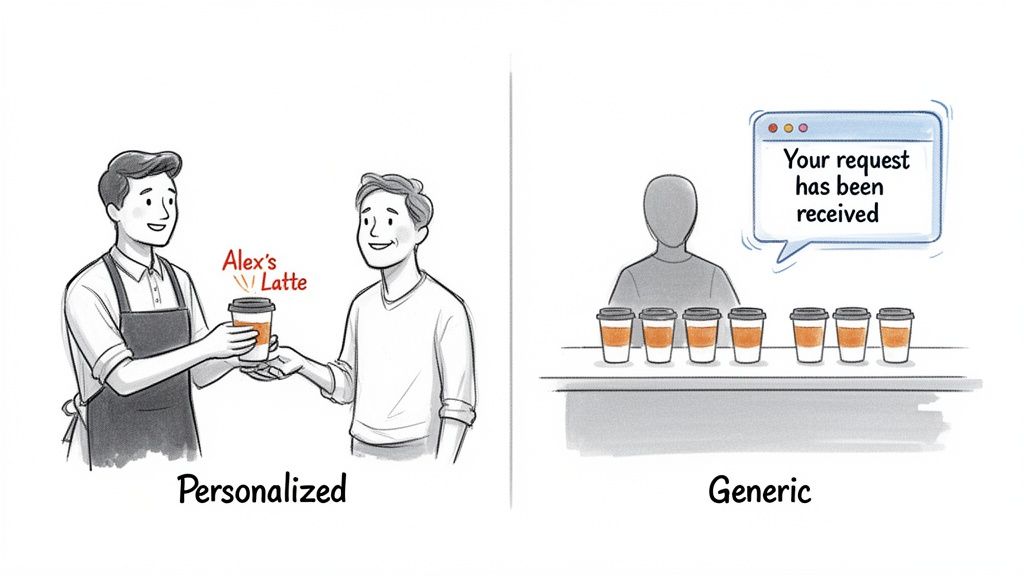
Think about the difference between your favorite local coffee shop and a massive, faceless chain. At the local spot, the barista knows your name, remembers your usual order ("The usual, Alex?"), and actually seems to care. You feel seen and valued. At the big chain, you’re just another order number in a long line, getting a standardized product with a scripted "Have a nice day."
For too many Shopify stores, customer support feels exactly like that faceless chain. You're drowning in tickets, fighting to keep customers from churning, and your brand's unique personality gets lost in a flurry of generic replies. That classic "Your request has been received..." email does absolutely nothing to build confidence or connection.
The True Cost of a One-Size-Fits-All Approach
This copy-paste strategy isn't just inefficient; it's actively damaging your brand and your bottom line. Customers today don't just want their problems solved—they want to feel heard and understood. When they have to repeat their order number for the third time or explain an issue that’s clearly documented in their account history, it creates friction and deepens their frustration.
This disconnect is more than a minor annoyance. In today's crowded e-commerce world, a staggering 76% of customers expect personalization when they interact with brands. This isn't just a preference; it directly impacts loyalty. In fact, brands that get this right are 71% more likely to see improved customer loyalty. Failing to meet this standard means you're not just losing a sale, you're losing a relationship. You can dig deeper into these customer service statistics to see what people really expect.
The biggest risk of generic support is treating valuable customers like transactions. Personalization turns those transactions into relationships, and relationships are what build a brand that lasts.
To see the difference in black and white, here's a quick breakdown of the outcomes you can expect from each approach.
Personalized vs. Generic Support At a Glance
| Metric | Generic Support | Personalized Support |
|---|---|---|
| Customer Loyalty | Low; customers feel like a number and are quick to churn. | High; customers feel valued and are more likely to make repeat purchases. |
| Average Reply Time | Can be slow due to agents manually searching for context. | Faster; agents have all relevant data upfront, reducing research time. |
| Resolution Time | Longer; back-and-forth is common to gather basic information. | Shorter; problems are understood and solved more quickly and accurately. |
| Upsell/Cross-sell | Ineffective; recommendations are generic and often ignored. | Highly effective; recommendations are based on past purchases and needs. |
| Brand Perception | Seen as transactional, inefficient, and impersonal. | Seen as helpful, attentive, and human-centric. |
| Agent Satisfaction | Lower; agents face repetitive tasks and frustrated customers. | Higher; agents feel empowered to genuinely help and build rapport. |
As you can see, the benefits go far beyond just making a customer happy in the moment. Personalized support has a direct, positive impact on key business metrics across the board.
Personalization as a Competitive Advantage
Customer service personalization is no longer a "nice-to-have" feature reserved for enterprise giants. For any growing Shopify brand, it’s an essential strategy for survival and growth.
By simply acknowledging a customer's loyalty, referencing their past purchases, and speaking to them with a consistent brand voice, you create memorable moments that build powerful, long-term trust.
This guide will give you a clear, actionable path to creating that level of memorable support at scale. We’ll show you exactly how to turn your support operations into a powerful engine for building loyalty, protecting revenue, and standing out in a very crowded market.
Building the Three Pillars of Personalization
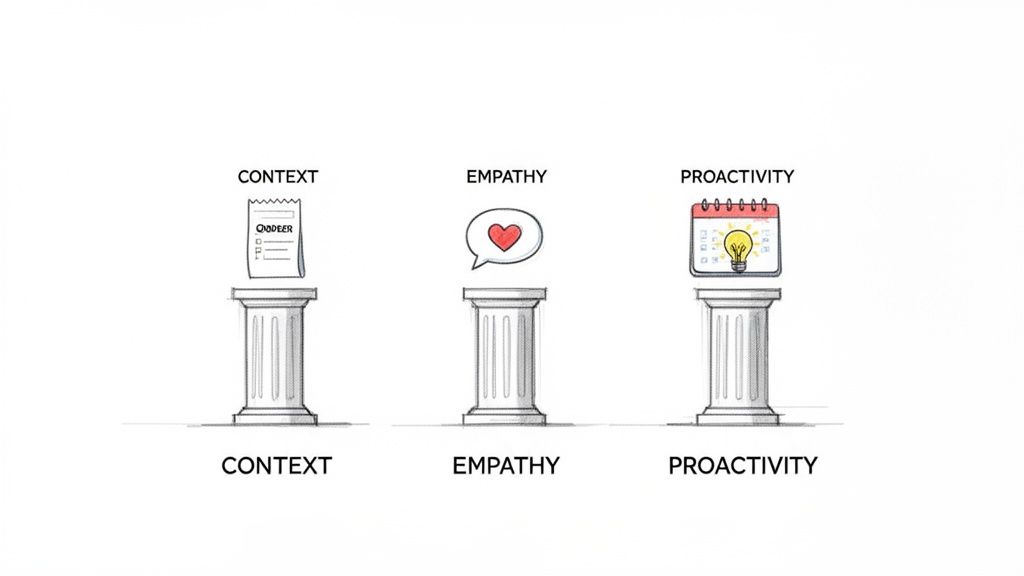
Real personalization in customer service goes way beyond just slotting a first name into an email template. It's about genuine understanding and thoughtful action. I like to think of it like a master chef creating a signature dish—it’s a careful blend of the right ingredients, perfect seasoning, and a final presentation that wows the customer.
This recipe for standout service is built on three essential pillars: Context, Empathy, and Proactivity. When you get these three right, you stop just answering tickets and start building real, lasting relationships with the people who buy your products.
The First Pillar: Context
Context is the foundation. It’s knowing your customer’s story with your brand—the who, what, and when of their entire journey. A support agent working without context is like a detective showing up to a crime scene completely cold. They’re stuck asking basic questions that, frankly, they should already know the answers to.
For any Shopify store, context means having key customer data right at your fingertips. This isn't just nice to have; it's the raw material for a meaningful conversation.
- Past Conversations: What did they ask about last time? Was the problem fixed? Bringing up a past issue shows you were paying attention.
- Order History: What have they bought? Is this their first order, or are they a loyal customer who has spent hundreds with you?
- Browsing Behavior: What pages or products were they just looking at? This gives you incredible clues about what’s on their mind right now.
Think about it: a whopping 80% of consumers say they're more likely to buy from a company that offers personalized experiences. Having this context is the first step. It makes customers feel seen and saves them the frustration of repeating themselves.
The Second Pillar: Empathy
If context gives you the ingredients, empathy is the seasoning that makes the interaction feel human. It’s the simple act of understanding how your customer is feeling and adjusting your tone to match their emotional state.
A customer who is obviously frustrated about a late shipment doesn’t want a reply packed with cheerful emojis. They need you to acknowledge their frustration, give them a straight answer, and offer a sincere apology. On the other hand, if someone emails you just to say how much they love their new product, you should absolutely share in their excitement.
Empathy isn't about being overly emotional. It's about being emotionally intelligent. It’s the skill of tweaking your brand's voice to meet the customer where they are, making them feel genuinely heard and understood.
This is where your brand’s personality really comes to life. Whether your voice is quirky, professional, or super reassuring, empathy is what makes it feel authentic in any situation. It’s the difference between a reply that just solves a problem and one that actually builds a connection.
The Third Pillar: Proactivity
The final pillar, proactivity, is where you take your service from good to great. This is the art of anticipating what your customer needs and solving problems before they even have to ask. You’re no longer just reacting to emails in your inbox; you’re actively creating positive moments for your customers.
For a Shopify merchant, this can look like a few different things:
- Shipping Delay Alerts: Instead of waiting for the inevitable "Where is my order?!" email, you can send a quick heads-up the moment a delay occurs, explaining what’s going on and resetting expectations.
- Post-Purchase Check-ins: A simple, automated email sent a week after delivery asking how they're enjoying the product can uncover small issues before they blow up into major complaints.
- Smart Recommendations: If a customer asks a question about a specific product, you could proactively suggest a complementary item based on their order history, adding value that goes beyond their initial question.
When you build your customer service personalization strategy around these three pillars—Context, Empathy, and Proactivity—you create a complete framework. It guarantees that every interaction is informed, emotionally aware, and genuinely helpful, turning routine support tickets into opportunities to earn a customer for life.
How AI Unlocks Personalization at Scale
https://www.youtube.com/embed/LW1I1c8gnc
If you're running a growing Shopify store, the idea of giving every single customer a one-on-one, personalized experience probably sounds like a fantasy. How could you possibly look up every order, remember past chats, and write a unique reply when you have thousands of customers? It just doesn’t scale.
This is exactly where AI becomes your team's secret weapon.
Let's clear up a common misconception right away: automation does not have to mean cold, robotic service. In fact, it’s the complete opposite. Modern AI isn't here to replace your team; it’s here to act as a tireless, incredibly smart assistant that handles the grunt work. It takes care of the tedious tasks that slow humans down, making true customer service personalization a reality for brands of any size.
From Manual Drudgery to Intelligent Assistance
Think of AI as the world's fastest research assistant. In the split second it takes an agent to open a new email, the AI has already dug through your Shopify data, helpdesk history, and any other tools you use. It instantly gets the full picture of that customer's journey and puts the most important details front and center.
This completely changes the game. Instead of your agents spending precious minutes digging for order numbers or tracking info, they have everything they need to start a real conversation right away. It's a massive shift, and it’s why 57% of businesses say personalizing customer engagement is the main reason they're bringing in AI. The proof is in the results, with companies using AI seeing an average customer satisfaction boost of 12%.
Here’s a look at how a platform like Mailo AI puts all that key customer data—like order history and lifetime value—right inside the support inbox, ready to go.
Having this context at their fingertips frees your agents to focus on the human side of the conversation instead of being data entry clerks.
The Real-World Benefits of AI in Support
Bringing in AI isn't just about moving faster; it's about adding a layer of intelligence that used to be out of reach for most brands. AI-powered platforms can handle a whole range of smart tasks automatically, creating a consistently amazing experience for every customer.
Here are a few game-changing things it can do:
- Instant Ticket Sorting: AI reads incoming emails, figures out what the customer needs (a return, a shipping update, etc.), and tags the ticket automatically. This keeps your inbox organized and makes sure urgent issues are handled first.
- A Consistent Brand Voice: You can train an AI on your past support replies to learn your brand’s unique voice. From that point on, every AI-assisted response will nail your tone, whether you're fun and witty or formal and empathetic.
- Proactive Problem Solving: The AI can keep an eye on order data for signs of trouble. For instance, if it spots a shipping delay from a carrier, it can automatically send a personalized, heads-up email to the customer, turning a potential complaint into a moment of great service.
The magic of AI is that it handles all the repetitive, data-heavy work with perfect accuracy and speed. This frees up your human agents to pour their energy into the complex, emotional situations where a personal connection makes all the difference.
This smart division of labor is the key to scaling great service. To see more on how this works in practice, you can explore the different ways AI customer support software fits into day-to-day operations.
Making Personalization Your New Standard
At the end of the day, AI makes personalization the default, not the exception. It ensures every customer gets the same thoughtful, proactive, and context-aware support, no matter which agent helps them or how swamped your team is.
By automating the foundational work, you empower your team to build stronger customer relationships and solve tougher problems. For a deeper look at elevating your service, check out how great digital customer experiences are built with personalization and AI. The dream of personal service at scale is no longer just a nice idea—it’s a practical reality for any brand with the right tools.
Actionable Tactics for Personalized Email Support
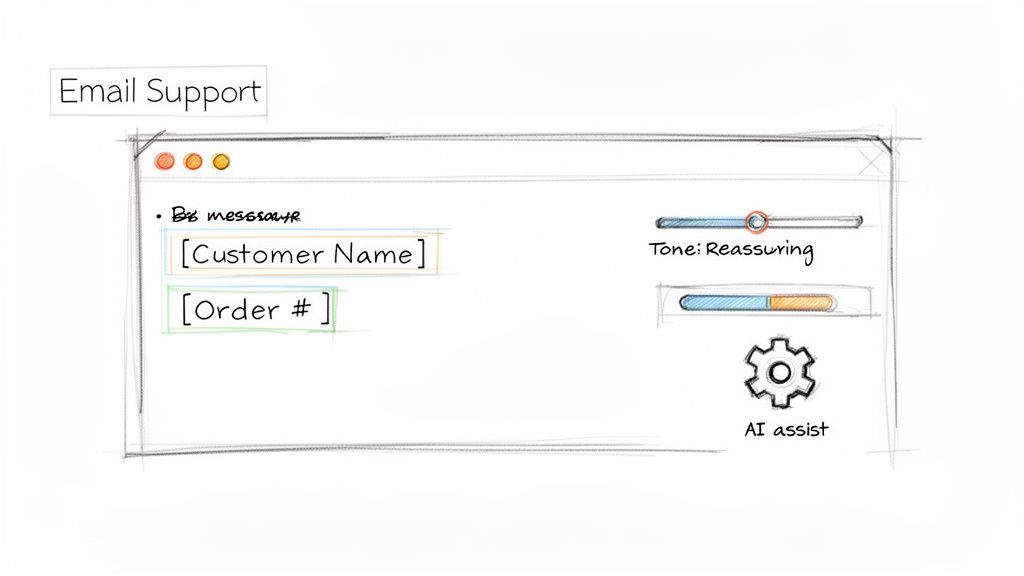
Understanding the theory is great, but putting personalization into practice is where you’ll see the real results. This is where the rubber meets the road inside your Shopify inbox. So, let's get practical and move from the "what" to the "how" with specific strategies to make every customer feel seen and valued.
Think of this as your playbook for leveling up email support. We'll walk through four core tactics, looking at how to do them manually and then how a tool like MAILO AI can put them on autopilot, transforming a time-consuming chore into a seamless workflow.
H3: Weave Shopify Data into Every Reply
The quickest way to show a customer you aren’t sending a canned response is to reference their actual history with your brand. Mentioning their specific order number, the products they bought, or even their loyalty status instantly turns a generic email into a genuine conversation.
The Manual Way:
Before hitting "reply," your agent has to switch tabs, open Shopify, search for the customer, and then manually copy-paste details like order numbers (#12345) or item names ("the blue Voyager backpack") into the email. It works, but it’s slow and adds precious minutes to every single ticket.
The AI-Powered Way: An AI tool connected to your Shopify store does all the heavy lifting for you. It instantly pulls the relevant customer and order data and uses it to draft a reply that’s already rich with context. What used to be a manual research task now happens in a blink.
H3: Use Dynamic Content for Speed and Accuracy
Dynamic content is all about using smart placeholders that automatically pull in specific customer information. This is a foundational step in scaling customer service personalization without letting mistakes slip through the cracks.
Using dynamic content is like having an assistant who fills in all the boring details for you. It ensures you never mistype an order number or misspell a customer's name, freeing you to focus on the message itself.
For a deeper dive into making your communications more efficient, you might find these automated email response templates helpful as a starting point.
Here are a few common dynamic fields you might use:
-
Customer Name:
{{customer.first_name}} -
Order Number:
{{order.number}} -
Product Purchased:
{{order.product_name}} -
Shipping Address:
{{order.shipping_address}}
The Manual Way: Most helpdesks support basic placeholders. The problem is, your agents still have to hunt for the right template and double-check that all the necessary info is there. It saves some typing, but it still requires manual oversight.
The AI-Powered Way: This is where AI really shines. It doesn't just fill in the blanks; it builds the entire conversational context around them. Instead of just dropping in an order number, it can craft a complete sentence like, "I've looked into your order, #54321, and I can see that your package is currently out for delivery."
H3: Master Brand Voice Adaptation
Your brand's voice shouldn't be a one-size-fits-all script. True personalization means adapting your tone to match the customer's mood while staying true to your brand’s core personality. A frustrated customer needs calm reassurance, while a happy one will appreciate a more enthusiastic, celebratory tone.
The Manual Way: This approach relies entirely on the emotional intelligence and training of each support agent. Keeping that tone consistent across a growing team is a huge challenge, and one off-key reply can sour a customer relationship for good.
The AI-Powered Way: Modern AI can detect the sentiment of an incoming email and adjust the tone of the reply to match. You can set guidelines for your brand voice—like "helpful and friendly, but always professional"—and the AI will generate responses that nail the emotional cues while always sounding like you.
H3: Send Proactive and Timely Outreach
The highest form of personalization is anticipating what your customer needs before they even ask. This means reaching out at key moments in their journey to solve a problem before it happens or just to show you care.
The Manual Way: An agent could try to manually track delivery dates to send follow-up emails for reviews. Or they could keep a list of top spenders to thank them personally. It’s incredibly effective, but it’s nearly impossible to manage once you have more than a handful of orders a day.
The AI-Powered Way: AI can completely automate these workflows based on real-time triggers from Shopify.
- Review Requests: Automatically send a personalized email asking for a review 7 days after an order is delivered.
- High-Value Customer Check-in: For customers who have spent over $500, an automated email can go out to thank them for their loyalty and offer a special discount.
- Shipping Delay Alerts: If a package gets stuck in transit, the AI can proactively notify the customer with an updated ETA, turning a potential "Where is my order?" ticket into a positive interaction.
To help you visualize how these tactics come together, here’s a quick breakdown:
| Key Personalization Tactics and Their Impact | | :--- | :--- | :--- | | Tactic | Data Source Required | Primary Benefit | | Referencing Order History | Shopify Order Data | Builds immediate trust and shows you're paying attention. | | Dynamic Content Fields | Shopify Customer & Order APIs | Increases speed and eliminates manual data entry errors. | | Adaptive Tone of Voice | Customer Email Sentiment Analysis | Matches the customer's emotional state, leading to better resolutions. | | Proactive Outreach | Shopify Order Status & Customer Lifetime Value | Prevents support tickets and creates moments of delight. |
By weaving these tactics into your support strategy, you’re not just answering emails anymore. You’re building a powerful engine for customer loyalty and turning your support team into a true retention machine.
Measuring the True ROI of Personalization
Investing in personalization feels like the right thing to do, but how do you prove it’s a smart business decision? To really justify the effort, you have to draw a straight line from better customer conversations to better business outcomes. It’s about getting past the surface-level numbers and tracking the metrics that actually move the needle on your bottom line.
This means looking beyond just how many tickets you close. The real magic of personalization shows up in customer loyalty, massive efficiency gains, and ultimately, profitable growth. When you track the right key performance indicators (KPIs), you can show leadership that this isn't just another expense—it's a high-return investment.
Core Metrics That Reveal True Value
To get a real sense of personalization's impact, you need to look at a mix of customer-facing and operational metrics. Together, these numbers tell the full story, connecting a single great interaction to the long-term health of your business.
- Customer Satisfaction (CSAT): This is your most direct feedback loop. After you start personalizing support, are your CSAT scores climbing? Higher scores mean customers feel heard and valued, which is the first step to earning their loyalty.
- First Response Time (FRT): Personalization, especially when powered by AI, gives agents all the context they need in an instant. This slashes the time they spend digging for information, leading to faster first replies and a much better customer experience right out of the gate.
- Agent Efficiency: Keep an eye on how many tickets an agent can handle per hour. When AI drafts personalized replies and takes care of the repetitive stuff, your team can solve more complex problems without getting bogged down. We're talking about saving hundreds of operational hours.
While these are all crucial, they don't paint the complete financial picture. The most powerful KPI for seeing the return on your personalization efforts is Customer Lifetime Value (CLV).
Connecting Personalization to Customer Lifetime Value
Customer Lifetime Value is the ultimate report card for your customer relationships. It’s the total amount of money a customer is likely to spend with your brand over their entire time with you. A higher CLV means your customers are sticking around longer and buying more often.
A personalized support experience is one of the single most effective ways to drive up CLV. When customers feel like you get them, they're far more likely to make repeat purchases and tell their friends about you.
Think about the direct link here: a customer has a fantastic, personalized chat with your support team and leaves a high CSAT score. Because of that positive feeling, they decide to buy from you again instead of checking out a competitor. That single repeat purchase directly increases their CLV.
This isn't just a nice theory; it’s a proven model for growth. Brands that master personalization build a loyal base of customers who provide predictable, recurring revenue. And that’s a whole lot cheaper than constantly chasing new customers. For more on this, you can learn a lot by exploring different ways to measure customer service success.
Proving the Financial Impact
To build a rock-solid case for personalization, you need to translate these metrics into dollars and cents. Start by calculating the average CLV of customers who've had a positive, personalized support interaction and compare it to those who received generic service. The gap between those two numbers? That's the direct ROI of your efforts.
Don't forget to quantify the time saved, either. If AI-driven personalization saves each of your agents five hours a week, that's 260 hours per agent per year. Multiply that by their hourly rate, and you’ve got a clear, hard number for operational savings.
By tracking CSAT, agent efficiency, and, most importantly, CLV, you can build a data-backed argument that’s impossible to ignore. You’ll prove that investing in customer service personalization isn’t just about making customers happy—it’s about building a more resilient and profitable business.
Your Step-By-Step Implementation Roadmap
Jumping into customer service personalization can feel like a massive undertaking, but it doesn't have to be. The secret is to treat it as a process of building momentum, not flipping a switch overnight. Think of it as a gradual rollout that delivers real value in days, not months.
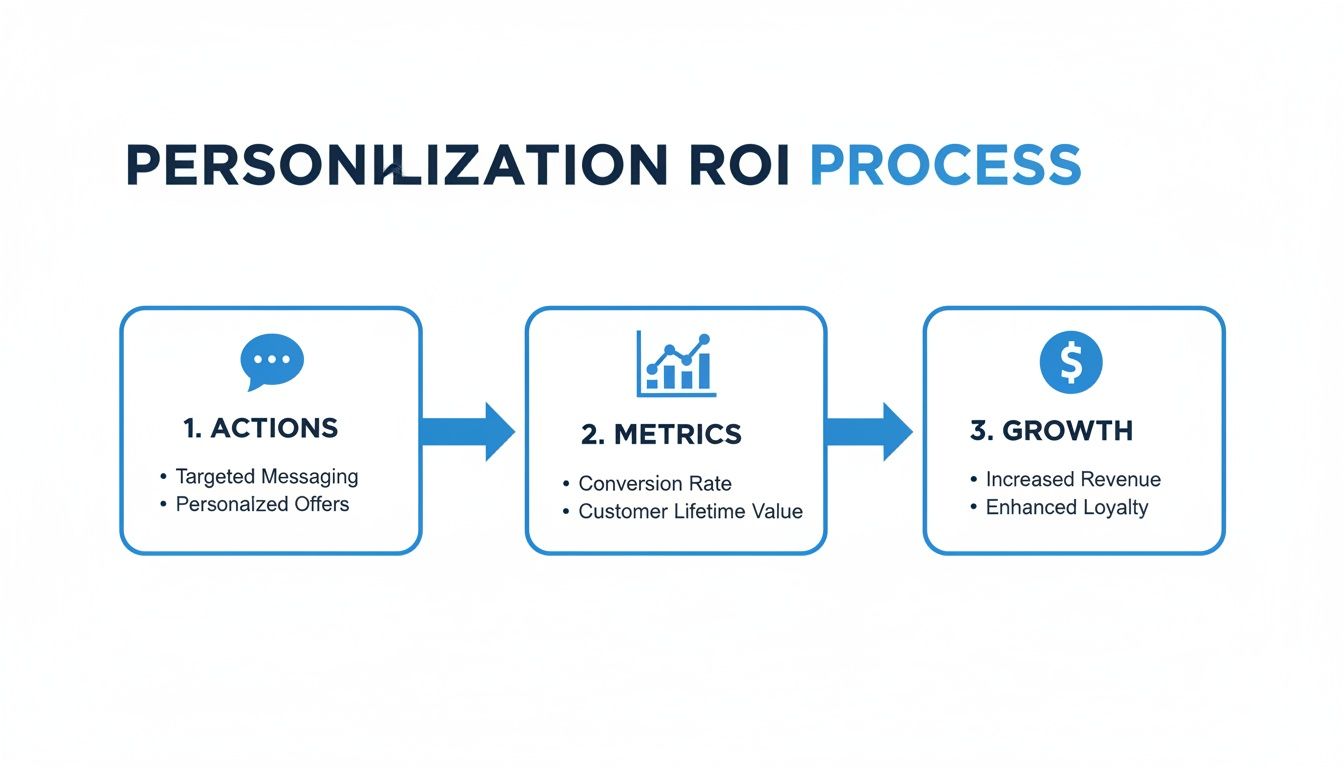
This flow shows how small, consistent actions create a domino effect, leading to measurable growth and a serious return on investment.
As you can see, every personalized touchpoint directly influences key metrics, which in turn fuels sustainable growth for your brand.
Phase 1: Lay The Foundation
Before you can start personalizing, you need a solid base. This first phase is all about getting your data and brand identity in order. It’s the essential prep work that makes everything else click into place.
- Integrate Your Shopify Store: The first, non-negotiable step. Connect your e-commerce platform to your support tool. This syncs all that rich customer data—order history, contact info, past purchases—giving you the raw material you need.
- Define Your Brand Voice: If you haven't already, get this documented. Are you witty and informal, or more reassuring and professional? An AI tool like MAILO AI can actually learn this voice by analyzing your past emails, ensuring every automated response still sounds like you.
Phase 2: Secure Quick Wins
With the foundation in place, it's time to tackle the low-hanging fruit for an immediate impact. The goal here is to automate your most frequent, mind-numbing inquiries. This instantly frees up your team’s time and gets customers their answers faster.
Start by identifying your top three most common support questions. For almost every Shopify store, these are:
- "Where is my order?" (WISMO)
- Return and exchange requests
- Product information questions
By setting up personalized, automated responses for these tickets, you can instantly resolve a huge chunk of your support volume without lifting a finger.
A Quick Word on Privacy and Trust: As you implement these steps, always put customer privacy first. Be transparent about the data you collect and make it clear you're only using it to improve their experience. Building a trustworthy system is just as important as building an effective one.
Phase 3: Optimize And Expand
Now that your initial automations are humming along, you can use the data to find new opportunities. Dive into your support tickets and look for the next wave of common questions you can address. This becomes a continuous improvement loop, expanding your personalization efforts over time.
This phase is where you start meeting modern expectations head-on. A whopping 69% of consumers now expect personalized and consistent experiences across every channel. Meeting that demand is directly tied to engagement and sales. You can dig into more of the numbers with these personalization statistics you need to know on fastsimon.com.
Phase 4: Go Proactive
The final stage is where you evolve from reactive to proactive support. Instead of just waiting for customers to reach out with a problem, you start anticipating their needs and contacting them first. This is the gold standard of customer service personalization and a ridiculously powerful way to build loyalty.
- Automated Check-Ins: Send a personalized email a week after delivery to see how they're enjoying their purchase.
- Proactive Review Requests: Automatically ask satisfied customers for reviews, turning happy shoppers into powerful social proof.
By following this roadmap, you’ll methodically build a powerful, scalable personalization engine that doesn't just meet customer expectations—it actively drives your business forward.
Got Questions About AI and Personalization? We Have Answers.
Jumping into AI for your customer support can feel like a big step, and it's natural to have questions. Shopify owners often ask me if automation will kill the human vibe of their brand, or if the tech is just too complicated for a small team. Let's clear the air and tackle these concerns head-on.
The whole point here is to help you move forward with confidence, seeing AI for what it is: a powerful tool to amplify the very human touch that makes your brand special, not replace it.
Will AI Make My Customer Support Sound Robotic?
This is the number one fear I hear, but it’s based on an outdated idea of what AI can do. Modern AI doesn't just spit out generic, pre-canned responses. Instead, it’s designed to learn your unique brand voice by analyzing your team’s past support conversations. The result? Every reply sounds like it came straight from you.
Think of it less as an automaton and more as a helpful guide. It gives your team the perfect context and the right tone for every single customer interaction, ensuring your support stays human and consistent, even as you scale.
Is This Actually Affordable for a Small Store?
Absolutely. Customer service personalization powered by AI is no longer just for the big players. Many platforms are built from the ground up for growing brands, with free or low-cost plans that scale right alongside your business.
These tools plug directly into Shopify, handling all the technical heavy lifting for you. This means even a one-person shop can offer top-tier, personalized support without a huge budget or an IT department on standby.
The real question isn't whether you can afford to adopt AI. It's whether you can afford the lost revenue and customer loyalty that comes from sticking with slow, impersonal support.
How Quickly Can I Actually Get This Up and Running?
You can start seeing a real return on your time almost immediately. The whole setup process is built for speed and to deliver value in minutes, not months. A great way to start is by picking your top two or three most common customer questions—you know, the classic "Where is my order?" inquiries.
From there, getting started is a breeze:
- Connect Your Shopify Store: This instantly syncs all your crucial customer and order data.
- Set Your Brand Voice: The AI gets to work learning from your past replies.
- Go Live: The system can start handling those common questions right away with personalized, context-rich answers.
This frees you and your team up almost instantly, letting you focus on the more complex conversations that build real, lasting relationships with your customers.
Ready to see how fast and easy it is to scale personalized support? With MAILO AI, you can automate replies, delight customers, and get back to growing your brand. Start your free trial today.