

An apology email to a customer isn't just a courtesy—it's one of the most powerful tools you have for keeping customers around. When things inevitably go sideways, a genuine and well-handled apology can take a bad situation and turn it into a moment that actually builds loyalty.
Why a Great Apology Email Is a Retention Superpower
Let's face it: mistakes happen. No matter how buttoned-up your e-commerce operation is, a shipment will get delayed, the wrong item will end up in a box, or a site glitch will frustrate a shopper. The mistake itself is a problem, but what truly defines your brand in that customer's eyes is how you clean it up.
Ignoring the problem or firing off a cold, robotic reply? That just pours salt in the wound. But a quick, empathetic email that actually solves the problem can completely flip the script. This is the service recovery paradox in action—it's a weird but true phenomenon where a customer can end up more loyal to you after you've fixed a problem than they would have been if nothing ever went wrong.
The Financial Case for Saying Sorry
The numbers don't lie. In the cutthroat world of e-commerce, it's far cheaper to keep the customers you have than to constantly hunt for new ones. In fact, it costs 6-7 times more to acquire a new customer than to retain an existing one. Think of every apology email as a direct investment in your bottom line.
A good apology doesn't just save that one sale; it protects all the sales that customer might make in the future. And when you handle it well, service recovery works. A staggering 77% of customers are ready to forgive a brand's mistake if they get a sincere apology and a real solution, like a discount or free shipping. You can learn more about the impact of service recovery and see why a solid apology is a financial game-changer.
When you turn a moment of frustration into one of reassurance, you’re doing more than just fixing an error. You’re building a more resilient, loyal customer base that will come back again and recommend you to others.
Beyond Damage Control
A smart apology strategy is about more than just putting out one fire. It's a proactive move that helps you hit several business goals at once.
- Prevents Negative Reviews: A quick, satisfying fix is often the difference between a customer who moves on and one who heads straight to Google to leave a one-star review.
- Repairs Trust: Owning your mistake shows integrity. It tells your customer you value their business and reinforces the trust that was momentarily shaken.
- Encourages Repeat Business: When a customer feels seen and respected during a tough situation, they're much more likely to shop with you again.
At the end of the day, a thoughtful apology email to a customer is a strategic move. It shows respect and proves your brand is committed to a great experience, even when you miss the mark.
The Anatomy of an Apology Email That Actually Works
Let's be honest, a good apology email is much more than just saying "we're sorry." It's a carefully crafted message that has to do a lot of heavy lifting. It needs to make the customer feel heard, restore their trust in your brand, and clearly show them how you're going to fix the problem.
And the stakes are sky-high. Think about it: a single bad experience is enough to make one in three customers walk away for good. If it happens more than once? A whopping 73% will jump to a competitor.
But a great apology can turn things around. When you get it right, you rebuild confidence and strengthen loyalty—in fact, 96% of customers say excellent service is key to their brand allegiance. Knowing how to structure this message is critical, especially when you're learning how to handle an angry customer.
Let’s break down what really makes an apology email hit the mark.
First Up: The Subject Line
Before a customer can even read your apology, they have to open the email. Your subject line is the first hurdle, and it has to be perfect. The goal is to be clear, direct, and professional without setting off alarm bells or looking like a marketing email.
Skip the vague, anxiety-inducing lines like "Urgent Issue" or "An Important Message." They just make people nervous. Get specific instead.
- Good: "An Update on Your Recent Order [#12345]"
- Better: "Regarding Your Recent Purchase from [Your Brand Name]"
- Best: "We're Sorry - A Note About Your [Product Name] Shipment"
This approach gives them immediate context and shows you're proactively addressing a specific issue they care about.
The Opening: Acknowledgment and Empathy
The very first sentence needs to set a sincere, empathetic tone. Don't beat around the bush or hide behind corporate jargon. Jump straight in by acknowledging their frustration and validating their feelings.
A strong opening instantly shows you see things from their perspective. Instead of a cold, "We are writing to inform you of an issue," try something warmer that connects on a human level.
Key Takeaway: Start with a human touch. A simple, "We're so sorry for the frustration our shipping delay has caused" is far more effective than a sterile, impersonal opening. It shows you're thinking about the person, not just the problem.
Taking Full Ownership—No Excuses
This is where so many companies get it wrong. The absolute worst thing you can do is make excuses or shift blame, even if a third-party vendor dropped the ball. From the customer's point of view, they did business with you, and the buck stops there.
Take complete, unconditional ownership of the mistake.
Accepting full responsibility is a powerful move. It shows integrity, de-escalates the situation, and stops the customer from feeling like they have to fight to be heard.
The Remedy: Your Plan to Make It Right
An apology without a clear solution feels hollow. This is the part of the email where you have to spell out exactly what you're doing to fix the situation. The remedy should also match the severity of the mistake—a minor hiccup might just need a sincere apology, but a major screw-up requires something more substantial.
Get specific about the fix:
- Don't say: "We will fix this for you."
- Do say: "We have already shipped a replacement via overnight delivery at no cost to you. You can track it here: [Tracking Link]."
Whether it's a full refund, a replacement, or a discount on their next order, make the path forward crystal clear. It shows you’re committed to action, not just words.
To pull it all together, here's a quick look at how each piece of the email works to rebuild that crucial customer trust.
Apology Email Structure Breakdown
| Component | Objective | Example Snippet |
|---|---|---|
| Subject Line | Get the email opened by being clear, direct, and professional. | "An Update on Your Order [#12345]" |
| Opening | Immediately show empathy and acknowledge the customer's frustration. | "We're so sorry for the delay with your recent shipment." |
| Ownership | Take full, unconditional responsibility without making excuses. | "We made a mistake, and this is not the experience we want for our customers." |
| The Remedy | Clearly state the specific action you're taking to make it right. | "We've issued a full refund, which you'll see in 3-5 business days." |
| Timelines | Manage expectations by providing a clear timeframe for the resolution. | "Your replacement item will arrive by this Friday, June 21st." |
| Call-to-Action | Give the customer a simple way to get more help if they need it. | "If you have any other questions, just reply to this email." |
By following this structure, you create a message that not only apologizes but actively works to repair the customer relationship.
Real-World Apology Email Templates You Can Adapt
Knowing the right way to structure an apology email is great, but when you're in the middle of a service meltdown, finding the right words is what really matters. To help you get a head start, I've put together a few go-to templates for the most common e-commerce hiccups.
Think of these as a foundation. You'll want to tweak the tone to match your brand's voice and, of course, plug in the specifics of what actually happened. The goal here isn't a copy-paste solution, but a solid framework that saves you time while still sounding human.
The whole process boils down to a few key moments: getting them to open the email, making a genuine connection with your apology, and then rebuilding their trust with a real solution.
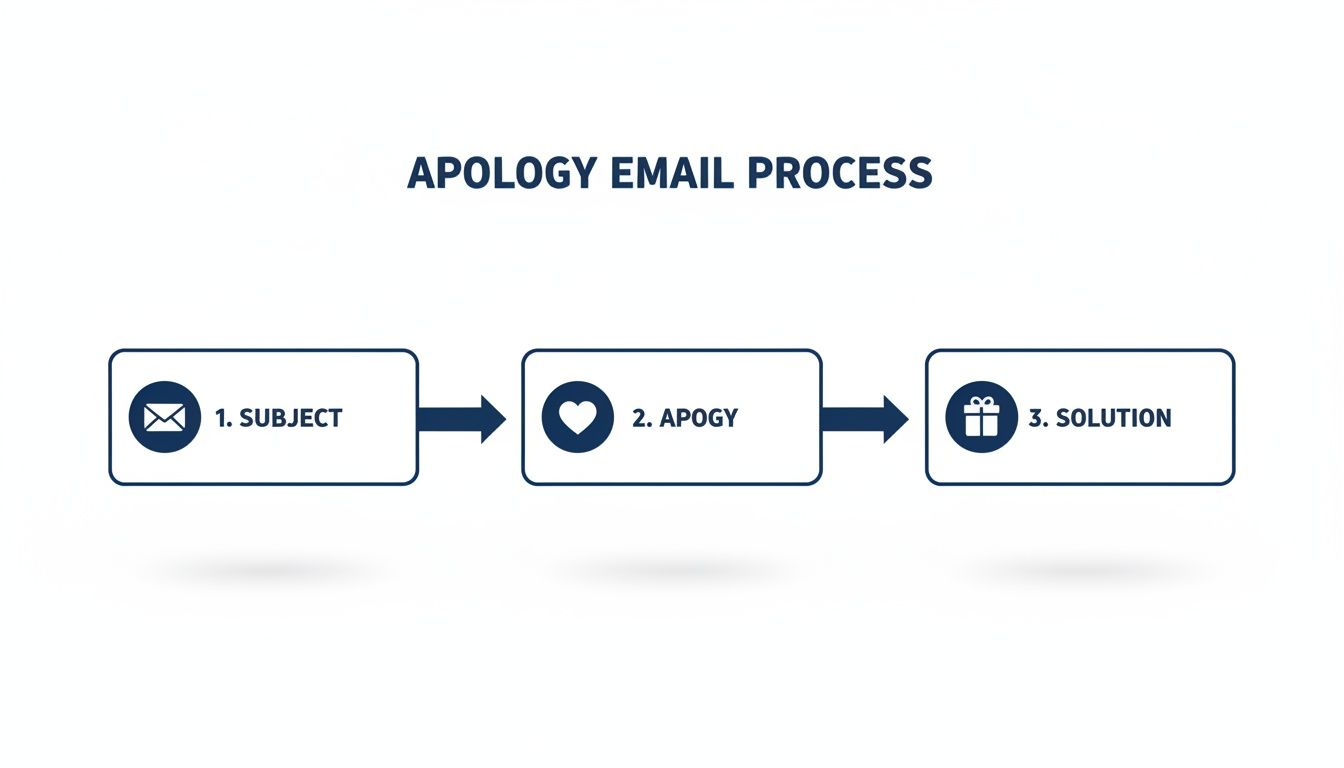
It’s a simple flow, but every step counts. A vague subject line means your apology never gets read. An apology without a fix just feels hollow.
For a Significant Shipping Delay
Shipping delays are one of the most frequent (and frustrating) issues customers face. Getting out ahead of the problem with a proactive email can completely change the customer's experience.
Subject: An important update regarding your order [#12345]
Hi [Customer Name],
We're writing to let you know about an unexpected delay with your recent order. We are so sorry for the wait and any frustration this has caused.
A mistake in our warehouse has pushed back our shipping timeline. Your order is now expected to ship by [New Date].
This isn't the level of service we aim to provide. To help make things right, we've upgraded your shipping to complimentary overnight delivery.
Thank you for your patience.
Sincerely,
The [Your Brand Name] Team
Key Phrase: "We made a mistake in our warehouse..." This is huge. It takes direct ownership instead of blaming the courier, which goes a long way in rebuilding trust.
For Receiving the Wrong Item
Getting the wrong item is a massive inconvenience. Your job is to make the fix feel absolutely effortless for the customer.
Subject: Oops! We're fixing your order [#67890]
Hi [Customer Name],
We are so sorry—it looks like we sent you the wrong item. We know how disappointing that is, and we're already working to correct our mistake.
The correct [Product Name] is on its way to you now and should arrive within [Number] business days.
And don't worry about sending the wrong item back. Please consider it a gift from us for the trouble.
We sincerely apologize for the mix-up.
Best,
[Your Name]
When a Product Arrives Damaged
Nothing sours a purchase faster than opening the box to find a broken item. Empathy and a fast, no-hoops-to-jump-through solution are your only moves here.
Subject: Regarding your recent delivery - Order [#11223]
Hi [Customer Name],
I was so sorry to see the photos of your damaged [Product Name]. It’s completely unacceptable for an item to arrive in that condition, and I understand how disappointing that must be.
We have already processed a replacement for you. It's been carefully inspected by our team and was shipped out today.
You'll receive a separate email with new tracking information shortly. Please don't worry about sending the damaged item back; feel free to dispose of it.
We really appreciate you giving us the chance to make this right.
Warmly,
[Your Name]
For an Unexpected Out-of-Stock Item
This one stings. A customer orders something, gets excited, and then finds out it’s not available. You need to be transparent and offer a good alternative or incentive.
Subject: An issue with your recent order [#44556]
Hi [Customer Name],
We're writing with a sincere apology. Due to an inventory error on our end, the [Product Name] you ordered is out of stock.
We know this is frustrating. We have already issued a full refund for the item, which you should see in your account in 3-5 business days. As a small gesture for our mistake, we'd also like to offer you a 20% discount on your next order.
We expect the item to be back in stock around [Date]. If you'd like, we can notify you the moment it’s available.
Thank you for your understanding.
Sincerely,
The [Your Brand Name] Team
For a Website Glitch or Technical Error
Site bugs don't just stop sales; they make you look unreliable. Your apology needs to be clear, confident, and focused on reassuring the customer that all is well.
Subject: We're sorry for the recent site issues
Hi [Customer Name],
You may have had some trouble using our website earlier today. We hit a technical snag, but our engineering team has now fully resolved the issue.
We sincerely apologize for any frustration this caused. Everything is back to running smoothly.
If you had any trouble finishing a purchase, please let us know. We're here to help.
Thanks for bearing with us,
[Your Brand Name]
After a Billing Error
Mistakes involving money need to be handled immediately and with the utmost seriousness. This is not the time for casual language. Clarity is everything.
Subject: Correction and Apology Regarding Invoice [#78901]
Dear [Customer Name],
I am writing to personally apologize for a billing error on your recent order. We incorrectly charged you [Incorrect Amount] instead of the correct [Correct Amount].
This was our mistake, and we have already fixed it. We've issued a refund for the overcharge of [Difference Amount], which will appear on your statement within 3-5 business days.
We are re-evaluating our billing process to ensure this doesn't happen again. We deeply regret the error and any concern it may have caused.
Sincerely,
[Your Name], Head of Customer Support
After a Poor Customer Service Interaction
When a customer takes the time to complain about a bad support experience, it's a gift. A manager needs to step in to show the feedback is taken seriously.
Subject: Following up on your recent support experience
Hi [Customer Name],
My name is [Your Name], and I'm the Head of Customer Support here at [Your Brand Name]. I was very concerned when I read about the experience you had with our team.
Please accept my sincere apologies. The service you described falls well short of our standards, and I'm sorry we let you down. We'll be using your feedback in additional team training.
I've personally looked into your original issue about [Original Issue], and I've [explain the resolution you provided].
We truly value your business and hope we get a chance to provide a much better experience next time.
Best,
[Your Name]
For a Mass Apology (e.g., Widespread Service Outage)
When a problem hits a large chunk of your customer base, a mass email is the only way. The trick is to be transparent without oversharing, take full responsibility, and be crystal clear about what happens next.
Subject: An important update from [Your Brand Name]
Dear Valued Customer,
We're writing to apologize for the widespread [Issue, e.g., shipping delays, website outage] you may have experienced over the past 48 hours.
A [brief, simple explanation of the root cause] caused a significant disruption, and for that, we are truly sorry. Our team has been working around the clock, and we have now resolved the underlying issue.
We understand the trust you place in us when you shop here, and we are putting new systems in place to prevent this from happening again.
Thank you for your patience and understanding as we worked through this.
Sincerely,
The [Your Brand Name] Leadership Team
Nailing the right response is a skill that takes practice, but having these templates in your back pocket is a huge help. For a deeper look at communication strategies, check out our guide on professional email etiquette samples.
Using AI to Personalize Apologies at Scale
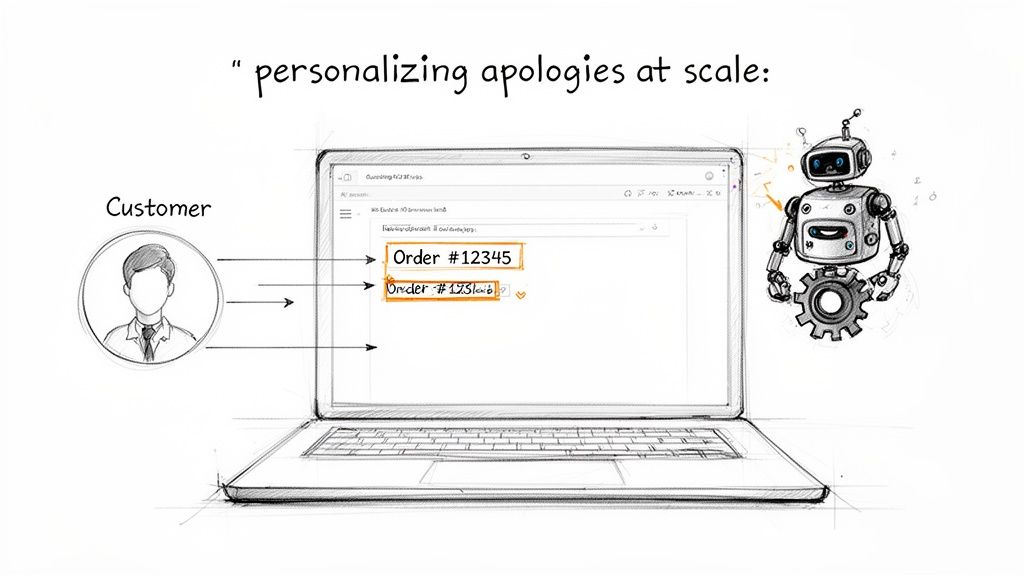
As your Shopify store grows, the flood of customer emails can become a serious problem. You know you need to send a thoughtful, personalized apology email to customer for every mix-up, but crafting each one by hand just isn't realistic. This is exactly where AI stops being a buzzword and becomes an essential part of your service recovery toolkit.
The real trick isn't just sending emails faster; it's keeping them personal. A generic, copy-paste "we're sorry for the inconvenience" can make an already frustrated customer feel completely ignored. Modern AI is built to bridge this gap, merging the efficiency of automation with the specific details that make an apology feel authentic.
Let Data Do the Heavy Lifting for You
The magic of using AI for customer support is its ability to tap directly into your store's data. Tools like Mailo AI plug right into Shopify, pulling customer and order details into an email draft in real-time.
Think about it: an AI can suggest a reply that already mentions "your delayed Black Friday order #12345 containing the Blue Performance Hoodie." This happens instantly, saving your support agent from toggling between screens to hunt down order details. That kind of effortless, specific personalization is a game-changer for rebuilding trust and resolving issues fast.
A recent study showed that 71% of consumers expect personalized interactions from brands. When a customer needs an apology, that expectation skyrockets. AI makes it possible to deliver on that, every single time.
This data-first approach allows AI to draft replies that are not only accurate but also context-aware. It knows the customer's purchase history, the specific item they're asking about, and its current shipping status. The result is an apology that sounds like it was written by someone who has the full picture. If you're curious about the broader applications, our guide on https://mailo.ai/blogs/customer-support-automation/ai-customer-support-software digs deeper into these capabilities.
Combine AI Speed with a Human Touch
Bringing AI into your workflow doesn't mean replacing your team with robots. The smartest approach is a semi-automated system that blends the speed of AI with the final judgment and empathy of a human agent.
Here’s a quick look at how this hybrid model works in practice:
- Smart Sorting: An intelligent inbox automatically flags incoming emails that likely need an apology, looking for keywords like "late," "damaged," or "wrong size."
- Instant Drafts: The system generates a personalized apology draft using the customer’s data and your pre-set brand voice.
- Human Review: Your support agent sees the AI's suggested reply. They can send it with one click, tweak the tone slightly, or take over completely for extra-sensitive cases.
This "human-in-the-loop" process provides crucial quality control while getting rid of the tedious work of digging for information and typing the same things over and over. For businesses wanting even deeper customization, exploring how Custom ChatGPT solutions can be integrated can unlock some seriously powerful options for scaling empathetic responses.
By automating the routine tasks, you empower your team to dedicate their time and energy to the most complex customer problems—the situations where their human touch truly makes a difference. This balance is the secret to scaling your support without sacrificing the personal connection that builds a loyal customer base.
How to Know If Your Apology Strategy Is Actually Working
Sending a well-crafted apology email to a customer feels right, but let's be honest—in e-commerce, good intentions have to pay the bills. If you aren't tracking the right data, you're essentially just hoping your service recovery efforts are protecting your brand and your bottom line.
The real trick is to look past the single interaction and measure the long-term ripple effects on customer behavior. Did that apology actually save the relationship? Let's dig into how you can find out.
Right after you send an apology and resolve an issue, your Customer Satisfaction (CSAT) score is your first-glance indicator. A quick follow-up survey about 24 hours later gives you a direct pulse on how that customer is feeling. If you see CSAT scores for these specific customers trending up, you know your apologies are hitting the mark.
Key Metrics to Monitor
But immediate satisfaction is just one piece of the puzzle. A truly successful apology should have a positive impact on the overall health of your business. You're trying to retain customers who were on the brink of leaving for good.
Here are the essential KPIs I always keep an eye on:
- Customer Churn Rate: You need to segment your data. Isolate the group of customers who received an apology and watch their churn rate. If it's noticeably lower than the churn rate for customers with unresolved issues, your strategy is working.
- Customer Lifetime Value (LTV): This is where it gets interesting. Are the customers who received a great apology actually spending more with you down the road? When LTV rises for this group, you haven't just patched a hole—you've built a stronger, more loyal relationship.
- Response and Resolution Times: Speed is everything. Customers see a fast response as a sign that you genuinely care. It's no surprise that a 70% rate of complaining customers will stick around if their problem is fixed efficiently. Fast, effective resolution is non-negotiable.
Remember, the ultimate goal isn't just to get better at apologizing—it's to reduce the need for apologies in the first place. Use your analytics to connect the dots. If you’re constantly saying sorry for late shipments from a particular warehouse, you haven’t found a customer service problem; you’ve found an operations bottleneck.
Turning Data Into Action
Once you start tracking these numbers, you get a much clearer picture of what actually works. You might discover that apology emails containing a 15% discount code lead to a 20% higher repeat purchase rate compared to those that just offer a sincere sorry.
That's an incredibly powerful insight. It lets you move from guessing games to making data-driven decisions that directly impact your retention rates.
By analyzing these metrics, you can turn your apology process from a reactive, damage-control chore into a proactive, strategic tool for building customer loyalty. For a deeper dive into the numbers you should be tracking, check out our complete list of customer support KPI examples.
A Few Common Questions About Apology Emails
Even with the best game plan, some situations just make you pause. Sending an apology to a customer is a delicate dance, and it’s completely normal to have questions about getting the steps right.
Think of this section as your quick-reference guide for those tricky, "what do I do here?" moments that every e-commerce manager faces.
When Is It an Absolute Must to Send an Apology Email?
Honestly, you should send one anytime your business messes up and it sours the customer's experience. This goes way beyond the big, obvious blunders.
Of course, you need to apologize for tangible problems like shipping delays, wrong or damaged products, or billing errors. But it's just as critical for the less obvious issues—a clunky support interaction, misleading product info on your site, or website downtime that stopped a customer from buying.
The real pro move is to be proactive. Don't wait for the customer to come to you, angry and frustrated. If you spot a widespread problem, like a batch of shipments getting stuck, sending a mass (but still personalized) apology email can stop a tidal wave of support tickets before it starts. That kind of transparency shows you're in control and builds a surprising amount of trust.
Should I Slap a Discount on Every Apology?
Not at all. The fix you offer should match the size of the mistake. For a minor hiccup, like a one-day shipping delay, a genuine apology and a quick update are often more than enough to keep a customer happy.
But for more serious errors—think a shattered item or a multi-week delivery nightmare—compensation is a smart move. This could look like:
- A discount on their next purchase
- A partial or full refund on the spot
- Free express shipping for the replacement
- A small, unexpected gift card
Be careful not to overuse discounts. You don't want to devalue your products or accidentally teach customers that complaining equals a coupon. A better way is to think in tiers. A small slip-up gets a sincere apology and a fast solution. A major screw-up gets the apology, a replacement or refund, and a meaningful discount for their trouble. It's a balancing act between keeping your customer and keeping your business healthy.
The single biggest mistake is making excuses or shifting blame. Phrases like 'Our shipping partner was delayed' may be true, but to the customer, they sound like you’re avoiding responsibility. The customer has a relationship with your brand, not your courier.
How Can I Apologize Without Admitting Legal Fault?
This is a really smart question, especially if you're in a more sensitive industry. The trick is to use empathetic language that takes responsibility for the customer's experience without using words that imply legal liability.
Focus on how the problem affected the customer, not on the internal reason it happened. For instance, instead of saying, "Our warehouse was negligent and broke the product," try this: "We are so sorry that your item arrived damaged. This is not the standard of quality we pride ourselves on, and we completely understand how disappointing this must be."
See the difference? This phrasing validates the customer's frustration and takes ownership of making it right, without admitting to a specific internal failure. Always keep the conversation centered on the solution and how the customer feels. For really high-stakes situations, it's a good idea to have a few legally pre-approved templates on standby.
What's the Biggest Mistake to Avoid in an Apology Email?
Making excuses. Nothing tanks an apology faster. When you shift the blame, you're telling the customer their frustration isn't valid, and that makes your apology feel hollow. Just own it. A simple "We sincerely apologize for the delay in your shipment" is all it takes before you pivot to the solution.
The other major pitfall is using generic, robotic language. An email that sounds like it was written by a corporate drone feels dismissive. Personalize it with their name and order details. Write like a human being with empathy. A genuine apology can repair a relationship, but a fake-sounding one will just burn the bridge for good.
Ready to stop writing apology emails from scratch? Let MAILO AI handle it. Our platform integrates with Shopify to generate instant, personalized, on-brand replies that turn frustrated shoppers into loyal fans. Start your free trial today.